


Listening to Turkish classical music decreases patients' anxiety, pain, dissatisfaction and the dose of sedative and analgesic drugs during colonoscopy: a prospective randomized controlled trial
- PMID: 17167846
- PMCID: PMC4087603
- DOI: 10.3748/wjg.v12.i46.7532
Listening to Turkish classical music decreases patients' anxiety, pain, dissatisfaction and the dose of sedative and analgesic drugs during colonoscopy: a prospective randomized controlled trial
Abstract
Aim: To determine whether listening to music decreases the requirement for dosages of sedative drugs, patients' anxiety, pain and dissatisfaction feelings during colonoscopy and makes the procedure more comfortable and acceptable.
Methods: Patients undergoing elective colonoscopy between October 2005 and February 2006 were randomized into either listening to music (Group 1, n = 30) or not listening to music (Group 2, n = 30). Anxiolytic and analgesic drugs (intravenous midazolam and meperidine) were given according to the patients' demand. Administered medications were monitored. We determined their levels of anxiety using the State-Trait Anxiety Inventory Test form. Patients' satisfaction, pain, and willingness to undergo a repeated procedure were self-assessed using a visual analog scale.
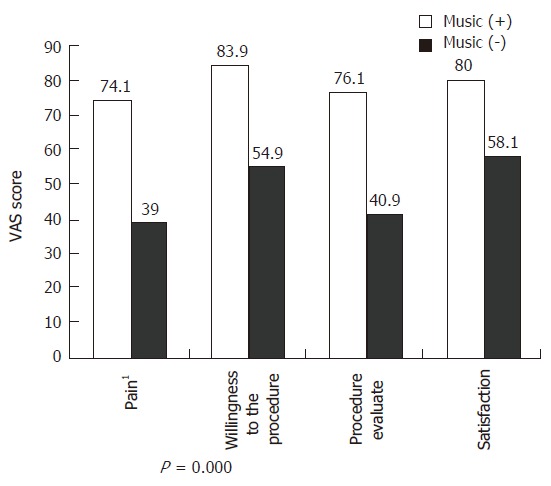
Results: The mean dose of sedative and analgesic drugs used in group 1 (midazolam: 2.1 +/- 1.4, meperidine: 18.1 +/- 11.7) was smaller than group 2 (midazolam: 2.4 +/- 1.0, meperidine: 20.6 +/- 11.5), but without a significant difference (P > 0.05). The mean anxiety level in group 1 was lower than group 2 (36.7 +/- 2.2 vs 251.0 +/- 1.9, P < 0.001). The mean satisfaction score was higher in group 1 compared to group 2 (87.8 +/- 3.1 vs 58.1 +/- 3.4, P < 0.001). The mean pain score in group 1 was lower than group 2 (74.1 +/- 4.7 vs 39.0 +/- 3.9, P < 0.001).
Conclusion: Listening to music during colonoscopy helps reduce the dose of sedative medications, as well as patients' anxiety, pain, dissatisfaction during the procedure. Therefore, we believe that listening to music can play an adjunctive role to sedation in colonoscopy. It is a simple, inexpensive way to improve patients' comfort during the procedure.
Figures


Comment in
-
Colonoscopy and the role of music therapy: how to go about an ideal protocol?World J Gastroenterol. 2007 Jun 21;13(23):3272-3. doi: 10.3748/wjg.v13.i23.3272. World J Gastroenterol. 2007. PMID: 17589914 Free PMC article. No abstract available.
-
Frequently overlooked and rarely listened to: music therapy in gastrointestinal endoscopic procedures.World J Gastroenterol. 2007 Sep 7;13(33):4533. doi: 10.3748/wjg.v13.i33.4533. World J Gastroenterol. 2007. PMID: 17724817 Free PMC article.
References
-
- Lee DW, Chan AC, Wong SK, Fung TM, Li AC, Chan SK, Mui LM, Ng EK, Chung SC. Can visual distraction decrease the dose of patient-controlled sedation required during colonoscopy A prospective randomized controlled trial. Endoscopy. 2004;36:197–201. - PubMed
-
- Nelson DB, Barkun AN, Block KP, Burdick JS, Ginsberg GG, Greenwald DA, Kelsey PB, Nakao NL, Slivka A, Smith P, et al. Propofol use during gastrointestinal endoscopy. Gastrointest Endosc. 2001;53:876–879. - PubMed
-
- Bell GD. Premedication, preparation, and surveillance. Endoscopy. 2002;34:2–12. - PubMed
-
- Rex DK, Imperiale TF, Portish V. Patients willing to try colonoscopy without sedation: associated clinical factors and results of a randomized controlled trial. Gastrointest Endosc. 1999;49:554–559. - PubMed
-
- Ristikankare M, Hartikainen J, Heikkinen M, Janatuinen E, Julkunen R. Is routinely given conscious sedation of benefit during colonoscopy. Gastrointest Endosc. 1999;49:566–572. - PubMed
Publication types
MeSH terms
Substances
LinkOut - more resources
Full Text Sources
Medical
