. 2006 Dec 26;103(52):19842-7.
doi: 10.1073/pnas.0606343104. Epub 2006 Dec 14.

p21 delays tumor onset by preservation of chromosomal stability

Affiliations

p21 delays tumor onset by preservation of chromosomal stability

Juan A Barboza et al. Proc Natl Acad Sci U S A. .

Abstract

The p53 protein suppresses tumorigenesis by initiating cellular functions such as cell cycle arrest and apoptosis in response to DNA damage. A p53 mutant, p53R172P, which is deficient for apoptosis but retains a partial cell cycle arrest function, delays tumor onset in mice. Remarkably, lymphomas arising in Trp53(515C/515C) mice (encoding p53R172P) retain stable genomes. Given the dominant role of p21 in p53 cell cycle control, we crossed Trp53(515C/515C) mice onto a p21-null background to determine whether p21 was required for maintaining chromosomal stability and delaying tumor onset. Loss of p21 completely abolished the cell cycle arrest function of p53R172P and accelerated tumor onset in Trp53(515C/515C) mice. Cytogenetic examination of Trp53(515C/515C) p21(-/-) sarcomas and lymphomas revealed aneuploidy and chromosomal aberrations that were absent in Trp53(515C/515C) malignancies. Thus, p21 coupled p53-dependent checkpoint control and preservation of chromosomal stability, and cooperated with apoptosis in suppressing tumor onset in mice.


Conflict of interest statement

The authors declare no conflict of interest.

Figures
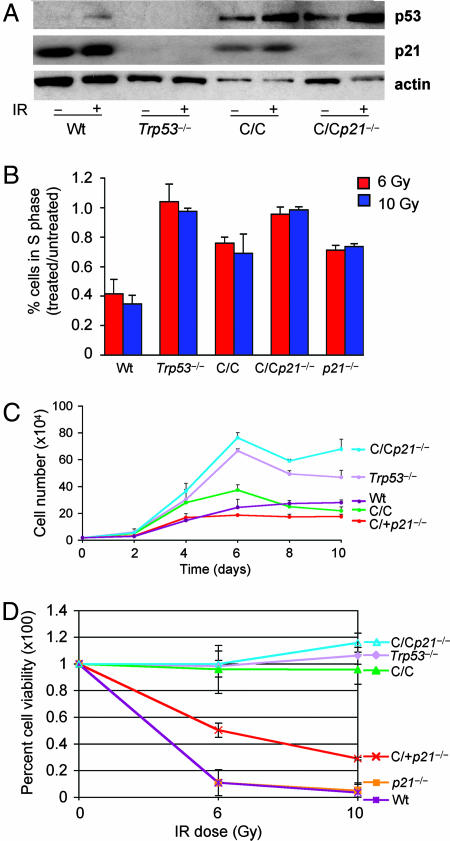
Fig. 1.
Fig. 1.
Trp53515C/515C p21−/− cells are deficient for apoptosis and cell cycle arrest. (A) Immunoblot analysis of p53 and p21 in MEFs of the indicated genotypes before and after treatment with 6 Gy of γ-radiation. Actin was used as a loading control. (B) Cell cycle progression was assayed by determining the ratio of cells in S phase from irradiated (6 Gy) to nonirradiated MEFs with different genotypes: wild-type (Wt), Trp53−/−, Trp53515C/515C (C/C), Trp53515C/515Cp21−/− (C/Cp21−/−), and p21−/−. (C) Equal numbers of MEFs of different genotypes at passage 2 were plated in triplicate and counted at the indicated times. Similar results were obtained from at least two independently derived MEF lines. (D) Apoptosis in mouse thymocytes after treatment with γ-radiation was measured by labeling cells with Annexin-V. Depicted are average values determined from at least three mice of each genotype with SE shown.
Fig. 2.
Fig. 2.
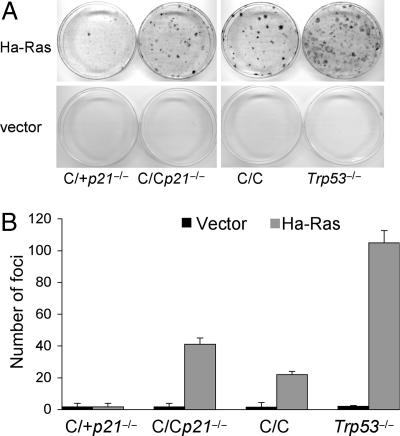
Loss of p21 enhances transformation of Trp53515C/515C MEFs by oncogenic Ras. (A) Transformation of Trp53515C/+p21−/− (C/+p21−/−), Trp53515C/515Cp21−/− (C/Cp21−/−), Trp53515C/515C (C/C), and Trp53−/− MEFs in cooperation with activated Ras was determined by a focus-forming assay. Passage-2 cells were infected with an Ha-RasV12 or control retroviral vector and plated with noninfected cells of the same genotype. Foci were counted after 15 days of culture. (B) Quantification of the number of foci arising in MEFs with different genotypes. Depicted are averages with SEs as determined from triplicate dishes from a representative experiment performed three times.
Fig. 3.
Fig. 3.
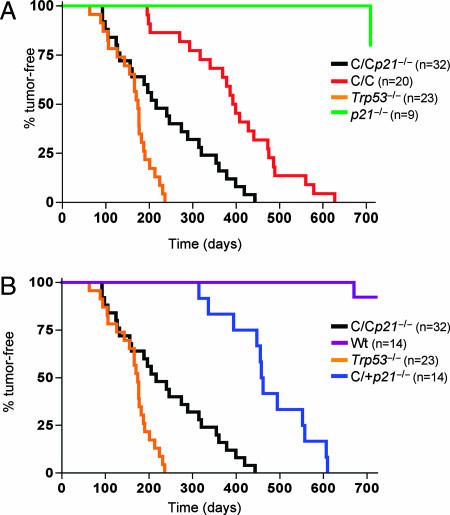
Loss of p21 accelerates tumor onset in Trp53515C/515C mice. Shown are tumor-free survival rates of Trp53515C/515C (C/C; n = 20), Trp53515C/515Cp21−/− (C/Cp21−/−; n = 32) Trp53−/− (n = 23), wild-type (Wt, n = 14), p21−/− (n = 9), and Trp53515C/+p21−/− (C/+p21−/−; n = 14) mice. Survival was calculated by using the Kaplan–Meier method.
Fig. 4.
Fig. 4.
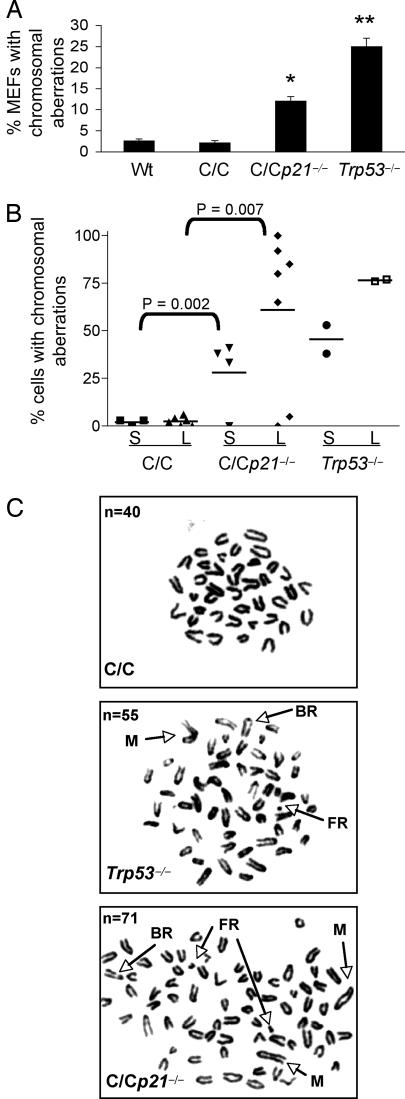
Loss of p21 causes CIN in Trp53515C/515C MEFs and tumors. (A) Metaphase spreads from wild-type (Wt), Trp53515C/515C (C/C), Trp53515C/515Cp21−/− (C/Cp21−/−), and Trp53−/− MEFs at passage 2 were scored for chromosomal aberrations (n = 128 metaphases scored). ∗, P < 0.01; ∗∗, P < 0.005 (Student's t test). (B) Percentage of sarcoma (S) or lymphoma (L) tumor cells with chromosomal aberrations arising in p53 mutant mice. At least 30 cells per tumor sample were scored for chromosomal aberrations. P values were determined by Student's t test. (C) Representative metaphase spreads of lymphoma cells derived from p53 mutant mice. FR, fragment; BR, break; M, marker. n, total chromosome number.
Fig. 5.
Fig. 5.
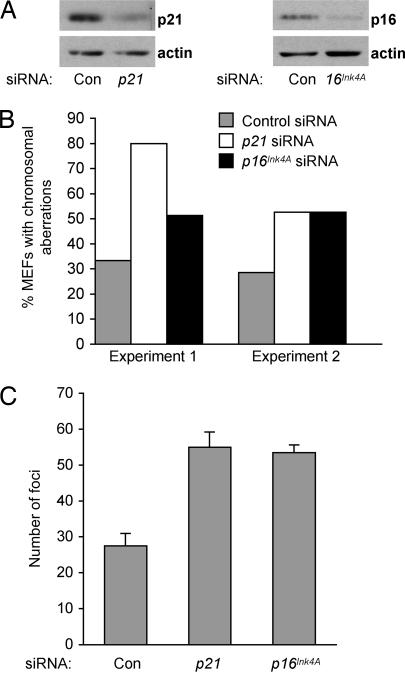
p16Ink4A deficiency enhanced CIN and transformation of Trp53515C/515C cells. (A) Trp53515C/515C MEFs at passage 2 were transfected with the indicated siRNAs, and decreased protein levels were confirmed by immunoblot analysis. (B) Metaphase spreads of Trp53515C/515C MEFs transfected with the indicated siRNAs were scored for chromosomal aberrations. Depicted are the results obtained from two independent experiments in which duplicate dishes of MEFs were transfected with siRNAs then pooled for chromosomal analysis 6 days later. (C) Trp53515C/515C MEFs were infected with Ha-RasV12, transfected with the indicated siRNAs, and then plated 48 h later. Foci were counted at day 15. Con, control.
Fig. 6.
Fig. 6.
Real-time RT-PCR analysis for transcriptional activation by p53R172P. Gene expression was first normalized to Gapdh. Fold induction was calculated as gene expression differences in irradiated (6 Gy) wild-type (A), Trp53515C/515C (B), and Trp53515C/515Cp21−/− (C) MEFs over that in irradiated Trp53-null cells. Data are depicted as the fold induction with SE from triplicate samples.

References

    1. el-Deiry WS, Tokino T, Velculescu VE, Levy DB, Parsons R, Trent JM, Lin D, Mercer WE, Kinzler KW, Vogelstein B. Cell. 1993;75:817–825. - PubMed
    1. Harper JW, Adami GR, Wei N, Keyomarsi K, Elledge SJ. Cell. 1993;75:805–816. - PubMed
    1. Deng C, Zhang P, Harper JW, Elledge SJ, Leder P. Cell. 1995;82:675–684. - PubMed
    1. Waldman T, Kinzler KW, Vogelstein B. Cancer Res. 1995;55:5187–5190. - PubMed
    1. Brugarolas J, Chandrasekaran C, Gordon JI, Beach D, Jacks T, Hannon GJ. Nature. 1995;377:552–557. - PubMed

Publication types

MeSH terms

Substances