Sensitivity of routine system for reporting patient safety incidents in an NHS hospital: retrospective patient case note review
- PMID: 17175566
- PMCID: PMC1767248
- DOI: 10.1136/bmj.39031.507153.AE
Sensitivity of routine system for reporting patient safety incidents in an NHS hospital: retrospective patient case note review
Abstract
Objective: To evaluate the performance of a routine incident reporting system in identifying patient safety incidents.
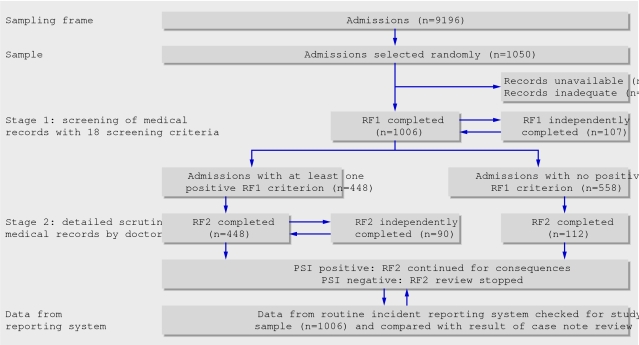
Design: Two stage retrospective review of patients' case notes and analysis of data submitted to the routine incident reporting system on the same patients.
Setting: A large NHS hospital in England.
Population: 1006 hospital admissions between January and May 2004: surgery (n=311), general medicine (n=251), elderly care (n=184), orthopaedics (n=131), urology (n=61), and three other specialties (n=68).
Main outcome measures: Proportion of admissions with at least one patient safety incident; proportion and type of patient safety incidents missed by routine incident reporting and case note review methods.
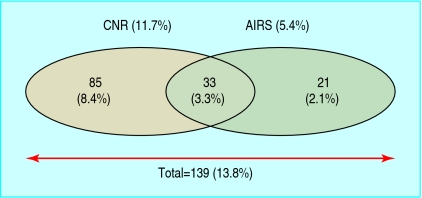
Results: 324 patient safety incidents were identified in 230/1006 admissions (22.9%; 95% confidence interval 20.3% to 25.5%). 270 (83%) patient safety incidents were identified by case note review only, 21 (7%) by the routine reporting system only, and 33 (10%) by both methods. 110 admissions (10.9%; 9.0% to 12.8%) had at least one patient safety incident resulting in patient harm, all of which were detected by the case note review and six (5%) by the reporting system.
Conclusion: The routine incident reporting system may be poor at identifying patient safety incidents, particularly those resulting in harm. Structured case note review may have a useful role in surveillance of routine incident reporting and associated quality improvement programmes.
Conflict of interest statement
Figures
Comment in
-
Incident reporting and patient safety.BMJ. 2007 Jan 13;334(7584):51. doi: 10.1136/bmj.39071.441609.80. BMJ. 2007. PMID: 17218667 Free PMC article.
References
-
- Brennan T, Leape L, Laird N, Hebert L, Localio A, Lawthers A, et al. Incidence of adverse events and negligence in hospitalized patients: results of the Harvard medical practice study I. N Engl J Med 1991;324:370-6. - PubMed
-
- Wilson R, Runciman W, Gibberd R, Harrison B, Newby L, Hamilton J. The quality in Australian health care study. Med J Aust 1995;163:458-71. - PubMed
-
- Davis P, Lay YR, Briant R, Ali W, Scott A, Schug S. Adverse events in New Zealand public hospitals I: occurrence and impact. N Z Med J 2002;115:U271. - PubMed
Publication types
MeSH terms
LinkOut - more resources
Full Text Sources
Medical