


Case Reports
doi: 10.3201/eid1210.060464.
Nematode symbiont for Photorhabdus asymbiotica
Affiliations
- PMID: 17176572
- PMCID: PMC3290952
- DOI: 10.3201/eid1210.060464
Item in Clipboard
Case Reports
Nematode symbiont for Photorhabdus asymbiotica
Emerg Infect Dis.
2006 Oct.
Abstract
Photorhabdus asymbiotica is an emerging bacterial pathogen that causes locally invasive soft tissue and disseminated bacteremic infections in the United States and Australia. Although the source of infection was previously unknown, we report that the bacterium is found in a symbiotic association with an insect-pathogenic soil nematode of the genus Heterorhabditis.
Figures
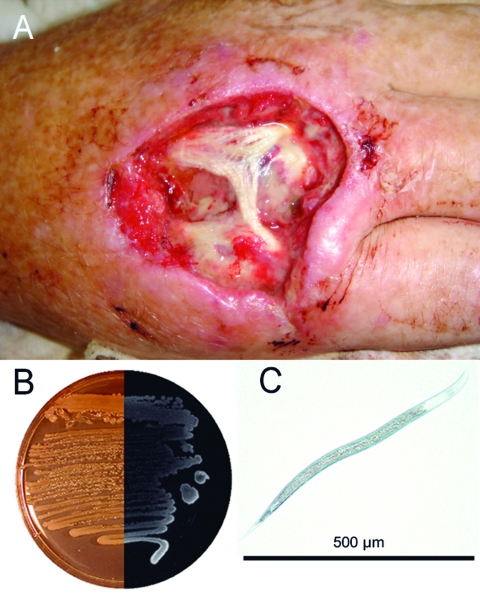
A) Hand of the patient infected with Photorhabdus asymbiotica after debridement. B) Composite photograph of a culture of P. asymbiotica taken in visible light and in darkness to demonstrate bioluminescence (Luria-Bertani medium). C) Soil nematode from which P. asymbiotica was isolated.
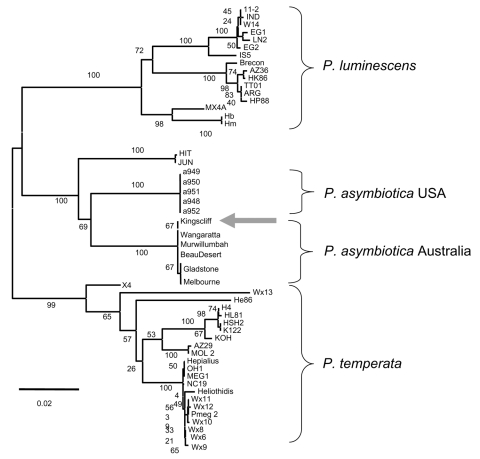
Phylogenetic tree of concatenated sequences of fragments of the glnA gene (474 bp) and the gyrB gene (576 bp) in 52 Photorhabdus isolates representing known diversity across the genus. The tree was constructed with the neighbor-joining algorithm and the K2-P method of distance estimation as implemented in MEGA version 3.0 (12). A total of 1,000 bootstrap replicates were performed, and the percentage of bootstrap trees supporting each node are given. The Kingscliff isolate (arrow) clusters with P. asymbiotica isolates from Australia, both in the concatenated tree (bootstrap score = 100%) and in individual gene trees (not shown). The scale bar shows percentage relatedness.
References
-
- Fischer-Le Saux M, Viallard V, Brunel B, Normand P, Boemare N. Polyphasic classification of the genus Photorhabdus and proposal of new taxa: P. luminescens subsp. luminescens subsp. nov., P. luminescens subsp akhurstii subsp.nov., P. luminescens subsp. laumondii subsp. nov., P. temperata subsp.nov. and P. asymbiotica sp.nov. Int J Syst Bacteriol. 1999;49:1645–56. 10.1099/00207713-49-4-1645 - DOI - PubMed
Publication types
MeSH terms
LinkOut - more resources
Full Text Sources