


doi: 10.3201/eid1210.060051.
Spatial epidemiology of Plasmodium vivax, Afghanistan
Affiliations
- PMID: 17176583
- PMCID: PMC1773016
- DOI: 10.3201/eid1210.060051
Item in Clipboard
Spatial epidemiology of Plasmodium vivax, Afghanistan
Emerg Infect Dis.
2006 Oct.
Abstract
Plasmodium vivax is endemic to many areas of Afghanistan. Geographic analysis helped highlight areas of malaria risk and clarified ecologic risk factors for transmission. Remote sensing enabled development of a risk map, thereby providing a valuable tool to help guide malaria control strategies.
Figures
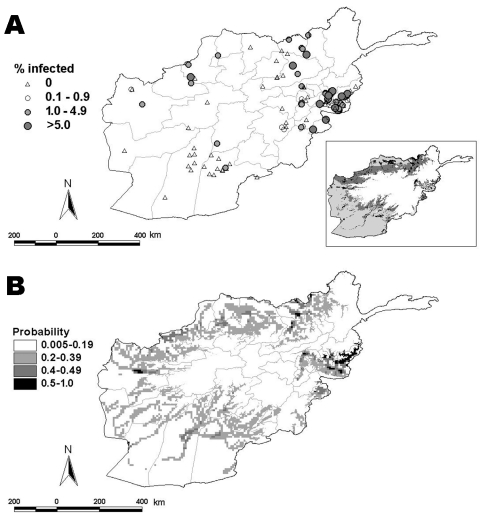
A) Prevalence of Plasmodium vivax in Afghanistan, according to a 2005 survey (n = 269) and previous prevalence surveys conducted by HealthNet-TPO, 2000–2003 (n = 64). Lower-right inset shows ecologic zones in Afghanistan according to differences in elevation, temperature, and land cover. White, high altitude rangeland; light gray, desert; dark gray, grassland; black, irrigated/marshland. B) Predicted probability of P. vivax transmission (prevalence >0%) in Afghanistan, according to logistic regression model.
References
-
- World Health Organization. World Malaria Report 2005. Geneva: The Organization; 2005.
-
- Lindberg K. Le paludisme en Afghanistan. Riv Malariol. 1949;28:1–54.
Publication types
MeSH terms
Substances
Grants and funding
LinkOut - more resources
Full Text Sources