


Review
doi: 10.1016/j.semcdb.2006.11.011.
Epub 2006 Nov 24.
Genetic pathways to mammalian heart development: Recent progress from manipulation of the mouse genome
Affiliations
- PMID: 17178242
- PMCID: PMC1934561
- DOI: 10.1016/j.semcdb.2006.11.011
Item in Clipboard
Review
Genetic pathways to mammalian heart development: Recent progress from manipulation of the mouse genome
Semin Cell Dev Biol.
2007 Feb.
Abstract
Mammalian heart development requires multiple genetic networks, only some of which are becoming known in all their complexity. Substantial new information has become available thanks to an expanding toolkit that offers more and more mouse gene manipulation options, and that is taking the mouse closer to more powerful invertebrate genetic models. We review examples of recent data with a cardiac-lineage-based view of heart development, especially outflow tract and right ventricle. The medical significance of these studies is not only relevant to congenital heart disease, but also to the biology of cardiac cell regeneration.
Figures
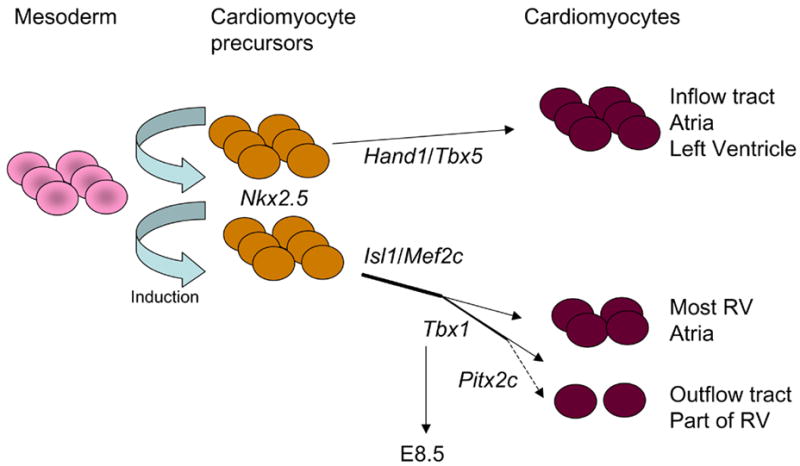
The two cell lineages that contribute to the heart.
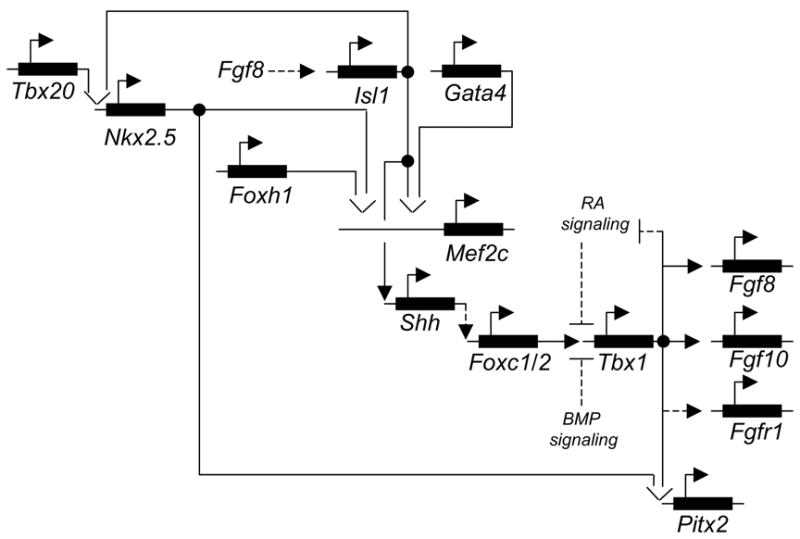
A putative genetic network operating in the second heart lineage. Dashed lines indicate the most speculative links.
References
-
- Hoffman JI. Incidence of congenital heart disease: I. Postnatal incidence. Pediatr Cardiol. 1995;16:103–13. - PubMed
-
- Hoffman JI. Incidence of congenital heart disease: II. Prenatal incidence. Pediatr Cardiol. 1995;16:155–65. - PubMed
-
- Meilhac SM, Esner M, Kelly RG, Nicolas JF, Buckingham ME. The clonal origin of myocardial cells in different regions of the embryonic mouse heart. Dev Cell. 2004;6:685–98. - PubMed
-
- Garcia-Martinez V, Schoenwolf GC. Primitive-streak origin of the cardiovascular system in avian embryos. Dev Biol. 1993;159:706–19. - PubMed
-
- Tam PP, Parameswaran M, Kinder SJ, Weinberger RP. The allocation of epiblast cells to the embryonic heart and other mesodermal lineages: the role of ingression and tissue movement during gastrulation. Development. 1997;124:1631–42. - PubMed
Publication types
MeSH terms
Grants and funding
LinkOut - more resources
Full Text Sources
