. 2007;35(2):614-22.
doi: 10.1093/nar/gkl1036. Epub 2006 Dec 18.

Encoding folding paths of RNA switches

Affiliations

Encoding folding paths of RNA switches

A Xayaphoummine et al. Nucleic Acids Res. 2007.

Abstract

RNA co-transcriptional folding has long been suspected to play an active role in helping proper native folding of ribozymes and structured regulatory motifs in mRNA untranslated regions (UTRs). Yet, the underlying mechanisms and coding requirements for efficient co-transcriptional folding remain unclear. Traditional approaches have intrinsic limitations to dissect RNA folding paths, as they rely on sequence mutations or circular permutations that typically perturb both RNA folding paths and equilibrium structures. Here, we show that exploiting sequence symmetries instead of mutations can circumvent this problem by essentially decoupling folding paths from equilibrium structures of designed RNA sequences. Using bistable RNA switches with symmetrical helices conserved under sequence reversal, we demonstrate experimentally that native and transiently formed helices can guide efficient co-transcriptional folding into either long-lived structure of these RNA switches. Their folding path is controlled by the order of helix nucleations and subsequent exchanges during transcription, and may also be redirected by transient antisense interactions. Hence, transient intra- and inter-molecular base pair interactions can effectively regulate the folding of nascent RNA molecules into different native structures, provided limited coding requirements, as discussed from an information theory perspective. This constitutive coupling between RNA synthesis and RNA folding regulation may have enabled the early emergence of autonomous RNA-based regulation networks.


Figures
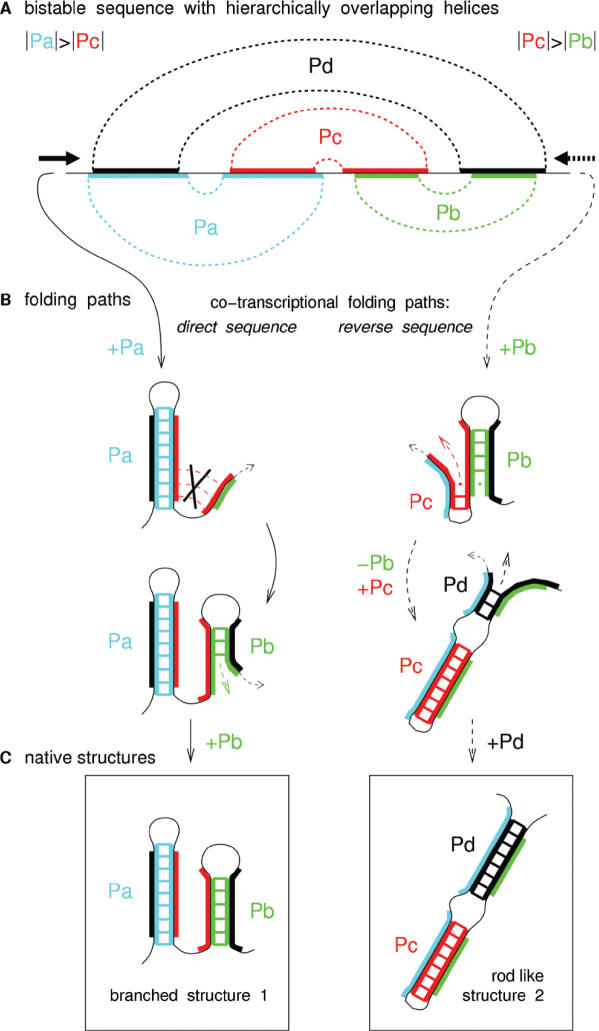
Figure 1
Figure 1
Encoded co-transcriptional folding path of a bistable RNA switch. (A). Bistable generic sequence with hierarchically overlapping helices. (B). Opposite co-transcriptional folding paths for the direct and reverse sequences rely on small asymmetries in helix length in the direction of transcription (i.e. |Pa| > |Pc| direct sequence and |Pc| > |Pb| reverse sequence). (C). Either branched or rod-like native structures are obtained depending on the direction of transcription, although both structures can be designed to co-exist at equilibrium.
Figure 2
Figure 2
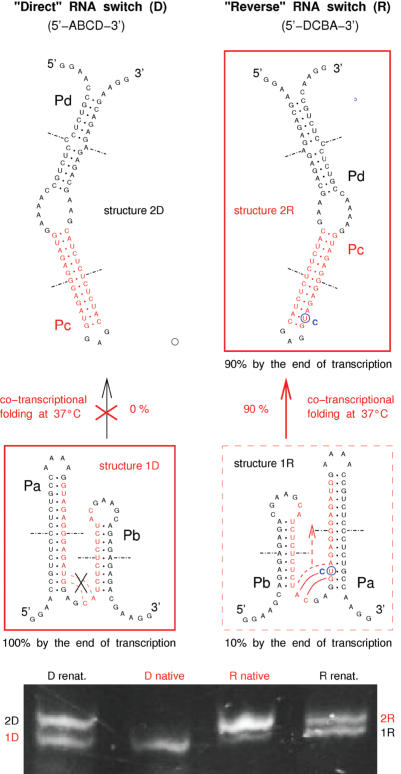
Opposite co-transcriptional folding paths of a pair of RNA switches with ‘direct’ and ‘reverse’ sequences (i.e. 5′-ABCD-3′ versus 5′-DCBA-3′). Structures 1D and 1R (respectively, 2D and 2R) of the direct and reverse switches are energetically equivalent because of helix symmetries; dashed lines indicate mirror symmetry of Pa, Pb, Pc and Pd which are therefore conserved under sequence reversal relating direct and reverse switches. Despite these strong similarities between D and R structures at equilibrium, direct and reverse switches display ‘opposite’ co-transcriptional folding paths (direct switch into structure 1D and reverse switch into structure 2R) guided through a helix encoded persistence (left) or exchange (right) during in vitro transcription using T7 RNA polymerase (see Materials and Methods).
Figure 3
Figure 3
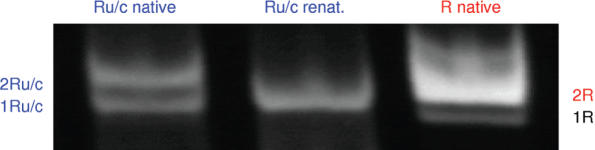
Correspondence between branched versus rod-like structure and migrating bands. A single mutation U38/C38 on the reverse sequence, Ru/c (see blue u/c mutation in Figure 2) unambiguously demonstrates the correspondence between the stabilized branched structure and the lower band on the gel (see text).
Figure 4
Figure 4
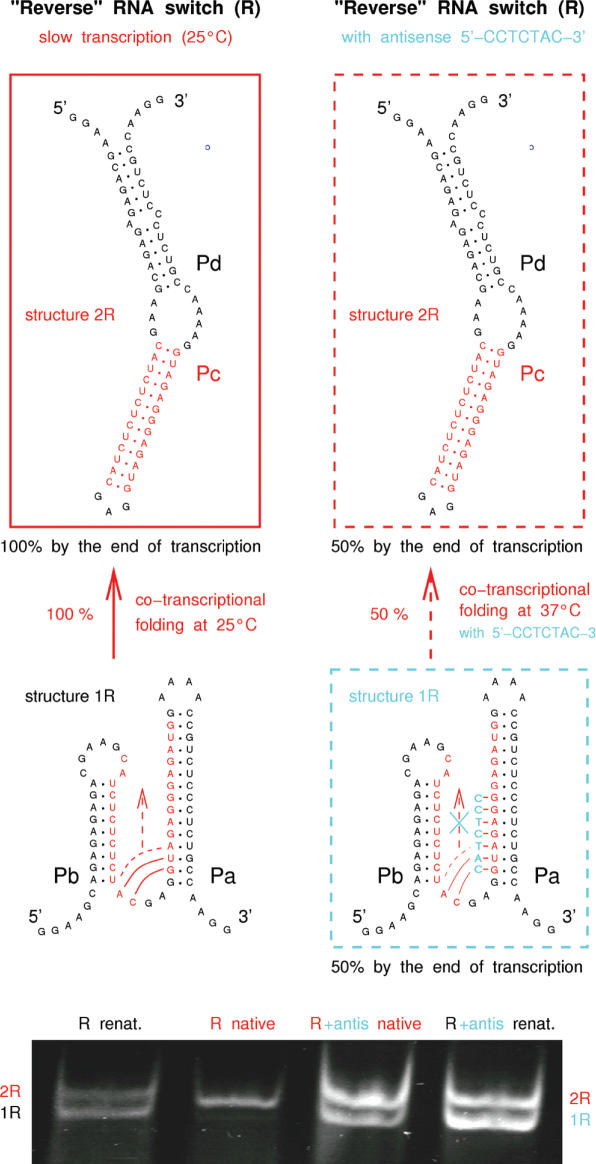
Influence of temperature and transient antisense interactions on co-transcriptional folding. Equilibrium and native structures of reverse switch (R) with in vitro T7 transcription at 25°C (left, see text) and under in vitro T7 transcription in presence of 0.3 nmol/μl of the 7 nt antisense DNA oligonucleotide CCTCTAC (right, see text). Structures are separated on a 12% 19:1 acryl-bisacrylamide non-denaturing gel (temperature <10°C) and observed using ethidium bromide staining as on Figure 2 (see Materials and Methods).
Figure 5
Figure 5
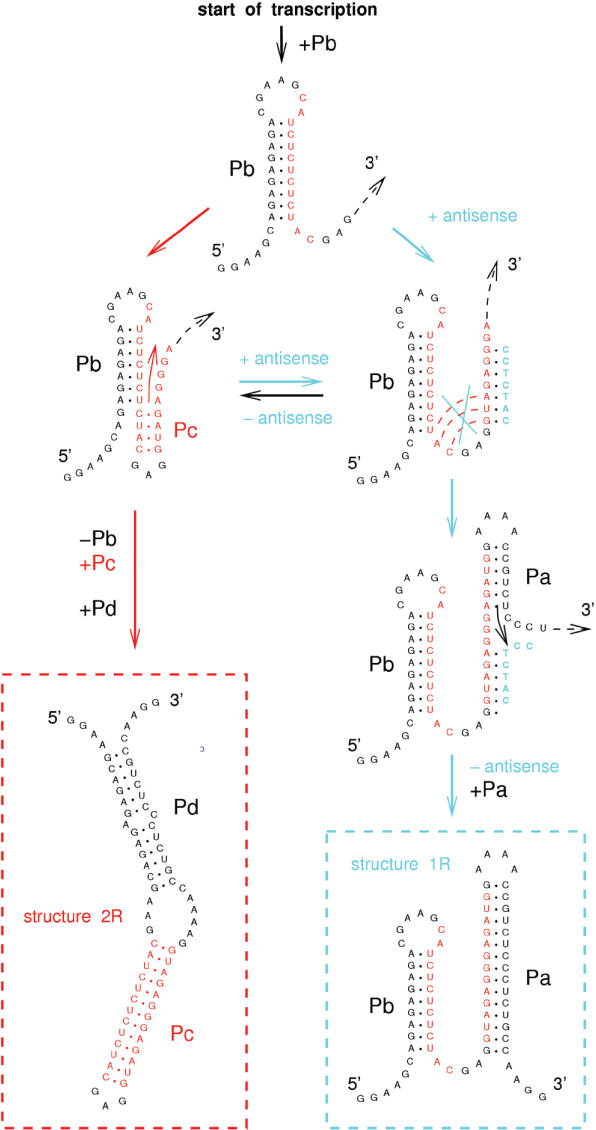
Antisense regulation of co-transcriptional folding paths. Interpretation of the encoded (left) and redirected (right) co-transcriptional folding paths of the reverse switch (Figure 4). This is based on simulations performed using the kinefold server (46) (), To simulate the effect of antisense interaction, the 7mer and RNA switch sequences are actually attached together via an inert linker (made of ‘X’ bases that do not pair).
Figure 6
Figure 6
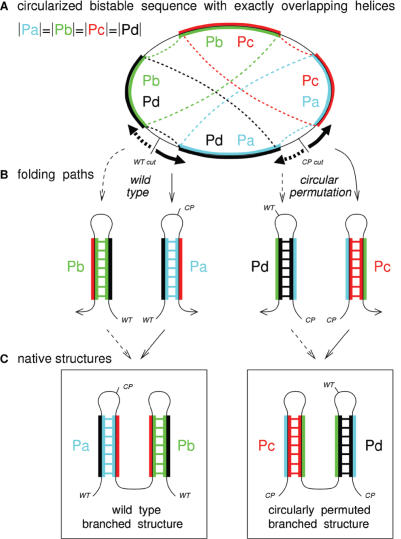
Simple sequential folding of a bistable RNA switch under sequence reversal and circular permutation. (A). Bistable generic sequence with exactly overlapping helices Pa, Pb, Pc and Pd. A permutation between the starting and ending regions of the wild-type sequence can be obtained by genetically connecting its 5′ and 3′ ends and engineering two new ends from an alternative break point in the circularized sequence. (B). Sequential folding path of the wild-type versus circularly permuted sequences. (C). Different branched structures obtained for wild-type and circularly permuted sequences independently from the direction of transcription or sequence reversal (solid versus dashed arrows). The alternative rod-like structures (wild-type Pd–Pc and circularly permuted Pa–Pb) are not formed through sequential folding, although they are expected to coexist with branched structures at equilibrium (not drawn). Figures 1 and 2 show, however, that small asymmetries (2–3 bases) between overlapping helices are sufficient to efficiently guide RNA switches into either branched or rod-like structures (see text).

References

    1. Dahlberg A.E. The ribosome in action. Science. 2001;292:868–869. - PubMed
    1. Kruger K., Grabowski P., Zaug A.J., Sands J., Gottschling D.E., Cech T.R. Self-splicing RNA: autoexcision and autocyclization of the ribosomal RNA intervening sequence of Tetrahymena. Cell. 1982;31:147–157. - PubMed
    1. Bartel D.P., Szostak J.W. Isolation of new ribozymes from a large pool of random sequences. Science. 1993;261:1411–1418. - PubMed
    1. Joyce G.F. Amplification, mutation and selection of catalytic RNA. Gene. 1989;82:83–87. - PubMed
    1. Ellington A.E., Szostak J.W. In vitro selection of RNA molecules that bind specific ligands. Nature. 1990;346:818–822. - PubMed

Publication types