. 2007 Feb;49(3):414-27.
doi: 10.1111/j.1365-313X.2006.02964.x. Epub 2006 Dec 20.

Red colouration in apple fruit is due to the activity of the MYB transcription factor, MdMYB10

Affiliations

Red colouration in apple fruit is due to the activity of the MYB transcription factor, MdMYB10

Richard V Espley et al. Plant J. 2007 Feb.

Abstract

Anthocyanin concentration is an important determinant of the colour of many fruits. In apple (Malus x domestica), centuries of breeding have produced numerous varieties in which levels of anthocyanin pigment vary widely and change in response to environmental and developmental stimuli. The apple fruit cortex is usually colourless, although germplasm does exist where the cortex is highly pigmented due to the accumulation of either anthocyanins or carotenoids. From studies in a diverse array of plant species, it is apparent that anthocyanin biosynthesis is controlled at the level of transcription. Here we report the transcript levels of the anthocyanin biosynthetic genes in a red-fleshed apple compared with a white-fleshed cultivar. We also describe an apple MYB transcription factor, MdMYB10, that is similar in sequence to known anthocyanin regulators in other species. We further show that this transcription factor can induce anthocyanin accumulation in both heterologous and homologous systems, generating pigmented patches in transient assays in tobacco leaves and highly pigmented apple plants following stable transformation with constitutively expressed MdMYB10. Efficient induction of anthocyanin biosynthesis in transient assays by MdMYB10 was dependent on the co-expression of two distinct bHLH proteins from apple, MdbHLH3 and MdbHLH33. The strong correlation between the expression of MdMYB10 and apple anthocyanin levels during fruit development suggests that this transcription factor is responsible for controlling anthocyanin biosynthesis in apple fruit; in the red-fleshed cultivar and in the skin of other varieties, there is an induction of MdMYB10 expression concurrent with colour formation during development. Characterization of MdMYB10 has implications for the development of new varieties through classical breeding or a biotechnological approach.


Figures
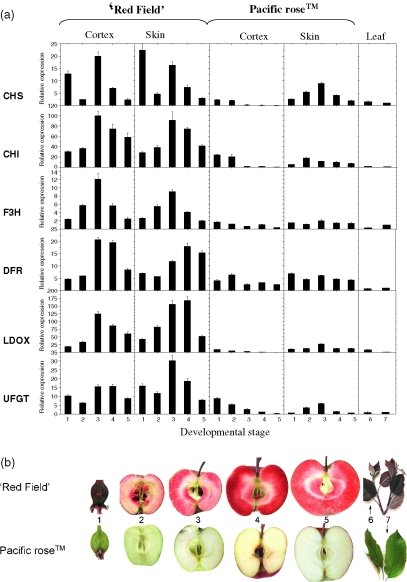
Figure 1
Figure 1
Expression profiling of apple anthocyanin genes. (a) Data from qPCR analysis of the apple anthocyanin biosynthetic genes in the cortex, skin and leaf of the apple cultivars ‘Red Field’ and Pacific RoseTM. CHS, chalcone synthase; CHI, chalcone isomerase; F3H, flavanone 3β-hydroxylase; DFR, dihydroflavonol 4-reductase (denoted as DFR1 in the text); LDOX, leucoanthocyanidin dioxygenase; UFGT, uridine diphosphate (UDP)-glucose:flavonoid 3-O-glycosyltransferase. Samples referred to on the x axis: (1) 40 days after full bloom (DAFB), (2) 67 DAFB, (3) 102 DAFB, (4) 130 DAFB, (5) 146 DAFB, (6) ‘Red Field’ leaf and (7) Pacific RoseTM leaf. Error bars are SE for three replicate reactions. (b) Fruit development series and leaves of ‘Red Field’ and Pacific RoseTM. Numbering from 1 to 7 as for (a).
Figure 2
Figure 2
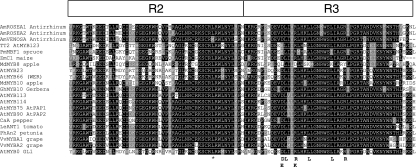
Protein sequence alignment of the R2R3 DNA-binding domains of MdMYB10 and other known anthocyanin MYB regulators from other species. Arrows indicate specific residues that contribute to a motif implicated in bHLH co-factor interaction in Arabidopsis (Zimmermann et al., 2004). These same residues are evident in MdMYB10, suggesting a similar protein–protein interaction. The asterisk represents a two-nucleotide change that results in a leucine to a glutamine amino acid change in some alleles. Identical residues are shown in black, conserved residues in dark grey, and similar residues in light grey. MdMYB8 and AtGL1 are included as examples of MYBs that are not involved in anthocyanin regulation. The accession number of these proteins, or translated products, in the GenBank database are as follows: AmROSEA1, ABB83826; AmROSEA2, ABB83827; AmVENOSA, ABB83828; MdMYB10, DQ267896; AtPAP1, CAB09230; AtPAP2, NP176813; AtMYB113, NM105308; AtMYB114, NM105309; AtMYB66, NM121479; VvMYBA1, AB242302; VvMYBA2, AB097924; Ca A, CAE75745; PhAN2, AAF66727; LeANT1, AAQ55181; GhMYB10, CAD87010; PmMBF1, AAA82943; ZmC1, AAK81903; AtTT2, Q9FJA2; MdMYB8, DQ267899; AtGL1, AAC97387.
Figure 3
Figure 3
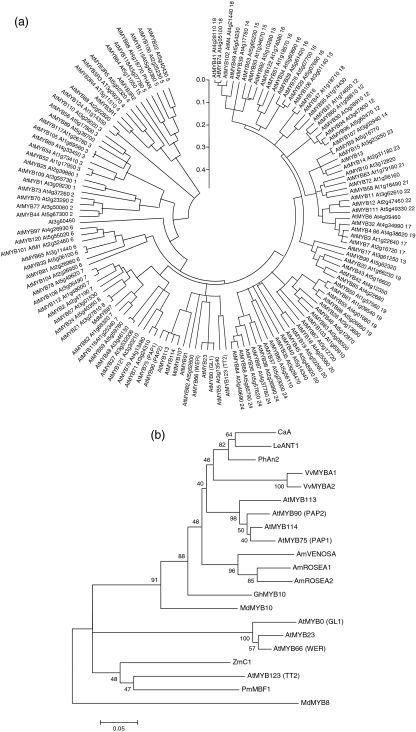
Phylogenetic relationships between Arabidopsis MYB transcription factors and anthocyanin-related MYBs of other species. (a) MdMYB10 clusters next to PAP1 (AtMYB75), within the anthocyanin MYB regulator subgroup 10. Subgroup numbers are those described by Stracke et al. (2001) and are shown as a suffix after most MYB descriptors. Arabidopsis genes are identified by Arabidopsis unique identifiers. (b) Phylogeny of MdMYB10 and MYB genes from other species involved in the regulation of anthocyanin biosynthesis. Full-length sequences were aligned using Clustal W (opening = 15, extension = 0.3) in Vector NTI 9.0. Conserved motifs were extracted and re-aligned as above. Phylogenetic and molecular evolutionary analyses were conducted using MEGA version 3.1 (Kumar et al., 2004) using a minimum evolution phylogeny test and 1000 bootstrap replicates. Accession numbers for genes from other species are given in Figure 2.
Figure 4
Figure 4
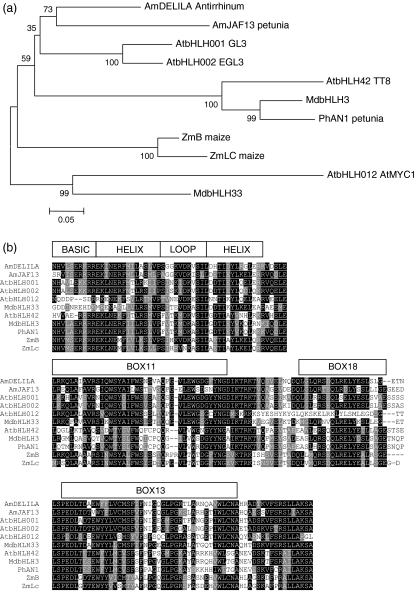
MdbHLH3 and MdbHLH33 share homology at the bHLH motif with anthocyanin bHLH regulators from other species. (a) Unrooted phylogenic tree showing that MdbHLH3 clusters in the same group as AtTT8 whilst MdbHLH33 clusters in the same group as AtMYC1. Full-length sequences were aligned using Clustal W (opening = 15, extension = 0.3) in Vector NTI 9.0. Conserved motifs were extracted and re-aligned as above. Phylogenetic and molecular evolutionary analyses were conducted using MEGA version 3.1 (Kumar et al., 2004) using a minimum evolution phylogeny test and 1000 bootstrap replicates. (b) Protein sequence alignment, with the structure of the bHLH binding domain indicated. The accession numbers of these proteins, or translated products, in the GenBank database are as follows: AmDELILA, AAA32663; ATMYC1, BAA11933; EGL1, Q9CAD0; G13, NP680372; PhJAF13, AAC39455; MdbHLH3, CN934367; MdbHLH33, DQ266451; PhAN1, AAG25928; AtTT8, CAC14865; ZmB, CAA40544; ZmLC, AAA33504. (c) N-terminus of the same bHLH subset showing regions (boxes 11, 18 and 13) conserved within the bHLH IIIf clade (according to Heim et al., 2003). Identical residues are shown in black, conserved residues in dark grey, and similar residues in light grey.
Figure 5
Figure 5
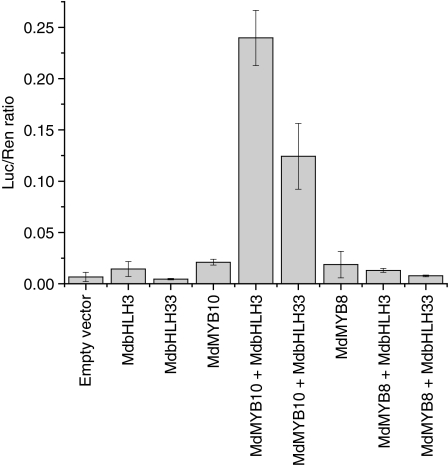
Interaction of MdMYB10 and apple bHLH TFs in transient tobacco transformation assays affects the activity of the DFR gene promoter. The dual luciferase assay shows promoter activity expressed as a ratio of DFR promoter luciferase (LUC) to 35S Renilla (REN), where an increase in activity equates to an increase in LUC relative to REN. Error bars are the SE for six replicate reactions.
Figure 6
Figure 6
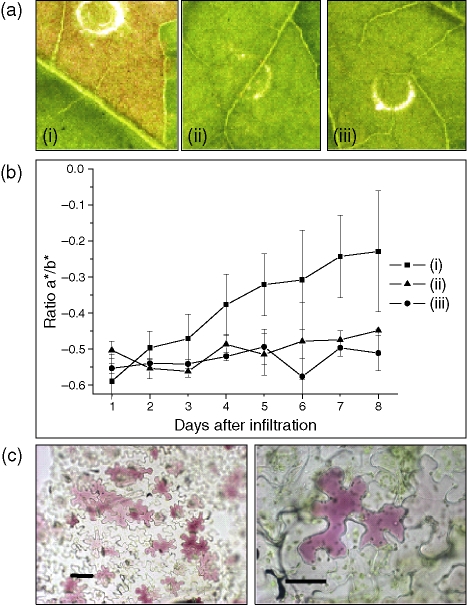
Development of colour due to transient transformation of Nicotiana tabacum leaves. (a) Digital images of infiltration sites 8 days after transformation with: (i) MdMYB10 + MdbHLH3, (ii) MdMYB10 alone, and (iii) empty vector control. (b) Colour measurement by Minolta chromameter, shown as a*/b* ratio. A shift towards positive indicates a colour change from green towards red; (i) to (iii) as above. Error bars are the SE for six replicate reactions. (c) Microscope images showing anthocyanin accumulation in tobacco epidermal cells infiltrated with MdMYB10 + MdbHLH3 at magnifications of 20× (left) and 40× (right). Scale bars = 50 μm.
Figure 7
Figure 7
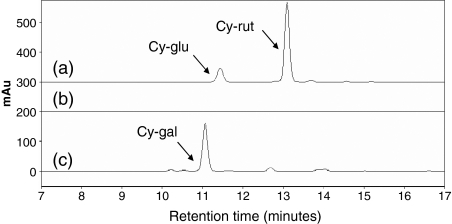
Anthocyanin profiles of N. tabacum and apple. HPLC traces at 520 nm of (a) MdMYB10 + MdbHLH3, (b) tobacco leaf infiltrated with empty vector control, and (c) Pacific RoseTM apple fruit skin. Peaks identified are as follows: cy-glu, cyanidin-3-glucoside; cy-rut, cyanidin-3-O-rutinoside; cy-gal, cyanidin-3-galactoside.
Figure 8
Figure 8
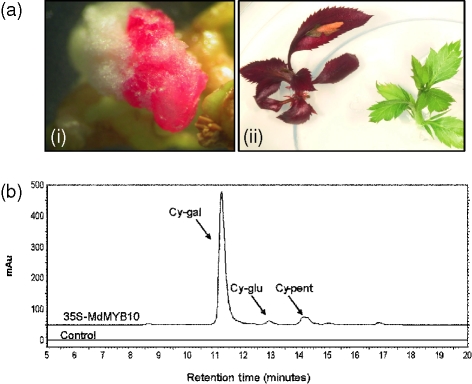
Over-expression of MdMYB10 in apple elevates anthocyanin production. (a) Pigmented callus (i) and apple plants (ii) transformed with 35S-MdMYB10 (left) and empty vector control plant (right). (b) Anthocyanin profiles of extracts of 35S-MdMYB10 apple leaf (top line) and empty vector control (bottom line). Peaks identified from HPLC traces at 520 nm: cy-gal, cyanidin-3-galactoside; with minor traces of cy-glu, cyanidin-3-glucoside and cy-pent, cyanidin-3-pentoside.
Figure 9
Figure 9
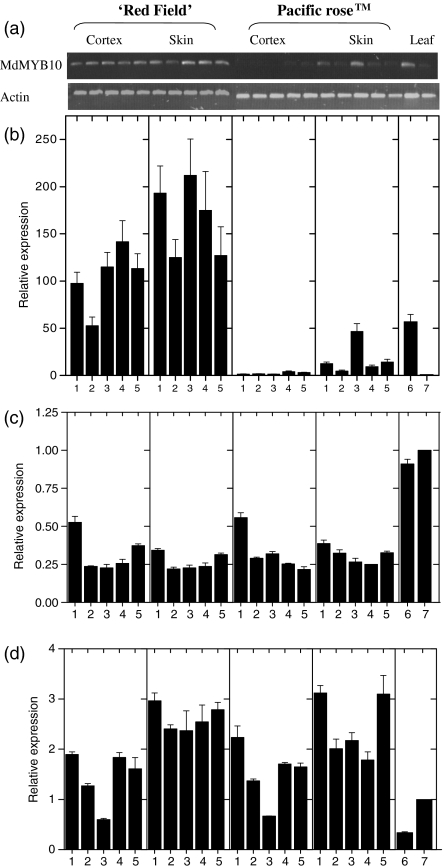
Expression analysis of the transcripts of MdMYB10, MdbHLH3 and MdbHLH33 during apple fruit development and in leaves. (a) RT-PCR analysis of MdMYB10 (220 bp) and actin (131 bp) in ‘Red Field’ (cortex, skin and leaf) and Pacific RoseTM (cortex, skin and leaf), and corresponding qPCR data for MdMYB10 (b), MdbHLH3 (c) and MdbHLH33 (d). Gel lane and x axis numbering as follows: (1) 40 DAFB, (2) 67 DAFB, (3) 102 DAFB, (4) 130 DAFB, (5) 146 DAFB, (6) ‘Red Field’ leaf and (7) Pacific RoseTM leaf. Error bars shown in qPCR data are of the SE for three replicate reactions.

References

    1. Baudry A. TT2, TT8, and TTG1 synergistically specify the expression of BANYULS and proanthocyanidin biosynthesis in Arabidopsis thaliana. Plant J. 2004;39:366–380. - PubMed
    1. Borevitz JO. Activation tagging identifies a conserved MYB regulator of phenylpropanoid biosynthesis. Plant Cell. 2000;12:2383–2394. - PMC - PubMed
    1. Boss PK. Expression of anthocyanin biosynthesis pathway genes in red and white grapes. Plant Mol. Biol. 1996;32:565–569. - PubMed
    1. Boyer J. Apple phytochemicals and their health benefits. Nutr. J. 2004;3:5. - PMC - PubMed
    1. Brooks RM. Register of New Fruit and Nut Varieties. Berkeley, California: University of California Press; 1972.

Publication types

MeSH terms