. 2007 Jan 2;104(1):198-202.
doi: 10.1073/pnas.0605642104. Epub 2006 Dec 20.

Divergence of reproductive phenology under climate warming

Affiliations

Divergence of reproductive phenology under climate warming

Rebecca A Sherry et al. Proc Natl Acad Sci U S A. .

Abstract

Because the flowering and fruiting phenology of plants is sensitive to environmental cues such as temperature and moisture, climate change is likely to alter community-level patterns of reproductive phenology. Here we report a previously unreported phenomenon: experimental warming advanced flowering and fruiting phenology for species that began to flower before the peak of summer heat but delayed reproduction in species that started flowering after the peak temperature in a tallgrass prairie in North America. The warming-induced divergence of flowering and fruiting toward the two ends of the growing season resulted in a gap in the staggered progression of flowering and fruiting in the community during the middle of the season. A double precipitation treatment did not significantly affect flowering and fruiting phenology. Variation among species in the direction and magnitude of their response to warming caused compression and expansion of the reproductive periods of different species, changed the amount of overlap between the reproductive phases, and created possibilities for an altered selective environment to reshape communities in a future warmed world.


Conflict of interest statement

The authors declare no conflict of interest.

Figures
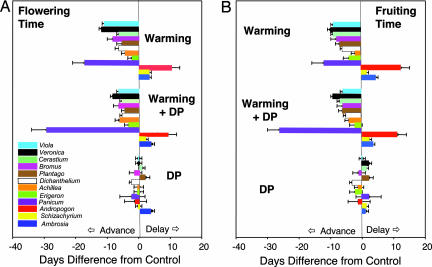
Fig. 1.
Fig. 1.
Changes in the onset of flowering (A) and fruiting (B) (in days) in three experimental treatments [i.e., warming, doubled precipitation (DP), and warming plus DP] compared with the control. Species are listed in the order buds were first observed in control plots, beginning in March with V. bicolor and ending in late August with A. psilostachya. A positive value indicates earlier flowering or fruiting than the control; a negative value indicates later flowering or fruiting than the control. For the warming and warming plus DP treatments, the differences in flowering and fruiting from the control are significant for all species except Erigeron (P < 0.05). In the DP treatment, there were no significant differences in the onset of flowering and fruiting from the control. Data are mean ± SE for advanced or delayed phenology, respectively.
Fig. 2.
Fig. 2.
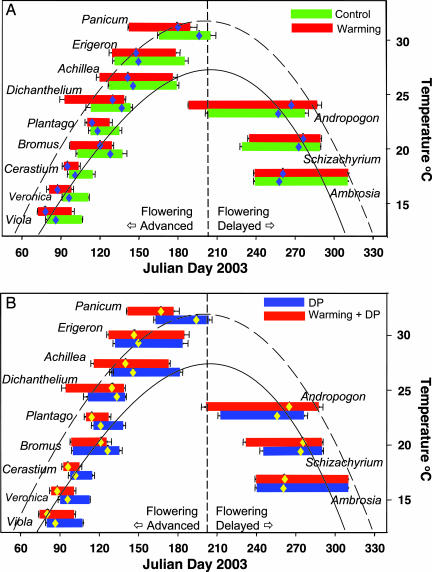
Timing and duration of the entire reproductive period composed of three phases (budding, flowering, and fruiting) for the 12 species under four treatments. The diamond symbol indicates the averaged starting date of flowering, from which differences of flowering times between warming and control treatments were calculated as presented in Fig. 1. Fruiting times were similarly analyzed. Lengths of the three phases are presented in SI Table 3. In A, green indicates control, and red indicates warming. In B, blue indicates doubled precipitation (DP), and red indicates warming plus DP. In A, the solid curve is the fitted polynomial regression to daily temperature in the control plots and the dashed curve is for the warmed plots. In B, the solid curve is for the DP, and the dashed curve is for the warming plus DP. The dotted vertical line indicates the peak summer temperature as defined by the maximum temperature of the regression curve. For Cerastium, Dichanthelium, Panicum, and Andropogon, changes in timing or duration caused by the warming and DP treatments are large enough to significantly affect the overlap between paired species (see text). Data are presented as duration ± SE at the two ends of reproductive periods.

References

    1. Walther G-R, Post E, Convey P, Menzel A, Parmesan C, Beebee TRC, Fromentin J-M, Hoegh-Guldberg O, Bairlein F. Nature. 2002;416:389–395. - PubMed
    1. Peñuelas J, Filella I. Science. 2001;294:793–795. - PubMed
    1. Parmesan C, Yohe G. Nature. 2003;421:37–42. - PubMed
    1. Root TL, Price JT, Hall KR, Schnelder SH, Rosenzweig C, Pounds JA. Nature. 2003;241:57–60. - PubMed
    1. Myneni RB, Keeling CD, Tucker CJ, Asrar G, Nemani RR. Nature. 1997;386:698–702.

Publication types

LinkOut - more resources