


Dental general anaesthetic trends among Australian children
- PMID: 17184552
- PMCID: PMC1770909
- DOI: 10.1186/1472-6831-6-16
Dental general anaesthetic trends among Australian children
Abstract
Background: Children receive dental general anaesthetic (DGA) care when standard dental treatment is not possible. Receipt of DGA care is resource-intensive and not without risk. This study examines trends in receipt of DGA care among Australian children.
Methods: Child DGA data were obtained from the Australian Institute of Health and Welfare Hospital Morbidity Database for 1993-2004. Poisson regression modelling was used to examine DGA rates in relation to age, sex, Indigenous status, location, year and procedure.
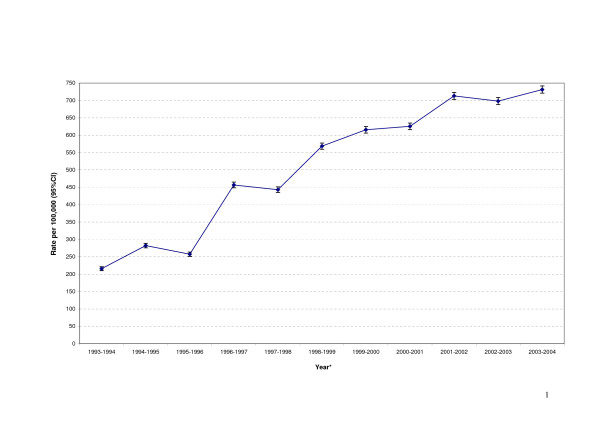
Results: There was a 3-fold increase in DGA rates from 1993-1994 (215.8 +/- 2.9 per 100,000) to 2003-2004 (731.4 +/- 5.3 per 100,000) (P < 0.001). Across all years, children who were aged 0-4 years, male or rural/remote-dwelling had higher DGA rates than their 5-9-year-old, female or metropolitan-dwelling counterparts respectively. There was a 7.0-fold increase in the rate of Indigenous admissions from 1993-1994 (116.5 +/- 10.2 per 100,000) to 2003-2004 (806.6 +/- 25.7 per 100,000). Extraction rates increased 4.9-fold from 1993-1994 (109.2 +/- 2.9 per 100,000) to 2003-2004 (540.0 +/- 4.5 per 100,000), while restoration rates increased 3.3-fold in the same observation period (139.5 +/- 2.3 per 100,000 in 1993-1994 to 462.6 +/- 4.2 per 100,000 in 2003-2004). For admissions in which one or more extractions were received, Indigenous rates were 47% greater than non-Indigenous rates after adjusting for other covariates.
Conclusion: Child DGA rates in Australia are increasing. Children who are pre-school-aged, male, Indigenous or living in a rural/remote location are disproportionally represented among those receiving such care. There are higher rates of extractions as opposed to more conservative procedures, particularly among Indigenous children.
Figures
References
-
- Sheller B, Williams BJ, Hays K, Manel L. Reasons for repeat dental treatment under general anesthesia for the healthy child. Pediatr Dent. 2003;25:546–552. - PubMed
LinkOut - more resources
Full Text Sources
