. 2007 Mar;21(3):906-14.
doi: 10.1096/fj.06-7229com. Epub 2006 Dec 21.

Regulation of Kv1 channel trafficking by the mamba snake neurotoxin dendrotoxin K

Affiliations

Regulation of Kv1 channel trafficking by the mamba snake neurotoxin dendrotoxin K

Helene Vacher et al. FASEB J. 2007 Mar.

Abstract

Modulation of voltage-gated potassium (Kv) channel surface expression can profoundly affect neuronal excitability. Some, but not all, mammalian Shaker or Kv1 alpha subunits contain a dominant endoplasmic reticulum (ER) retention signal in their pore region, preventing surface expression of Kv1.1 homotetrameric channels and of heteromeric Kv1 channels containing more than one Kv1.1 subunit. The critical amino acid residues within this ER pore-region retention signal are also critical for high-affinity binding of snake dendrotoxins (DTX). This suggests that ER retention may be mediated by an ER protein with a domain structurally similar to that of DTX. One facet of such a model is that expression of soluble DTX in the ER lumen should compete for binding to the retention protein and allow for surface expression of retained Kv1.1. Here, we show that luminal DTX expression dramatically increased both the level of cell surface Kv1.1 immunofluorescence staining and the proportion of Kv1.1 with processed N-linked oligosaccharides. Electrophysiological analyses showed that luminal DTX expression led to significant increases in Kv1.1 currents. Together, these data showed that luminal DTX expression increases surface expression of functional Kv1.1 homotetrameric channels and support a model whereby a DTX-like ER protein regulates abundance of cell surface Kv1 channels.


Figures
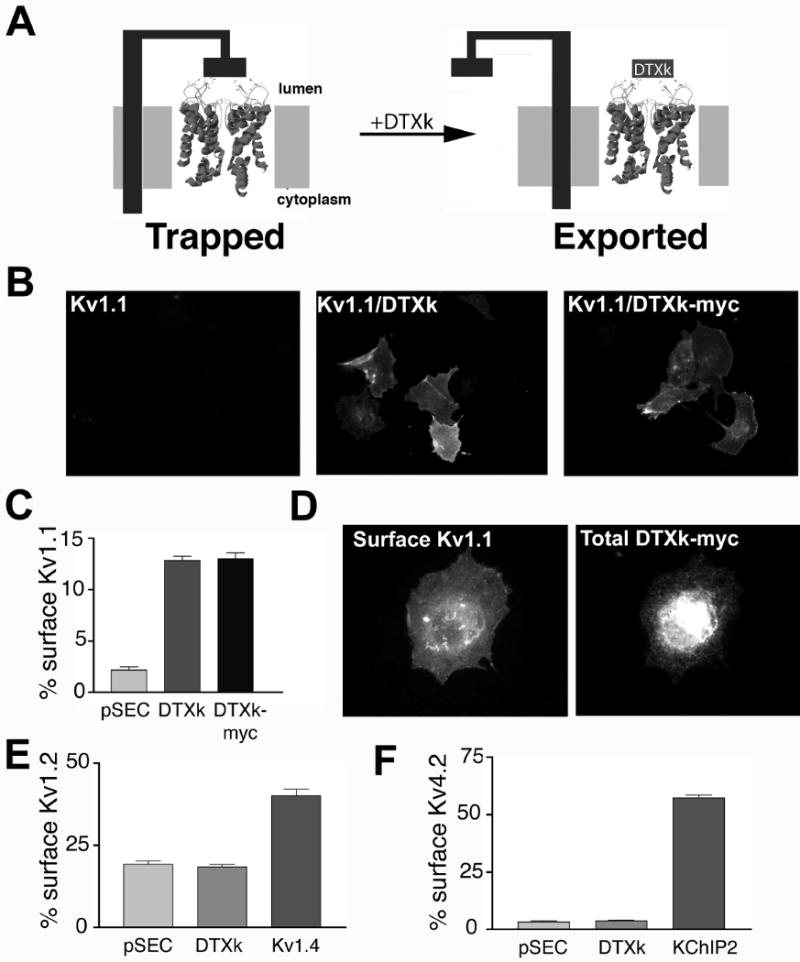
Figure 1
Figure 1
ER luminal DTXk expression exerts specific effects on Kv1.1 trafficking in COS-1 cells. A, Cartoon depicting competition of soluble DTXk (grey square) in the ER lumen with the putative resident ER protein (black) involved in retention of Kv1 channels. B, COS-1 cells transfected with Kv1.1 and pSECTAG2 (“Kv1.1”), DTXk (1:4 cDNA ratio), or DTXk-myc tag (1:4 cDNA ratio) were stained for surface Kv1.1 in the absence of detergent permeabilization. C, Kv1.1 surface expression efficiency when cotransfected with pSECTAG2, DTXk, DTXk-myc or Kv1.4 (1:4 cDNA ratio). Surface expression was quantified using surface immunofluorescence staining. D, Coexpression of Kv1.1 and DTXk-myc (1:4 cDNA ratio). COS-1 cells were double immunofluorescence stained for surface Kv1.1 and total cellular DTXk. E, COS-1 cells were transfected with DTXk-insensitive Kv1.2 and pSECTAG2, DTXk (1:4 cDNA ratio), or Kv1.4 (1:4 cDNA ratio), and surface expression assayed by surface immunofluorescence staining. F, COS-1 cells were transfected with DTXk-insensitive Kv4.2 and pSECTAG2, DTXk (1:4 cDNA ratio), or KChIP2 (1:1 cDNA ratio). Surface expression was assayed by surface immunofluorescence.
Figure 2
Figure 2. DTXk promotes the surface expression of Kv1.1 channels in COS-1 cells
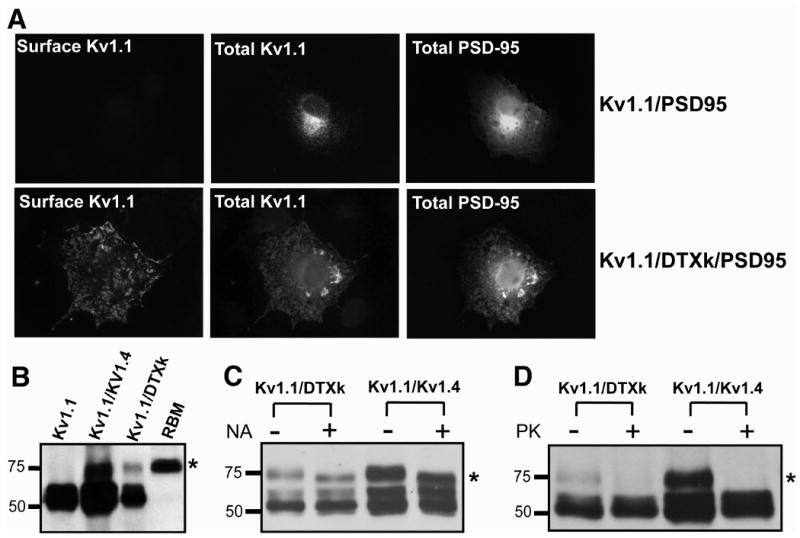
A, COS-1 cells were transfected with Kv1.1, pSECTAG2 and PSD-95 (1:4:1 cDNA ratio) (upper) or Kv1.1, DTXk, and PSD-95 (1:4:1 cDNA ratio) (lower). Left panel, surface expression was assayed by surface immunofluorescence. Middle and right panels, total cellular Kv1.1 and PSD95 staining. B, COS-1 cells were transfected with Kv1.1 and pSECTAG2 (“Kv1.1”), Kv1.4 or DTXk at 1:4 cDNA ratios as indicated. Cell lysates were analyzed by SDS-PAGE and immunoblotting for Kv1.1. * indicates Kv1.1 α subunits with increased Mr due to processing of oligosaccharide chains subsequent to ER export. RBM, rat brain membranes. C, Lysates prepared from COS-1 cells cotransfected with Kv1.1/DTXk or Kv1.1/Kv1.4 at 1:4 cDNA ratio were treated with neuraminidase (sialidase) (+) or buffer alone (-) and analyzed by SDS-PAGE and immunoblotting for Kv1.1. * indicates sialidase-sensitive population. D, COS-1 cells cotransfected with Kv1.1/DTXk or Kv1.1/Kv1.4 at 1:4 cDNA ratio were treated with Proteinase K (+) or buffer alone (-). Cell lysates were analyzed by SDS-PAGE and immunoblotting for Kv1.1. * Proteinase K-sensitive population.
Figure 3
Figure 3. DTXk affect Kv1.1 trafficking properties by directly binding to Kv1.1 channels
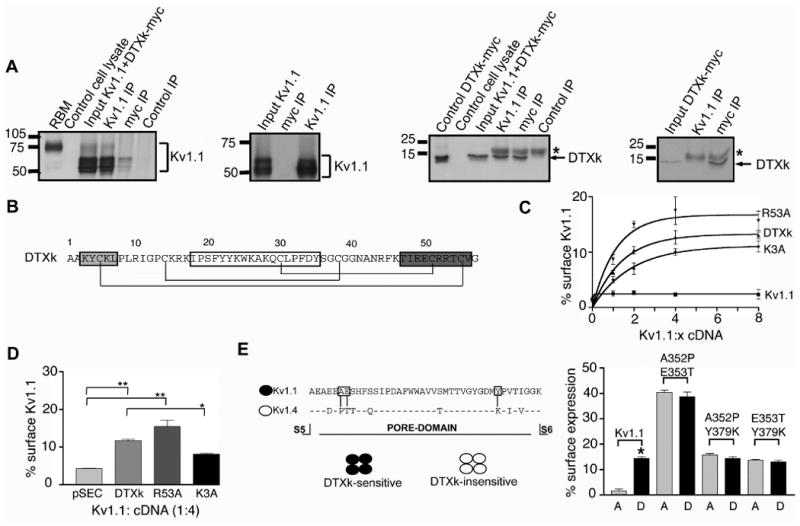
A, Coimmunoprecipitation (IP) experiments performed on COS-1 cell lysates expressing Kv1.1/DTXk-myc (1:4 cDNA ratios) using anti-Kv1.1, anti-myc, and isotype-matched control mouse monoclonal antibodies. “Control cell lysate” corresponds to a cell lysate from untransfected COS-1 cells. Control DTXk-myc was obtained from COS-1 cell lysates singly transfected with DTXk-myc. Middle right and far right panels show specificities of anti-Kv1.1 and anti-myc antibody immunoprecipitations against lysates from COS cells singly transfected with Kv1.1 or DTXk-myc. The bracket and the arrow indicate the position of Kv1.1 and DTXk-myc, respectively. * indicates the mouse IgG light chain band. Input and IP lanes are not normalized. B, Amino acid sequence of DTXk. The secondary structural elements and the cystine bonds are diagrammed with boxes representing: light grey: 310-helix; transparent: β-hairpin; dark grey: α-helix. C, Dose-response curves of surface Kv1.1 in presence of increased amount of pSECTAG (“Kv1.1”), DTXk, or the K3A and R53A point mutants in COS-1 cells, and surface expression quantified by surface immunofluorescence staining. D, Kv1.1 surface expression efficiency when cotransfected with pSECTAG2, DTXk, or the K3A and R53A point mutants (1:4 cDNA ratios) in primary rat astrocytes. Statistical significance was determined by one-way ANOVA followed by Tukey post-test. *p<0.05, **p<0.01. E, Analysis of Kv1.1 double mutants mutated in the three residues (A352P, E353T and Y379K) critical for DTX binding. Left panel, sequence alignment of P-domain sequences of Kv1.1 and Kv1.4 subunits. The crucial residues for DTX sensitivity are outlined with boxes. Right panel, surface expression of Kv1.1 and double mutants cotransfected in COS-1 cells with pSECTAG2 (A) or DTXk (D) at 1:4 cDNA ratios.
Figure 4
Figure 4. DTXk enhances the surface expression of functional Kv1.1 channels in COS-1 cells
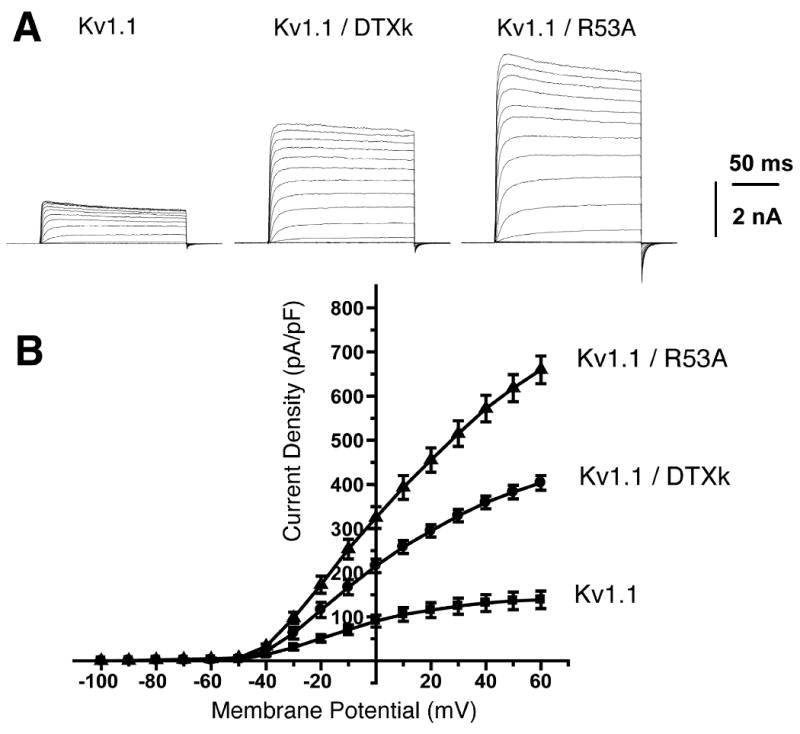
A, Representative whole-cell voltage-clamp recordings of Kv1.1 currents from COS-1 cells transiently expressing Kv1.1 with pSECTAG2 (“Kv1.1”) or with DTXk (ratio 1:4) or DTXk-R53A (ratio 1:2). The cells were held at −100 mV and step depolarized to +60 mV for 200 msec with +10 mV increments. B, Current-voltage relationship of Kv1.1 currents obtained from experiments as in panel A. Peak current amplitudes at each test-potential were divided by the cell capacitance to obtain the current densities. Mean ± SE of current densities obtained (n = 7 each) were plotted against each test potential.

References

    1. Hille B. Ionic channels of excitable membranes. Sinauer; Sunderland, MA: 2001.
    1. Manganas LN, Akhtar S, Antonucci DE, Campomanes CR, Dolly JO, Trimmer JS. Episodic ataxia type-1 mutations in the Kv1.1 potassium channel display distinct folding and intracellular trafficking properties. J Biol Chem. 2001;276:49427–49434. - PubMed
    1. Coetzee WA, Amarillo Y, Chiu J, Chow A, Lau D, McCormack T, Moreno H, Nadal MS, Ozaita A, Pountney D, Saganich M, Vega-Saenz de Miera E, Rudy B. Molecular diversity of K+ channels. In: Rudy B, Seeburg P, editors. Molecular and functional diversity of ion channels and receptors. Vol. 868. 1999. pp. 233–285. - PubMed
    2. Ann N Y Acad Sci
    1. Smart SL, Lopantsev V, Zhang CL, Robbins CA, Wang H, Chiu SY, Schwartzkroin PA, Messing A, Tempel BL. Deletion of the K(V)1.1 potassium channel causes epilepsy in mice. Neuron. 1998;20:809–819. - PubMed
    1. Rettig J, Heinemann SH, Wunder F, Lorra C, Parcej DN, Dolly JO, Pongs O. Inactivation properties of voltage-gated K+ channels altered by presence of beta-subunit. Nature. 1994;369:289–294. - PubMed

Publication types