


doi: 10.1086/510020.
Epub 2006 Nov 2.
Ribosomal protein S24 gene is mutated in Diamond-Blackfan anemia
Affiliations
- PMID: 17186470
- PMCID: PMC1698708
- DOI: 10.1086/510020
Item in Clipboard
Ribosomal protein S24 gene is mutated in Diamond-Blackfan anemia
Am J Hum Genet.
2006 Dec.
Abstract
Diamond-Blackfan anemia (DBA) is a rare congenital red-cell aplasia characterized by anemia, bone-marrow erythroblastopenia, and congenital anomalies and is associated with heterozygous mutations in the ribosomal protein (RP) S19 gene (RPS19) in approximately 25% of probands. We report identification of de novo nonsense and splice-site mutations in another RP, RPS24 (encoded by RPS24 [10q22-q23]) in approximately 2% of RPS19 mutation-negative probands. This finding strongly suggests that DBA is a disorder of ribosome synthesis and that mutations in other RP or associated genes that lead to disrupted ribosomal biogenesis and/or function may also cause DBA.
Figures
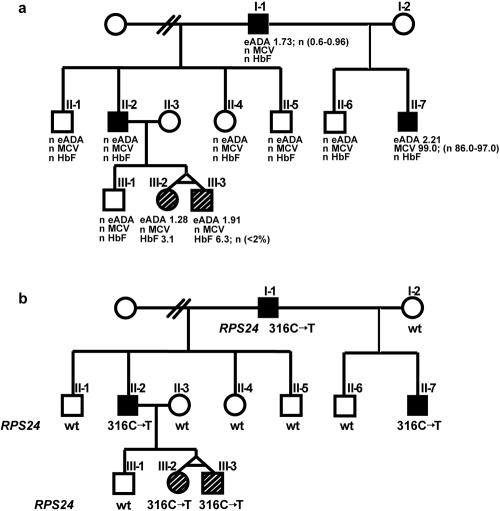
Phenotype and genotype cosegregation in family MA-1. Squares represent males, circles represent females, blackened symbols represent clinically affected individuals who presented with severe anemia (I-1 and II-7 depend on small steroid doses, and II-2 has been in steroid-induced remission since childhood and presented with webbed neck), open symbols represent unaffected individuals, and line-shaded symbols represent clinically unaffected individuals with abnormal laboratory tests, such as elevated eADA and HbF. a, Phenotype of family MA-1. n = Normal range. b, Genotype of family MA-1. Nonsense mutation c.316C→T (Gln106STOP) was found in clinically affected individuals I-1, II-2, and II-7 and in two apparently healthy individuals, III-2 and III-3, with elevated eADA and HbF. wt = Wild type.
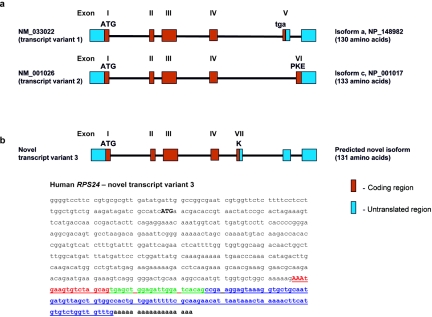
Structure of human RPS24 gene. a, Schema of the two variants of human RPS24, NCBI accession numbers NM_033022 (variant 1) and NM_001026 (variant 2), as a result of alternative 3′-end mRNA splicing. Variant 1 contains exons I–V and encodes RPS24 isoform a (130 aa) (NP_148982). Exon V encodes the stop codon (tga). Variant 2 contains exons I–IV and VI and encodes RPS24 isoform c (133 aa) (NP_001017). Exon VI encodes 3 aa, PKE. b, Schema of the novel human RPS24 variant 3, which contains exons I–IV and VII and encodes the 131-aa RPS24 isoform (isoform b). Below it is the sequence of the novel human RPS24 transcript variant 3. The ATG in bold uppercase letters represents the start codon. Alternatively spliced 3′ end of transcript variant 3 encodes Lys (AAA [red uppercase letters]) followed by stop codon tga. Red lowercase letters represent the untranslated region of exon VII, green letters represent untranslated exon V, and blue letters represent untranslated exon VI of the novel RPS24 transcript variant 3.
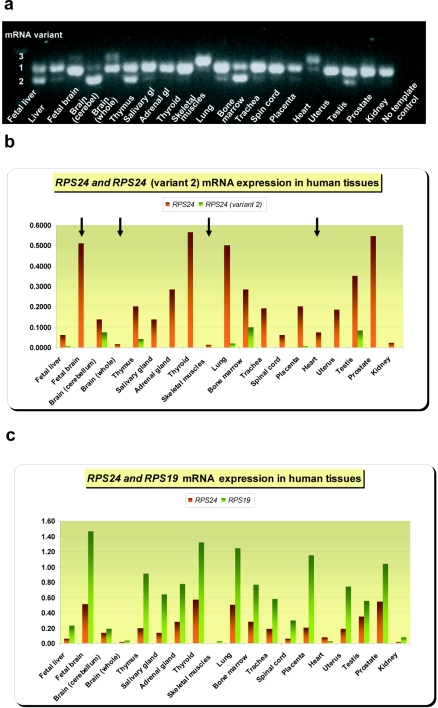
Expression of RPS24 mRNA in normal human tissues. a, RPS24 RT-PCR products from 20 human tissues visualized on a 1.3% agarose gel. Novel variant 3 is present in fetal brain, adult brain, heart, and skeletal muscle. gl = Gland. b, Tissue-specific expression of variant 2 and total RPS24 mRNA in human tissues, measured by qrt-PCR. Four arrows indicate four tissues where no variant 2 mRNA was detected. c, Tissue-specific expression of total RPS24 and RPS19 mRNA. (All results of qrt-PCR are normalized to reference gene GAPDH.)
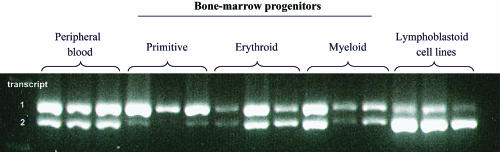
Differently spliced mRNA variants of RPS24 in human hematological tissues. The three bone-marrow cell populations, primitive (CD34+CD71−CD45RA−), erythroid (CD34+CD71+CD45RA−), and myeloid (CD34+CD71−CD45RA+) progenitors, and peripheral blood and lymphoblastoid cell lines express variants 1 and 2, which encode isoforms a and c, in different proportions. There is increasing expression of variant 2 with maturation of hematological cells. RNA samples were obtained from three unrelated controls.
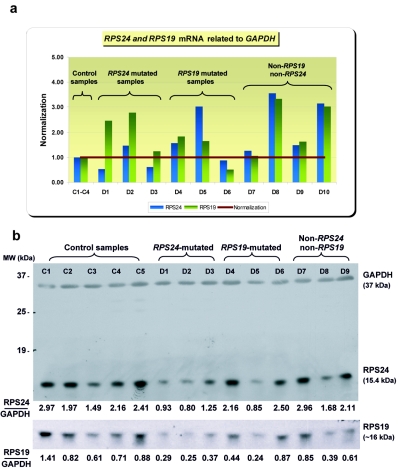
Expression of RPS24 mRNA and RPS24 protein in control and diseased lymphoblastoid cell lines. (All results of qrt-PCR are normalized to reference gene GAPDH.) a, RPS24 and RPS19 mRNA expression in control and diseased lymphoblastoid cell lines. b, RPS24 and RPS19 protein expression in control and diseased lymphoblastoid cell lines. Quantification of the RPS24 and RPS19 protein levels normalized to GAPDH was performed with the Quantity One version 4.2.1 software (Bio-Rad Laboratories) on Image Station 440 (Kodak DS). C1–C4 are control samples; D1–D9 are diseased samples. MW = molecular weight.
References
Web Resources
-
- NCBI Entrez, http://www.ncbi.nlm.nih.gov/gquery/gquery.fcgi (for RPS24 genomic [accession number NC_000010.9], cDNA [accession numbers NM_001026 and NM_033022], human RPS24 protein [accession numbers NP_001017 and NP_148982], and murine Rps24 protein [accession number NP_207635] sequences)
-
- Online Mendelian Inheritance in Man (OMIM), http://www.ncbi.nlm.nih.gov/Omim/ (for DBA) - PubMed
References
-
- Alter BP, Young NS (1998) The bone marrow failure syndromes. In: Nathan DG, Orkin HS (eds) Hematology of infancy and childhood. Vol 1. Saunders, Philadelphia, pp 237–335
-
- Willig TN, Niemeyer CM, Leblanc T, Tiemann C, Robert A, Budde J, Lambiliotte A, Kohne E, Souillet G, Eber S, Stephan JL, Girot R, Bordigoni P, Cornu G, Blanche S, Guillard JM, Mohandas N, Tchernia G (1999) Identification of new prognosis factors from the clinical and epidemiologic analysis of a registry of 229 Diamond-Blackfan anemia patients: DBA group of Societe d’Hematologie et d’Immunologie Pediatrique (SHIP), Gesellshaft fur Padiatrische Onkologie und Hamatologie (GPOH), and the European Society for Pediatric Hematology and Immunology (ESPHI). Pediatr Res 46:553–561 - PubMed
Publication types
MeSH terms
Substances
Grants and funding
LinkOut - more resources
Full Text Sources
Other Literature Sources
Medical
Molecular Biology Databases
Miscellaneous
