


Mammal diversity and infection prevalence in the maintenance of enzootic Borrelia burgdorferi along the western Coastal Plains of Maryland
- PMID: 17187577
- PMCID: PMC4128254
- DOI: 10.1089/vbz.2006.6.411
Mammal diversity and infection prevalence in the maintenance of enzootic Borrelia burgdorferi along the western Coastal Plains of Maryland
Abstract
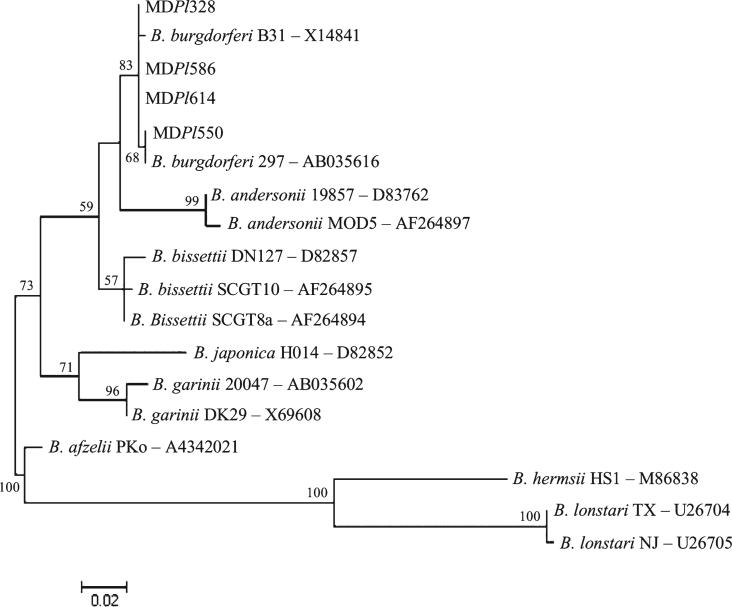
The primary vector of Borrelia burgdorferi in North America, Ixodes scapularis, feeds on various mammalian, avian, and reptilian hosts. Several small mammal hosts; Peromyscus leucopus, Tamias striatus, Microtus pennsylvanicus, and Blarina spp. can serve as reservoirs in an enzootic cycle of Lyme disease. The primary reservoir in the northeast United States is the white-footed mouse, P. leucopus. The infection prevalence of this reservoir as well as the roles of potential secondary reservoirs has not been established in southern Maryland, a region of low to moderate Borrelia infection in humans. Intensive trapping at 96 locations throughout the western Coastal Plains of Maryland was conducted and we found that 31.6% of P. leucopus were infected with B. burgdorferi. Sequence and phylogenetic analysis revealed that only B. burgdorferi sensu stricto circulated in southern Maryland. Feral house mice and voles also were infected and may serve as secondary hosts. Peromyscus gender, age and month of capture were significantly associated with infection status. Larval I. scapularis were the dominant ectoparasite collected from captured rodents even though host seeking A. americanum and D. variabilis were collected in greater numbers across the sampling region. Our findings illustrate that the enzootic cycle of LD is maintained in the western Coastal Plains region of southern Maryland between I. scapularis and P. leucopus as the dominant reservoir.
Figures

References
-
- Altschul SF, Gish W, Miller W, et al. Basic local alignment search tool. J Mol Biol. 1990;215:403–410. - PubMed
-
- Amerasinghe FP, Breisch NL, Azad AF, et al. Distribution, density, and Lyme disease spirochete infection in Ixodes dammini (Acari: Ixodidae) on white tailed deer in Maryland. J Med Entomol. 1992;29:54–61. - PubMed
-
- Amerasinghe FP, Breisch NL, Neidhardt K, et al. Increasing density and Borrelia burgdorferi infection of deer-infesting Ixodes dammini (Acari: Ixodidae) in Maryland. J Med Entomol. 1993;30:858–864. - PubMed
Publication types
MeSH terms
Substances
Grants and funding
LinkOut - more resources
Full Text Sources
Medical
Research Materials
Miscellaneous
