. 2007 Jan 2;104(1):87-92.
doi: 10.1073/pnas.0607919104. Epub 2006 Dec 26.

Multiple-motor based transport and its regulation by Tau

Affiliations

Multiple-motor based transport and its regulation by Tau

Michael Vershinin et al. Proc Natl Acad Sci U S A. .

Abstract

Motor-based intracellular transport and its regulation are crucial to the functioning of a cell. Disruption of transport is linked to Alzheimer's and other neurodegenerative diseases. However, many fundamental aspects of transport are poorly understood. An important issue is how cells achieve and regulate efficient long-distance transport. Mounting evidence suggests that many in vivo cargoes are transported along microtubules by more than one motor, but we do not know how multiple motors work together or can be regulated. Here we first show that multiple kinesin motors, working in conjunction, can achieve very long distance transport and apply significantly larger forces without the need of additional factors. We then demonstrate in vitro that the important microtubule-associated protein, tau, regulates the number of engaged kinesin motors per cargo via its local concentration on microtubules. This function of tau provides a previously unappreciated mechanism to regulate transport. By reducing motor reattachment rates, tau affects cargo travel distance, motive force, and cargo dispersal. We also show that different isoforms of tau, at concentrations similar to those in cells, have dramatically different potency. These results provide a well defined mechanism for how altered tau isoform levels could impair transport and thereby lead to neurodegeneration without the need of any other pathway.


Conflict of interest statement

The authors declare no conflict of interest.

Figures
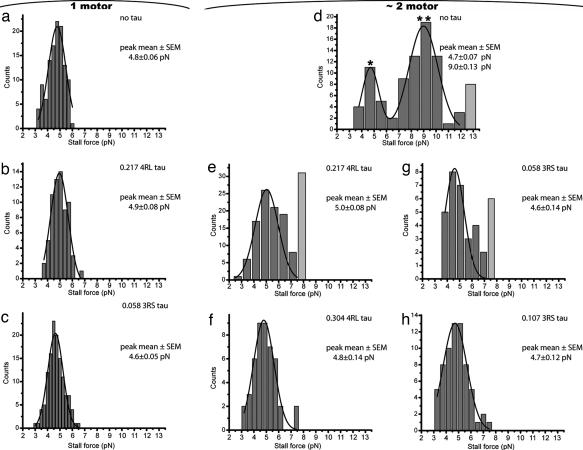
Fig. 1.
Fig. 1.
Changes in the number of engaged motors are revealed by the analysis of stall forces. Comparison of single motor no tau baseline case (a) with single motor assays with moderate amounts of 4RL (b) or 3RS (c) tau shows that tau does not affect the amount of force a single motor can produce against external load. Note that as tau is added to the assay, increased numbers of binding attempts are required to observe one stall event (serving as an effective experimental limitation for further increases in tau concentration). In contrast to the single-motor case (ac), stall forces in the ≈2 motor assay are strongly affected by tau. The bare MT assay (d) shows contributions from both single motor (*) and 2 motor events (**), with rare contributions from 3 or more motor events (gray bar). Comparing the bare MT assay (d) with assays featuring progressively higher 4RL (e and f) and 3RS (g and h) tau concentrations reveals that the frequency of two-motor stall events is gradually suppressed. The high-force (>7.0 pN) events account for 72.7% of the total in the no tau case (d), but the percentage is significantly reduced in e and g (28.7% and 20.0% respectively). The solid lines are fits to Gaussian form (the peak locations are reported in each subplot). The molar ratio of tau to tubulin dimer as well as the isoform of tau used are shown, as appropriate.
Fig. 2.
Fig. 2.
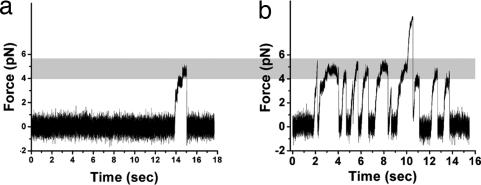
Binding events provide information on the motor density and motor force contributions for typical assay cargos. (a) Some beads incubated with low concentration of kinesin are able to bind MT. One can detect such binding events by monitoring the bead in an optical trap for systematic displacements from the center of the trap. The binding events are rare (0.15 ± 0.06 events per second; mean ± STD; seven beads) and do not reveal force production in excess of the range of forces observed for single kinesin motors (Fig. 1a). (b) On the other hand, beads incubated with higher concentrations of kinesin show increasing rate of binding events and an increasing number of those events shows very high corresponding forces (up to ≈10 pN). For example for the specific assay shown in b the binding events rate was 0.38 ± 0.25 events per second (mean ± STD; 20 beads). The overlap between the broad range of rates in b and a more narrow range in a is qualitatively consistent with the expectation that some beads incubated with higher concentrations of kinesin still only have one active kinesin on their surface.
Fig. 3.
Fig. 3.
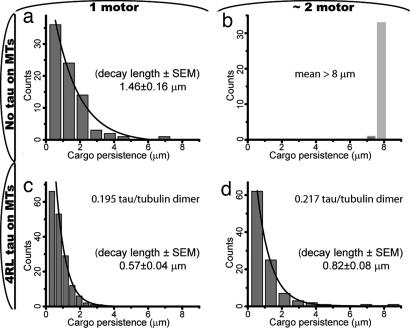
How far cargos typically travel critically depends on the number of participating motors. The single-motor assay, as expected, shows exponentially distributed cargo travel distances (a), but the beads in a ≈2 motor assay consistently traveled beyond the edge of our field of view (>8 μm) (b). The fact that the ≈2 motor assay shows more robust transport (compared with single motor case) is not in itself surprising (5). However, the amount of transport improvement is remarkable: adding (on average) just one extra motor increases cargo run lengths by at least one order of magnitude. A similar effect is seen for smaller beads incubated with the same kinesin/bead molar ratio as in b, suggesting that the transport enhancement is relevant to cargos of a wide range of sizes, including many cellular cargos (see SI Movie 3). Thus, two motors appear to be the minimum configuration sufficient for robust MT-based transport on biologically relevant length scales. When MTs are covered with a high concentration of tau (c and d), cargo travel is consistently reduced compared with the no tau baseline. A small but significant reduction is observed for a single motor assay (c); however, the most drastic change is seen for the ≈2 motor assay: here tau is seen to reduce robust long-distance transport (b) to submicron length scale (d), a >10-fold decrease in travel distance. Solid lines show exponential fits (the decay length is reported in each subplot, where appropriate).
Fig. 4.
Fig. 4.
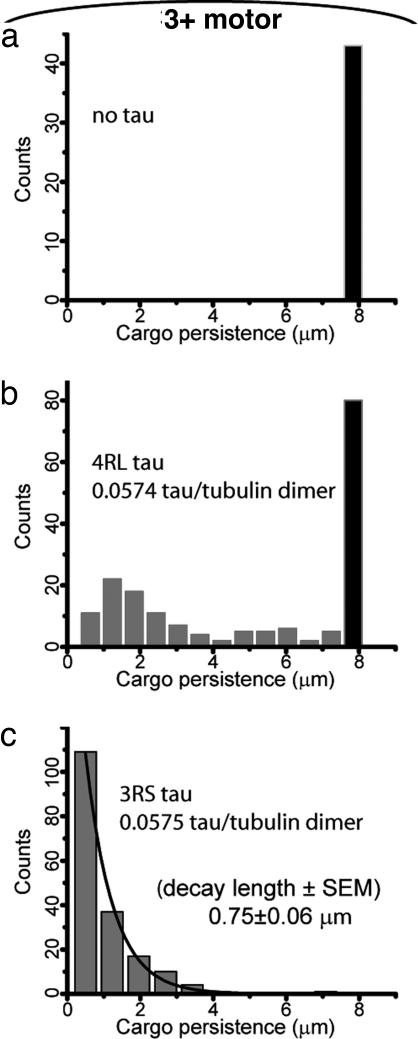
Different tau isoforms have drastically different effect on transport at tau levels similar to those in cells. Transport of beads in a 3+ motor assay is very robust on bare MTs (a), so beads in this assay never detached before escaping the field of view of our microscope (represented by the black bar on the right). Adding 4RL tau somewhat reduced cargo travel distances (b); however close to half of the beads (46%) still exceeded 8 μm of travel. A parallel assay with the same concentration of 3RS tau reveals just how much more potent this isoform is at regulating transport: the distribution of cargo travel lengths here (c) can be fit with a single exponential decay with a sub-micrometer decay constant (solid line shows a fit to a single exponential decay). Mean travel here is decreased at least 10-fold in comparison to travel on bare MTs (a).
Fig. 5.
Fig. 5.
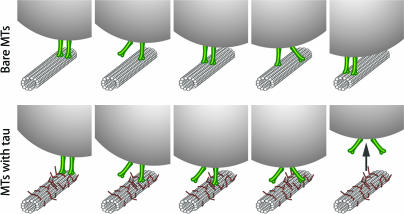
A model of multiple-motor driven cargo transport. Here we model a two-motor arrangement, the simplest case of multiple motor transport. Higher numbers of motors will not alter the qualitative picture presented below. Note that the actual number of participating motors is not resolved in our experiments for each binding event and for each bead. Rather, we determine the frequency of one, two, and more motor events in a statistical sense for a given bead assay. Without tau (top row sequence), motors frequently detach and reattach; however, at least one motor always tethers the cargo to the MT. In the presence of tau (lower row sequence), rebinding is suppressed. Therefore, once the first motor disengages from the MT, it is unlikely to reattach before the second motor also detaches. The bead then ceases its processive motion and diffuses away (arrow). One important net result of this tau effect is reduced cargo travel distances. Notice also that, by blocking rebinding, tau reduces the number of motors that on average drive the cargo. Therefore, tau is also expected (and indeed observed) to reduce the total force that the motors can apply to move the cargo. Likewise, tau is expected to reduce the force needed to detach the cargoes from MTs, an effect that is indeed observed in our pull-off experiments.

References

    1. Ashkin A, Schutze K, Dziedzic JM, Euteneuer U, Schliwa M. Nature. 1990;348:346–348. - PubMed
    1. Welte MA, Gross SP, Postner M, Block SM, Wieschaus EF. Cell. 1998;92:547–557. - PubMed
    1. Levi V, Serpinskaya AS, Gratton E, Gelfand V. Biophys J. 2006;90:318–327. - PMC - PubMed
    1. Howard J, Hudspeth AJ, Vale RD. Nature. 1989;342:154–158. - PubMed
    1. Block SM, Goldstein LS, Schnapp BJ. Nature. 1990;348:348–352. - PubMed

Publication types

LinkOut - more resources