


N-formylation of lysine in histone proteins as a secondary modification arising from oxidative DNA damage
- PMID: 17190813
- PMCID: PMC1765477
- DOI: 10.1073/pnas.0606775103
N-formylation of lysine in histone proteins as a secondary modification arising from oxidative DNA damage
Abstract
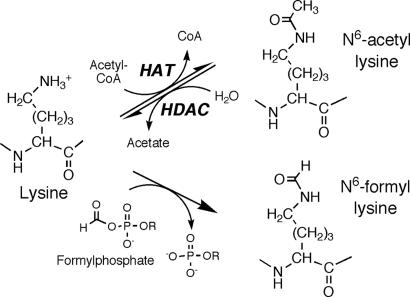
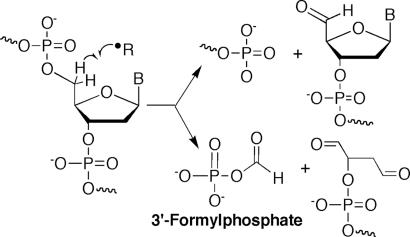
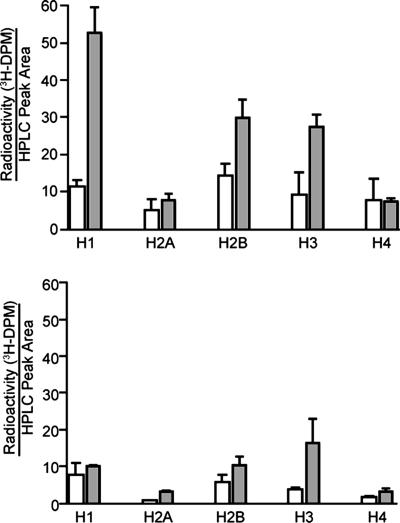
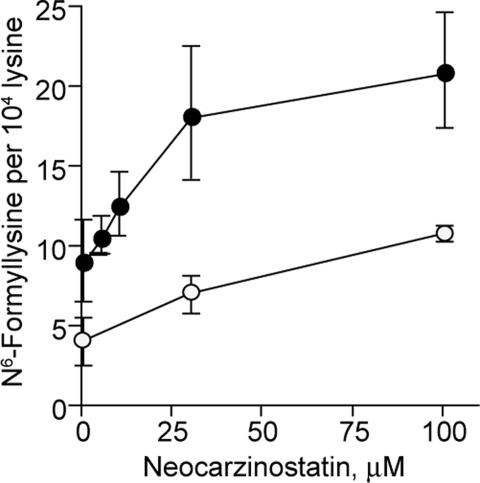
The posttranslational modification of histone and other chromatin proteins has a well recognized but poorly defined role in the physiology of gene expression. With implications for interfering with these epigenetic mechanisms, we now report the existence of a relatively abundant secondary modification of chromatin proteins, the N(6)-formylation of lysine that appears to be uniquely associated with histone and other nuclear proteins. Using both radiolabeling and sensitive bioanalytical methods, we demonstrate that the formyl moiety of 3'-formylphosphate residues arising from 5'-oxidation of deoxyribose in DNA, caused by the enediyne neocarzinostatin, for example, acylate the N(6)-amino groups of lysine side chains. A liquid chromatography (LC)-tandem mass spectrometry (MS) method was developed to quantify the resulting N(6)-formyl-lysine residues, which were observed to be present in unperturbed cells and all sources of histone proteins to the extent of 0.04-0.1% of all lysines in acid-soluble chromatin proteins including histones. Cells treated with neocarzinostatin showed a clear dose-response relationship for the formation of N(6)-formyl-lysine, with this nucleosome linker-selective DNA-cleaving agent causing selective N(6)-formylation of the linker histone H1. The N(6)-formyl-lysine residue appears to represent an endogenous histone secondary modification, one that bears chemical similarity to lysine N(6)-acetylation recognized as an important determinant of gene expression in mammalian cells. The N(6)-formyl modification of lysine may interfere with the signaling functions of lysine acetylation and methylation and thus contribute to the pathophysiology of oxidative and nitrosative stress.
Conflict of interest statement
The authors declare no conflict of interest.
Figures
References
-
- Strahl BD, Briggs SD, Brame CJ, Caldwell JA, Koh SS, Ma H, Cook RG, Shabanowitz J, Hunt DF, Stallcup MR, Allis CD. Curr Biol. 2001;11:996–1000. - PubMed
-
- Martin C, Zhang Y. Nat Rev Mol Cell Biol. 2005;6:838–849. - PubMed
-
- Wang Y, Fischle W, Cheung W, Jacobs S, Khorasanizadeh S, Allis CD. Novartis Found Symp. 2004;259:3–17. - PubMed
-
- Carbone DL, Doorn JA, Kiebler Z, Petersen DR. Chem Res Toxicol. 2005;18:1324–1331. - PubMed
Publication types
MeSH terms
Substances
Grants and funding
LinkOut - more resources
Full Text Sources
Other Literature Sources
