


Herbivore-initiated interaction cascades and their modulation by productivity in an African savanna
- PMID: 17190823
- PMCID: PMC1765433
- DOI: 10.1073/pnas.0609840104
Herbivore-initiated interaction cascades and their modulation by productivity in an African savanna
Abstract
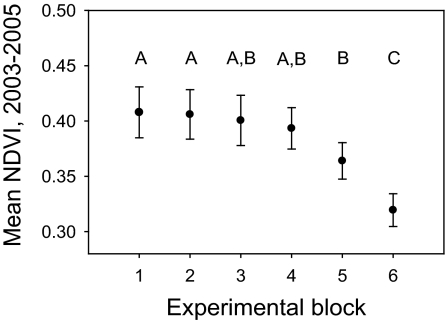
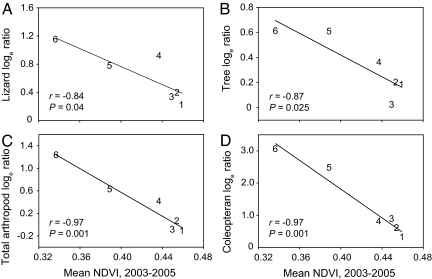
Despite conceptual recognition that indirect effects initiated by large herbivores are likely to have profound impacts on ecological community structure and function, the existing literature on indirect effects focuses largely on the role of predators. As a result, we know neither the frequency and extent of herbivore-initiated indirect effects nor the mechanisms that regulate their strength. We examined the effects of ungulates on taxa (plants, arthropods, and an insectivorous lizard) representing several trophic levels, using a series of large, long-term, ungulate-exclusion plots that span a landscape-scale productivity gradient in an African savanna. At each of six sites, lizards, trees, and the numerically dominant order of arthropods (Coleoptera) were more abundant in the absence of ungulates. The effect of ungulates on arthropods was mediated by herbaceous vegetation cover. The effect on lizards was simultaneously mediated by both tree density (lizard microhabitat) and arthropod abundance (lizard food). The magnitudes of the experimental effects on all response variables (trees, arthropods, and lizards) were negatively correlated with two distinct measures of primary productivity. These results demonstrate strong cascading effects of ungulates, both trophic and nontrophic, and support the hypothesis that productivity regulates the strength of these effects. Hence, the strongest indirect effects (and thus, the greatest risks to ecosystem integrity after large mammals are extirpated) are likely to occur in low-productivity habitats.
Conflict of interest statement
The authors declare no conflict of interest.
Figures
Comment in
-
Ungulate herbivory: indirect effects cascade into the treetops.Proc Natl Acad Sci U S A. 2007 Jan 2;104(1):5-6. doi: 10.1073/pnas.0610198103. Epub 2006 Dec 26. Proc Natl Acad Sci U S A. 2007. PMID: 17190822 Free PMC article. No abstract available.
References
-
- Hairston NG, Smith FE, Slobodkin LB. Am Nat. 1960;94:421–425.
-
- Paine RT. Am Nat. 1966;100:65–75.
-
- Paine RT. Am Nat. 1969;103:91–93.
-
- Paine RT. J Anim Ecol. 1980;49:667–685.
-
- Abrams PA, Menge BA, Mittelbach GG, Spiller DA, Yodzis P. In: Food Webs: Integration of Patterns and Dynamics. Polis GA, Winemiller KO, editors. New York: Chapman & Hall; 1996. pp. 371–395.
Publication types
MeSH terms
LinkOut - more resources
Full Text Sources
Other Literature Sources
Research Materials
