. 2007 Jan 22;204(1):17-23.
doi: 10.1084/jem.20062131. Epub 2006 Dec 26.

DNA polymerase eta is the sole contributor of A/T modifications during immunoglobulin gene hypermutation in the mouse

Affiliations

DNA polymerase eta is the sole contributor of A/T modifications during immunoglobulin gene hypermutation in the mouse

Frédéric Delbos et al. J Exp Med. .

Abstract

Mutations at A/T bases within immunoglobulin genes have been shown to be generated by a repair pathway involving the DNA-binding moiety of the mismatch repair complex constituted by the MSH2-MSH6 proteins, together with DNA polymerase eta (pol eta). However, residual A/T mutagenesis is still observed upon inactivation in the mouse of each of these factors, suggesting that the panel of activities involved might be more complex. We reported previously (Delbos, F., A. De Smet, A. Faili, S. Aoufouchi, J.-C. Weill, and C.-A. Reynaud. 2005. J. Exp. Med. 201:1191-1196) that residual A/T mutagenesis in pol eta-deficient mice was likely contributed by another enzyme not normally involved in hypermutation, DNA polymerase kappa, which is mobilized in the absence of the normal polymerase partner. We report the complete absence of A/T mutations in MSH2-pol eta double-deficient mice, thus indicating that the residual A/T mutagenesis in MSH2-deficient mice is contributed by pol eta, now recruited by uracil N-glycosylase, the second DNA repair pathway involved in hypermutation. We propose that this particular recruitment of pol eta corresponds to a profound modification of the function of uracil glycosylase in the absence of the mismatch repair complex, suggesting that MSH2-MSH6 actively prevent uracil glycosylase from error-free repair during hypermutation. pol eta thus appears to be the sole contributor of A/T mutations in the normal physiological context.


Figures
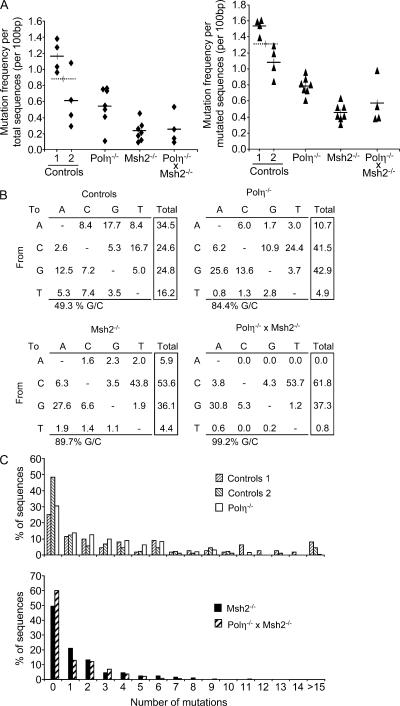
Figure 1.
Figure 1.
Analysis of mutations in rearranged JH4 intronic sequences isolated from Peyer's patches of controls and pol η–, MSH2- and pol η–MSH2–deficient mice. (A) Average mutation frequency per individual mouse, expressed relative to total sequences (left) or to mutated sequences (right). The mean values are represented by a horizontal bar. Controls (2) represent wild-type littermates of the Polh heterozygous breedings, whereas controls (1) come from a different module from the same animal facility (the dotted bar is the mean between the two sets of controls). These mean values differ slightly from the ones listed in Table I, which represent the average mutation frequency of pooled sequences. (B) Pattern of nucleotide substitution in the four different genotypes of mice. Values are expressed as the percentage of total mutations after correction for base composition. (C) Accumulation of mutations in individual JH4 intronic sequences. The number of sequences harboring a defined number of mutations relative to the total number of sequences is represented. MSH2-proficient (top) and MSH2-deficient (bottom) backgrounds are shown. All mutations are listed along the JH4 intronic sequence in Fig. S2, available at http://www.jem.org/cgi/content/full/jem.20062131/DC1.
Figure 2.
Figure 2.
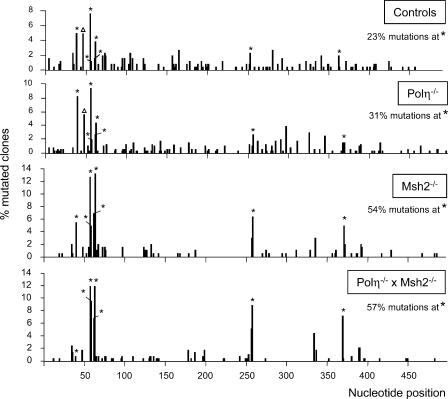
Hotspot clustering of mutations in MSH2-deficient backgrounds. The distribution of mutations at G/C bases along the JH4 intronic sequence is represented for the four different genetic backgrounds analyzed. The percentage of total mutations represented by the seven major hotspots observed in the Msh2−/− background (defined arbitrarily as a position mutated in 5% or more of sequences) is calculated for each genotype (marked by asterisks). These seven mutation hotspots occur in the following sequence context (described in their 5′ to 3′ order along the JH4 sequence, with the mutated base underlined and the position of the first base of the motif numbered from the JH4 intronic border): TGTT (position 38), AGCA (position 55), TGCA (position 60), TGCT (position 251), and AGCA (position 362). One hotspot marked with an open triangle (AGTT, at position 46) is restricted to the MSH2-proficient background.
Figure 3.
Figure 3.
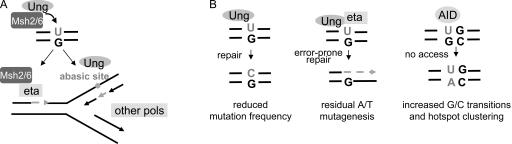
Impact of the MSH2–MSH6 complex on UNG activity during Ig gene hypermutation. (A) A simplified scheme of hypermutation. UNG would be prevented from performing error-free repair in the presence of MSH2–MSH6 and would generate mainly abasic sites upon uracil recognition. These DNA lesions would be copied by a set of translesional DNA polymerases (among which are Rev1, Rev3, and possibly pol θ [references –40], albeit the contribution of this latter enzyme was recently shown to be less likely [reference 41]), acting in S phase in their function of lesion bypass. MSH2–MSH6 would recruit pol η in an error-prone short patch synthesis of the uracil-containing strand, most likely in G1 (reference 42). (B) Outline of a possible altered behavior of UNG in the absence of MSH2 and of its consequences on hypermutation in Msh2−/− mice. (left) Increase of error-free repair (resulting in a reduced mutation frequency). (middle) Recruitment of pol η for an error-prone short patch repair (residual A/T mutagenesis). (right) Inefficient displacement of AID (increase in transitions at G/C), in particular at WGCW sites (increased focusing of mutations at specific hotspot positions).

References

    1. Longo, N.S., and P.E. Lipsky. 2006. Why do B cells mutate their immunoglobulin receptors? Trends Immunol. 27:374–380. - PubMed
    1. Muramatsu, M., K. Kinoshita, S. Fagarasan, S. Yamada, Y. Shinkai, and T. Honjo. 2000. Class switch recombination and hypermutation require activation-induced cytidine deaminase (AID), a potential RNA editing enzyme. Cell. 102:553–563. - PubMed
    1. Longerich, S., U. Basu, F.W. Alt, and U. Storb. 2006. AID in somatic hypermutation and class switch recombination. Curr. Opin. Immunol. 18:164–174. - PubMed
    1. Odegard, V.H., and D.G. Schatz. 2006. Targeting of somatic hypermutation. Nat. Rev. Immunol. 6:573–583. - PubMed
    1. Reynaud, C.-A., S. Aoufouchi, A. Faili, and J.-C. Weill. 2003. What role for AID: mutator, or assembler of the immunoglobulin mutasome? Nat. Immunol. 4:631–638. - PubMed

Publication types