


Recurrence and survival predictive value of phenotypic expression of Bcl-2 varies with tumor stage of colorectal adenocarcinoma
- PMID: 17192048
- PMCID: PMC2667690
- DOI: 10.3233/cbm-2005-14-507
Recurrence and survival predictive value of phenotypic expression of Bcl-2 varies with tumor stage of colorectal adenocarcinoma
Abstract
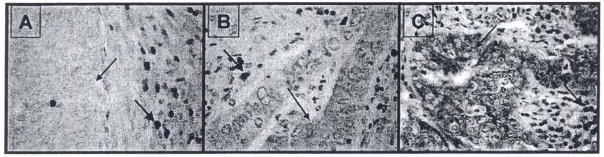
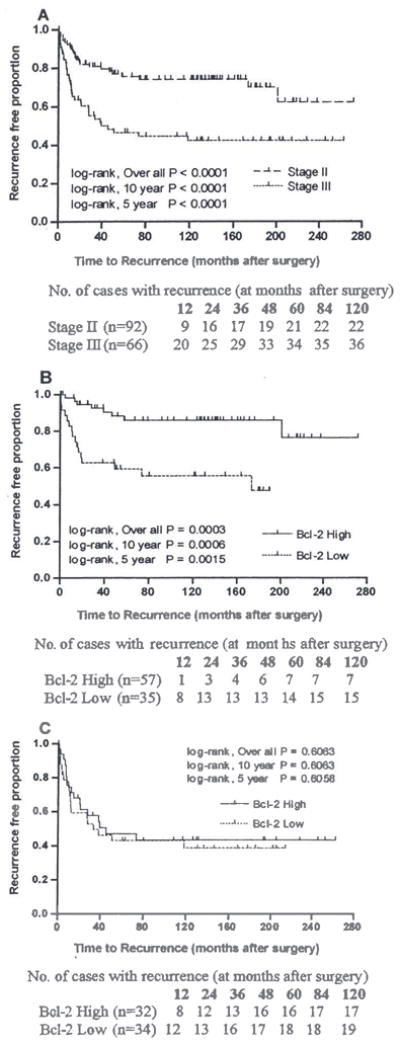
Although decreased or lack of expression of Bcl-2 has been correlated with advanced tumor stage and shortened patient survival in colorectal cancer (CRC), its value in predicting the recurrence has not been well explored. Therefore, we assessed the usefulness of phenotypic expression of Bcl-2 in non-Hispanic Caucasian patients with CRCs in identifying risk of recurrence. Archival tissues of 92 Stage II and 66 Stage III primary CRCs were evaluated for immunohistochemical expression of Bcl-2. None of these patients received either pre- or post-surgical adjuvant therapies. Kaplan-Meier and Cox proportional hazards methods were used to estimate the rates of recurrence and survival according to Bcl-2 expression. Decreased expression of Bcl-2 was associated with an increased rate of recurrence in patients with Stage II CRCs (5-year log-rank test P=0.0015; Hazard Ratio (HR)=3.90, 95%C.I.:1.55-9.77) but not with Stage III CRCs (5-year log-rank test P=0.6058; HR=1.07, 95%C.I.:0.47-2.45) after adjusting for other demographic and clinicopathological features. Furthermore, decreased expression of Bcl-2 was an indicator of short survival in patients with Stage II CRCs but not with Stage III CRCs. Thus, decreased or lack of Bcl-2 expression in primary CRCs may serve as a molecular biomarker of high risk of recurrence for Caucasian patients with Stage II CRCs. These findings might be useful in identifying biologically aggressive phenotypes of Stage II CRCs, and may aid the oncologist in designing maximally appropriate therapeutic regimens.
Figures
References
-
- American Cancer Society. Cancer facts and figures. Atlanta, GA: 2003. pp. 1–52.
-
- International Multicentre Pooled Analysis of B2 Colon Cancer Trials (IMPACT B2) Investigators. Efficacy of adjuvant fluorouracil and folinic acid in B2 colon cancer. J Clin Oncol. 1999;17(5):1356–1363. - PubMed
-
- Mamounas, Wieand, Wolmark, Bear, Atkins, Song, Jones, Rockette Comparative efficacy of adjuvant chemotherapy in patients with Dukes’ B versus Dukes’ C colon cancer: results from four National Surgical Adjuvant Breast and Bowel Project adjuvant studies (C-01, C-02, C-03, and C-04) J Clin Oncol. 1999;17(5):1349–1355. - PubMed
-
- McDonald Adjuvant therapy of colorectal cancer. CA Cancer J Clin. 1999;49:202–219. - PubMed
Publication types
MeSH terms
Substances
Grants and funding
LinkOut - more resources
Full Text Sources
Medical
