


Linkage disequilibrium of evolutionarily conserved regions in the human genome
- PMID: 17192199
- PMCID: PMC1769491
- DOI: 10.1186/1471-2164-7-326
Linkage disequilibrium of evolutionarily conserved regions in the human genome
Abstract
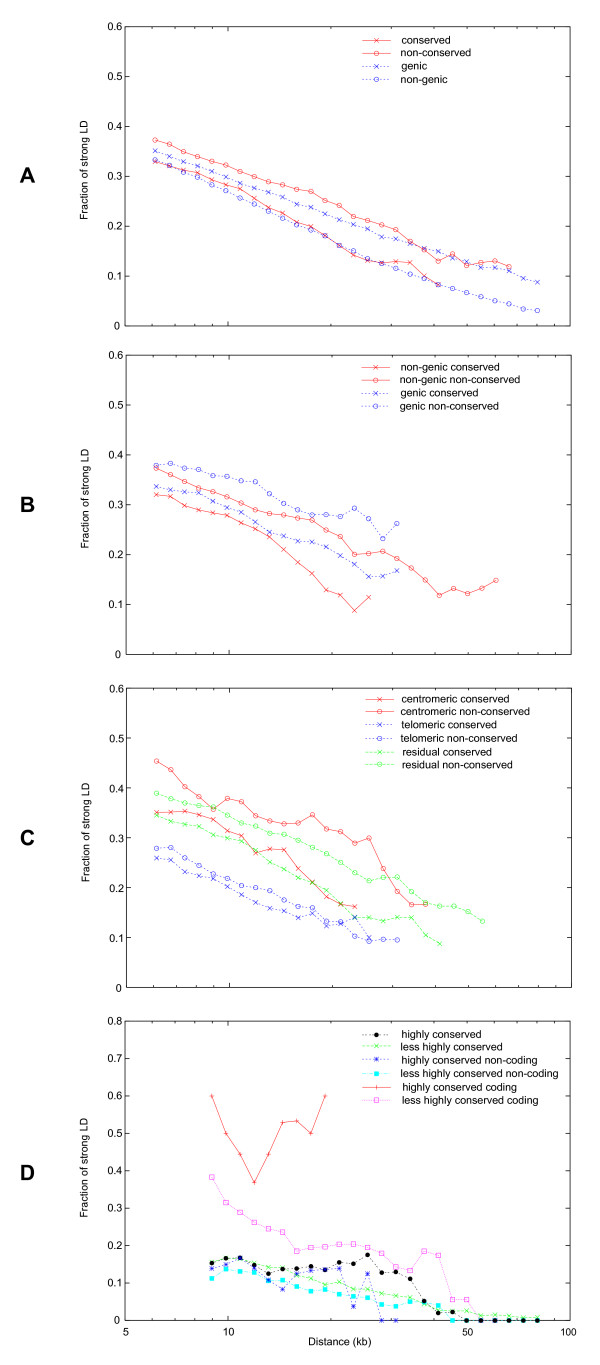
Background: The strong linkage disequilibrium (LD) recently found in genic or exonic regions of the human genome demonstrated that LD can be increased by evolutionary mechanisms that select for functionally important loci. This suggests that LD might be stronger in regions conserved among species than in non-conserved regions, since regions exposed to natural selection tend to be conserved. To assess this hypothesis, we used genome-wide polymorphism data from the HapMap project and investigated LD within DNA sequences conserved between the human and mouse genomes.
Results: Unexpectedly, we observed that LD was significantly weaker in conserved regions than in non-conserved regions. To investigate why, we examined sequence features that may distort the relationship between LD and conserved regions. We found that interspersed repeats, and not other sequence features, were associated with the weak LD tendency in conserved regions. To appropriately understand the relationship between LD and conserved regions, we removed the effect of repetitive elements and found that the high degree of sequence conservation was strongly associated with strong LD in coding regions but not with that in non-coding regions.
Conclusion: Our work demonstrates that the degree of sequence conservation does not simply increase LD as predicted by the hypothesis. Rather, it implies that purifying selection changes the polymorphic patterns of coding sequences but has little influence on the patterns of functional units such as regulatory elements present in non-coding regions, since the former are generally restricted by the constraint of maintaining a functional protein product across multiple exons while the latter may exist more as individually isolated units.
Figures
References
-
- Dawson E, Abecasis GR, Bumpstead S, Chen Y, Hunt S, Beare DM, Pabial J, Dibling T, Tinsley E, Kirby S, Carter D, Papaspyridonos M, Livingstone S, Ganske R, Lohmussaar E, Zernant J, Tonisson N, Remm M, Magi R, Puurand T, Vilo J, Kurg A, Rice K, Deloukas P, Mott R, Metspalu A, Bentley DR, Cardon LR, Dunham I. A first-generation linkage disequilibrium map of human chromosome 22. Nature. 2002;418:544–548. doi: 10.1038/nature00864. - DOI - PubMed
Publication types
MeSH terms
LinkOut - more resources
Full Text Sources
Research Materials
