TV viewing and physical activity are independently associated with metabolic risk in children: the European Youth Heart Study
- PMID: 17194189
- PMCID: PMC1705825
- DOI: 10.1371/journal.pmed.0030488
TV viewing and physical activity are independently associated with metabolic risk in children: the European Youth Heart Study
Abstract
Background: TV viewing has been linked to metabolic-risk factors in youth. However, it is unclear whether this association is independent of physical activity (PA) and obesity.
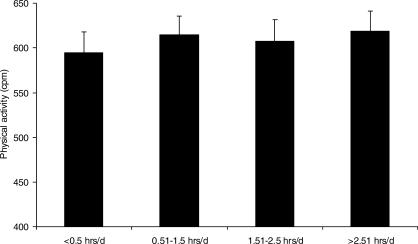
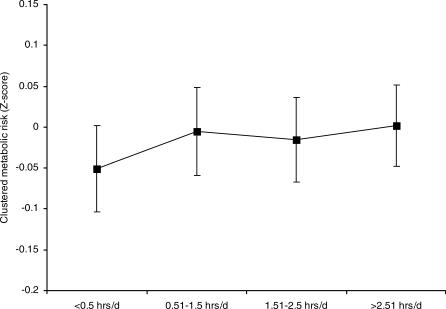
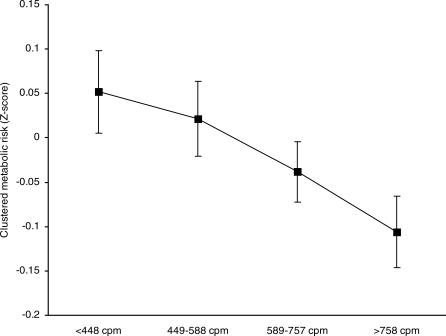
Methods and findings: We did a population-based, cross-sectional study in 9- to 10-y-old and 15- to 16-y-old boys and girls from three regions in Europe (n = 1,921). We examined the independent associations between TV viewing, PA measured by accelerometry, and metabolic-risk factors (body fatness, blood pressure, fasting triglycerides, inverted high-density lipoprotein (HDL) cholesterol, glucose, and insulin levels). Clustered metabolic risk was expressed as a continuously distributed score calculated as the average of the standardized values of the six subcomponents. There was a positive association between TV viewing and adiposity (p = 0.021). However, after adjustment for PA, gender, age group, study location, sexual maturity, smoking status, birth weight, and parental socio-economic status, the association of TV viewing with clustered metabolic risk was no longer significant (p = 0.053). PA was independently and inversely associated with systolic and diastolic blood pressure, fasting glucose, insulin (all p < 0.01), and triglycerides (p = 0.02). PA was also significantly and inversely associated with the clustered risk score (p < 0.0001), independently of obesity and other confounding factors.
Conclusions: TV viewing and PA may be separate entities and differently associated with adiposity and metabolic risk. The association between TV viewing and clustered metabolic risk is mediated by adiposity, whereas PA is associated with individual and clustered metabolic-risk indicators independently of obesity. Thus, preventive action against metabolic risk in children may need to target TV viewing and PA separately.
Conflict of interest statement
Figures
Comment in
-
TV and inactivity are separate contributors to metabolic risk factors in children.PLoS Med. 2006 Dec;3(12):e481. doi: 10.1371/journal.pmed.0030481. PLoS Med. 2006. PMID: 17194185 Free PMC article.
References
-
- Srinivasan SR, Myers L, Berenson GS. Predictability of childhood adiposity and insulin for developing insulin resistance syndrome (syndrome X) in young adulthood: The Bogalusa Heart Study. Diabetes. 2002;51:204–209. - PubMed
-
- Arslanian S, Suprasongsin C. Insulin sensitivity, lipids, and body composition in childhood: Is “syndrome X” present? J Clin Endocrinol Metab. 1996;81:1058–1062. - PubMed
-
- Bao W, Srinivasan SR, Wattigney WA, Berenson GS. Persistence of multiple cardiovascular risk clustering related to syndrome X from childhood to young adulthood. The Bogalusa Heart Study. Arch Intern Med. 1994;54:1842–1847. - PubMed
-
- Marshall SJ, Biddle SJ, Gorely T, Cameron N, Murdey I. Relationships between media use, body fatness and physical activity in children and youth: A meta-analysis. Int J Obes Relat Metab Disord. 2004;28:1238–1246. - PubMed
-
- Dietz WH, Jr, Gortmarker SL. Do we fatten our children at the television set? Obesity and television viewing in children and adolescents. Pediatrics. 1985;75:807–812. - PubMed
Publication types
MeSH terms
Grants and funding
LinkOut - more resources
Full Text Sources
Medical