


Prednisolone reduces recurrent wheezing after a first wheezing episode associated with rhinovirus infection or eczema
- PMID: 17196244
- PMCID: PMC7173342
- DOI: 10.1016/j.jaci.2006.11.003
Prednisolone reduces recurrent wheezing after a first wheezing episode associated with rhinovirus infection or eczema
Abstract
Background: Rhinovirus-induced early wheezing has been suggested as a new important risk factor for recurrent wheezing.
Objective: We sought to investigate the risk factors for recurrent wheezing and to determine post hoc the efficacy of prednisolone in risk groups.
Methods: We followed for 1 year 118 children (median age, 1.1 years) who had had their first episode of wheezing and had participated in a trial comparing prednisolone with placebo in hospitalized children. Demographics and laboratory data were obtained at study entry. The follow-up outcome was recurrent wheezing (3 physician-confirmed episodes).
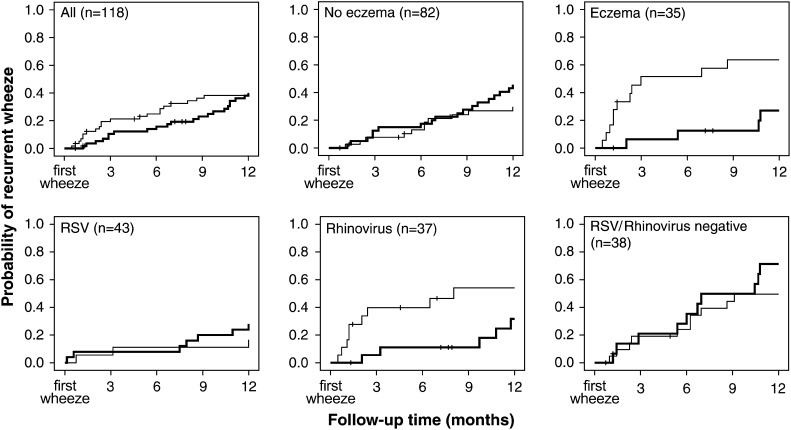
Results: Recurrent wheezing was diagnosed in 44 (37%) children. Independent risk factors were age < 1 year, atopy, and maternal asthma. The probability of recurrent wheezing was higher in rhinovirus than respiratory syncytial virus (RSV)-affected children among placebo recipients (hazard ratio, 5.05; 95% CI, 1.00-25.41). Prednisolone decreased the probability of recurrent wheezing in children with eczema (0.15; 95% CI, 0.04-0.63) but not in those without eczema (1.89; 95% CI, 0.83-4.29; P = .007 for interaction). Prednisolone was associated with less recurrent wheezing in the rhinovirus group (0.19; 95% CI, 0.05-0.71), but not in the RSV (2.12; 95% CI, 0.46-9.76) or in the RSV/rhinovirus-negative groups (2.03; 95% CI, 0.83-5.00; P = .017 for interaction).
Conclusion: Rhinovirus-induced early wheezing is a major viral risk factor for recurrent wheezing. Prednisolone may prevent recurrent wheezing in rhinovirus-affected first-time wheezers. The presence of eczema may also influence the response to prednisolone.
Clinical implications: A prospective trial is needed to test the hypothesis that prednisolone reduces recurrent wheezing in rhinovirus-affected wheezing children.
Figures

Comment in
-
Should corticosteroids be used for first-time young wheezers?J Allergy Clin Immunol. 2007 Mar;119(3):567-9. doi: 10.1016/j.jaci.2006.12.641. Epub 2007 Jan 25. J Allergy Clin Immunol. 2007. PMID: 17258307 No abstract available.
-
Are responses to treatment virus-specific in wheezing children?J Allergy Clin Immunol. 2007 Jun;119(6):1561-2. doi: 10.1016/j.jaci.2007.02.008. Epub 2007 Apr 6. J Allergy Clin Immunol. 2007. PMID: 17412400 No abstract available.
References
-
- Martinez F.D., Wright A.L., Taussig L.M., Holberg C.J., Halonen M., Morgan W.J. Asthma and wheezing in the first six years of life. The Group Health Medical Associates. N Engl J Med. 1995;332:133–138. - PubMed
-
- Lemanske R.F., Jackson D.J., Gangnon R.E., Evans M.D., Li Z., Shult P.A. Rhinovirus illnesses during infancy predict subsequent childhood wheezing. J Allergy Clin Immunol. 2005;116:571–577. - PubMed
-
- Papadopoulos N.G., Moustaki M., Tsolia M., Bossios A., Astra E., Prezerakou A. Association of rhinovirus infection with increased disease severity in acute bronchiolitis. Am J Respir Crit Care Med. 2002;165:1285–1289. - PubMed
-
- Jacques J., Bouscambert-Duchamp M., Moret H., Carquin J., Brodard V., Lina B. Association of respiratory picornaviruses with acute bronchiolitis in French infants. J Clin Virol. 2006;35:463–466. - PubMed
-
- Malmström K., Pitkäranta A., Carpen O., Pelkonen A., Malmberg L.P., Turpeinen M. Human rhinovirus in bronchial epithelium of infants with recurrent respiratory symptoms. J Allergy Clin Immunol. 2006;118:591–596. - PubMed
Publication types
MeSH terms
Substances
LinkOut - more resources
Full Text Sources
Other Literature Sources
Medical
