. 2007 Jan;170(1):388-98.
doi: 10.2353/ajpath.2007.060708.

Vasculoprotective effects of anti-tumor necrosis factor-alpha treatment in aging

Affiliations

Vasculoprotective effects of anti-tumor necrosis factor-alpha treatment in aging

Anna Csiszar et al. Am J Pathol. 2007 Jan.

Abstract

Vascular aging is associated with dysregulation of tumor necrosis factor (TNF)-alpha expression. TNF-alpha is a master regulator of vascular proatherogenic phenotypic changes, and it has been linked to endothelial dysfunction and apoptosis. To test the hypothesis that anti-TNF-alpha treatment exerts vasculoprotective effects in aging, aged (29 months old) F344 rats were treated with etanercept (1 mg/kg/week for 4 weeks), which binds and inactivates TNF-alpha. In aged carotid arteries, relaxations to acetylcholine were decreased, and endothelial O2* production was increased (as shown by dihydroethidine fluorescence measurements). Etanercept treatment significantly improved responses to acetylcholine and decreased vascular NAD(P)H oxidase activity and expression. In aged carotid and coronary arteries, there were increases in DNA fragmentation rate and caspase 3/7 activity (indicating an increased rate of apoptotic cell death), which were attenuated by etanercept treatment. In aged vessels, there was an up-regulation of inflammatory markers, including inducible nitric-oxide synthase and intercellular adhesion molecule-1, which was decreased by etanercept treatment. In carotid arteries of young animals, recombinant TNF-alpha elicited endothelial dysfunction, oxidative stress, and increased apoptosis and proinflammatory gene expression, mimicking many of the symptoms of vascular aging. Thus, we propose that anti-TNF-alpha treatment exerts anti-aging vasculoprotective effects.


Figures
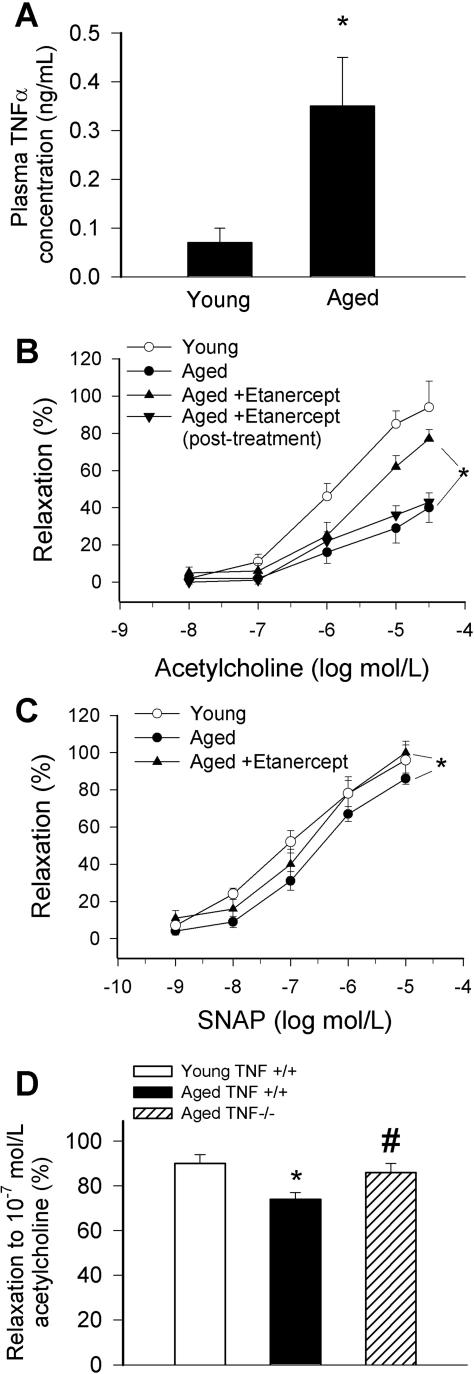
Figure 1
Figure 1
A: Plasma levels of TNF-α in 3-month-old and 29-month-old F344 rats. *P < 0.05 (n = 3 to 4). B and C: Relaxations to acetylcholine (B) and the NO donor S-nitrosopenicillamine (C) in carotid arteries of aged (29 months old) F344 rats treated with etanercept (1 mg/kg/week, for 4 weeks). Responses of vessels from untreated aged and young rats and rats 2 weeks after discontinuation of etanercept treatment are shown for comparison. Data are mean ± SEM (n = 5 to 10). *P < 0.05. D: Relaxations to acetylcholine in carotid arteries of young and aged TNF-α+/+ and TNF-α−/− mice. Data ± SEM are normalized to the young mean values (n = 5 to 10). *P < 0.05.
Figure 2
Figure 2
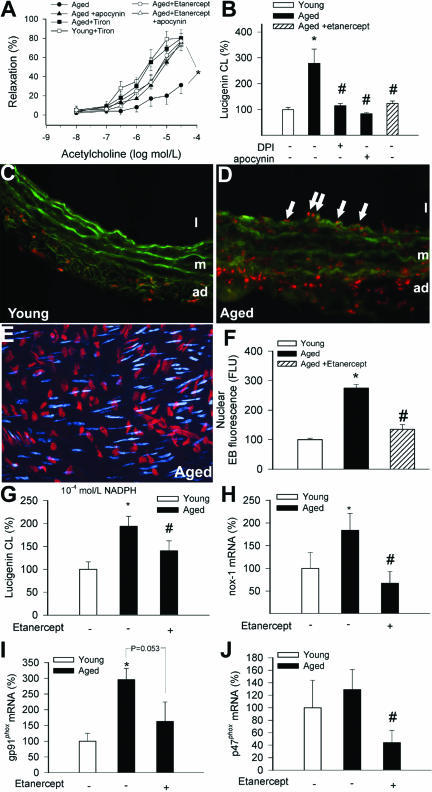
Figure 2. A: Relaxations to acetylcholine in carotid arteries of aged F344 rats with or without etanercept treatment (1 mg/kg/week, for 4 weeks) in the absence and presence of apocynin (3 × 10⁻⁴ mol/L) or Tiron (10 mmol/L). Data are mean ± SEM (n = 5 to 7). *P < 0.05. B: Superoxide production in vessels of young, aged, and etanercept-treated aged rats, as measured by the lucigenin chemiluminescence method. The NAD(P)H oxidase inhibitors diphenyleneiodonium (10−5 mol/L) and apocynin (3 × 10⁻⁴ mol/L) significantly decreased O2 generation in aged vessels. Data are mean ± SEM. *P < 0.05 versus young, #P < 0.05 versus untreated. C and D: Fluorescent photomicrographs showing that compared with young vessels (C), there was a significantly increased O2 production in the endothelial (arrows) and smooth muscle cells of aged arteries (D), as indicated by the intensive red fluorescent staining of the nuclei by EB. Green autofluorescence is shown for orientation purposes (L, lumen; m, media; ad, adventitia). Images are representative of six independent experiments. E: Representative image of en face preparation of EB-stained nuclei of endothelial cells (red) and smooth muscle cells (pseudocolored blue) in an aged artery. Optical sections were obtained using the Zeiss Apotome technology. F: Bar graphs are summary data for nuclear EB fluorescence intensities in endothelial cells in arteries of young, aged, and etanercept-treated aged rats. Data are mean ± SEM. *P < 0.05 versus young, #P < 0.05 versus untreated. G: NAD(P)H-driven O2 generation (assessed by the lucigenin chemiluminescence method) in homogenates of carotid arteries of young, aged, and etenercept-treated aged rats. Data are mean ± SEM. *P < 0.05 versus young, #P < 0.05 versus untreated. H–J: Vascular expression of the NAD(P)H oxidase subunits nox-1 (H), gp91phox (I), and p47phox (J) in young, aged, and etenercept-treated aged rats. Data are mean ± SEM. *P < 0.05 versus young, #P < 0.05 versus untreated.
Figure 3
Figure 3
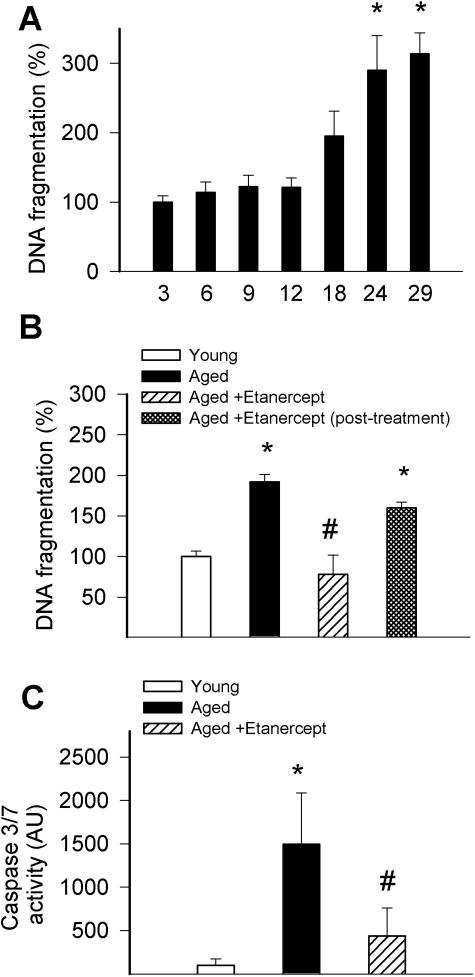
A: Age-dependent increases in DNA fragmentation in vessels of F344 rats. B: DNA fragmentation in carotid arteries of young, aged, and etenercept-treated aged F344 rats. Data obtained in vessels from rats 2 weeks after discontinuation of etanercept treatment are also shown. C: Caspase 3/7 activity in vessels of young, aged, and etenercept-treated aged F344 rats. Data ± SEM are normalized to the young mean values (n = 4 to 5 for each group). *P < 0.05 versus young, #P < 0.05 versus untreated.
Figure 4
Figure 4
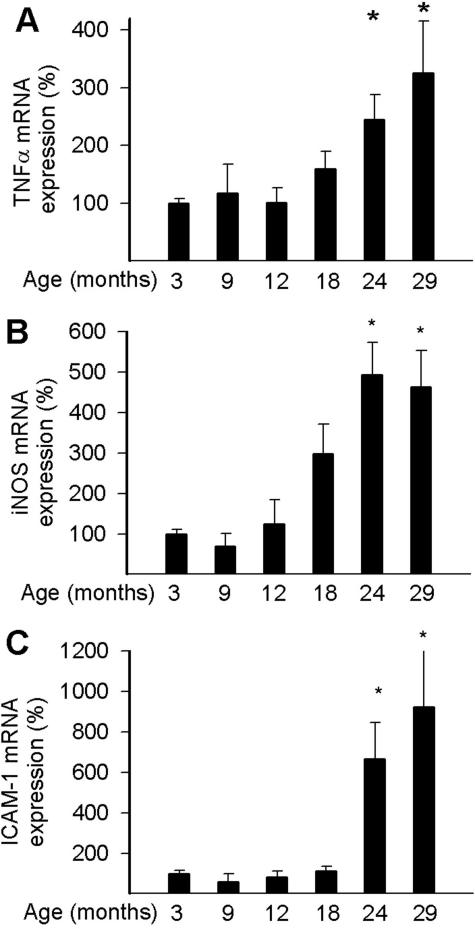
Expression of TNF-α (A), iNOS (B), and ICAM-1 (C) in vessels of 3-, 9-, 12-, 18-, 24-, and 29-month-old F344 rats. Analysis of mRNA expression was performed by real-time QRT-PCR. Data ± SEM are normalized to the 3-month-old mean values (n = 4 to 5 for each group). *P < 0.05 versus 3 months old.
Figure 5
Figure 5
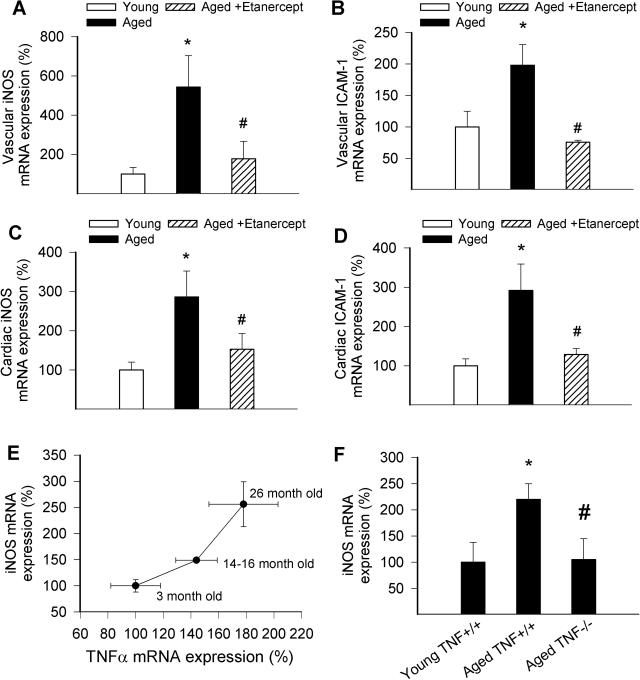
Vascular (A, B) and cardiac (C, D) expression of iNOS (A, C) and ICAM-1 (B, D) mRNA in aged (29 months old) rats with or without etanercept treatment (4 weeks, 1 mg/kg/week). Analysis of mRNA expression was performed by real-time QRT-PCR. Data ± SEM are normalized to the young (3 months old) mean values (n = 5 for each group). *P < 0.05 versus young, #P < 0.05 versus untreated. E: Correlation between age-related increases in TNF-α and iNOS mRNA expression in carotid arteries of wild-type mice. F: Expression of iNOS mRNA in carotid arteries of young and aged TNF+/+ mice and TNF−/− mice. Data ± SEM are normalized to the 3-month-old mean values (n = 5 to 6 for each group). *P < 0.05 versus young, #P < 0.05 versus wild type.
Figure 6
Figure 6
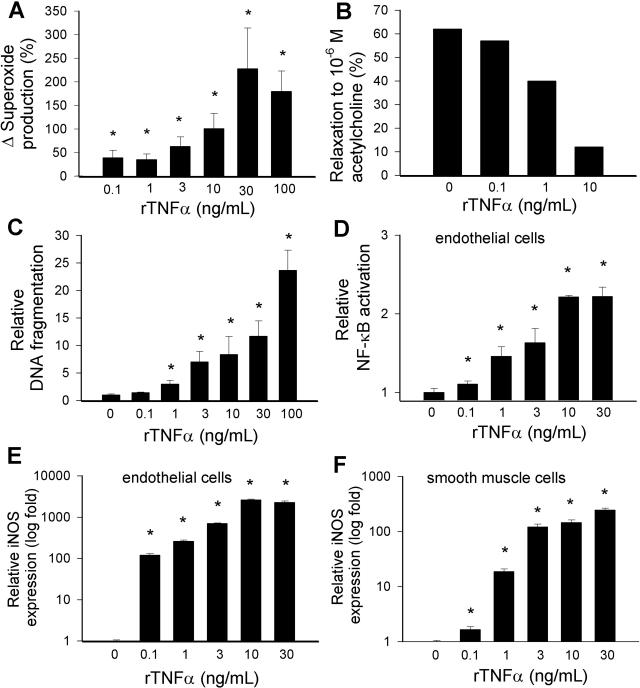
Concentration dependence of the vascular effects of TNF-α. A and B: Superoxide production (A; measured by the lucigenin chemiluminescence method) and relaxations to acetylcholine (B) and in ring preparations of carotid arteries of young F344 rats maintained in vessel culture (for 24 hours) in the absence and presence of TNF-α. Data are mean ± SEM (n = 4 to 6 in each group) *P < 0.05. C: DNA fragmentation in arteries of young F344 rats maintained in vessel culture (for 24 hours) in the absence and presence of TNF-α. Data are mean ± SEM (n = 4 to 6 in each group) *P < 0.05. D: Reporter gene assay showing the effects of TNF-α on NF-κΒ reporter activity in coronary arterial endothelial cells. Endothelial cells were transiently co-transfected with NF-κΒ-driven firefly luciferase and CMV-driven Renilla luciferase constructs followed by TNF-α stimulation. Cells were then lysed and subjected to luciferase activity assay. After normalization, relative luciferase activity was obtained from four independent transfections (data are mean ± SEM, *P < 0.05 versus control). E and F: Effect of TNF-α treatment (24 hours) on the expression of iNOS in coronary arterial endothelial cells (E) and smooth muscle cells (F). Analysis of mRNA expression was performed by real-time QRT-PCR. Data are mean of four independent experiments.
Figure 7
Figure 7
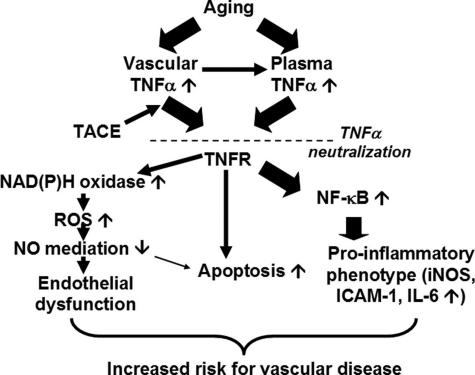
Proposed scheme for the vasculoprotective effects of TNF-α neutralization in aging. In aging, plasma TNF-α levels are increased. In addition, TNF-α is also up-regulated and secreted [by the TNF-α convertase enzyme (TACE)3] by vascular cells as a paracrine mediator. The resulting increased levels of TNF-α within the vascular wall activate NAD(P)H oxidase-derived O2 generation leading to endothelial dysfunction, induce apoptotic endothelial cell death, and promote vascular inflammation by inducing NF-κB activation. Etanercept is likely to neutralize both circulating and locally produced TNF-α, attenuating oxidative stress and vascular inflammation, limiting endothelial cell loss, and improving endothelial function in aging.

References

    1. Lakatta EG, Levy D. Arterial and cardiac aging: major shareholders in cardiovascular disease enterprises: part I: aging arteries: a “set up” for vascular disease. Circulation. 2003;107:139–146. - PubMed
    1. Csiszar A, Ungvari Z, Edwards JG, Kaminski PM, Wolin MS, Koller A, Kaley G. Aging-induced phenotypic changes and oxidative stress impair coronary arteriolar function. Circ Res. 2002;90:1159–1166. - PubMed
    1. Csiszar A, Ungvari Z, Koller A, Edwards JG, Kaley G. Proinflammatory phenotype of coronary arteries promotes endothelial apoptosis in aging. Physiol Genomics. 2004;17:21–30. - PubMed
    1. Francia P, delli Gatti C, Bachschmid M, Martin-Padura I, Savoia C, Migliaccio E, Pelicci PG, Schiavoni M, Luscher TF, Volpe M, Cosentino F. Deletion of p66shc gene protects against age-related endothelial dysfunction. Circulation. 2004;110:2889–2895. - PubMed
    1. Csiszar A, Pacher P, Kaley G, Ungvari Z. Role of oxidative and nitrosative stress, longevity genes and poly(ADP-ribose) polymerase in cardiovascular dysfunction associated with aging. Curr Vasc Pharmacol. 2005;3:285–291. - PMC - PubMed

Publication types

MeSH terms