Review
. 2007 Jan;4(1):58-68.
doi: 10.1513/pats.200607-146JG.

African Americans with asthma: genetic insights

Affiliations
Review

African Americans with asthma: genetic insights

Kathleen C Barnes et al. Proc Am Thorac Soc. 2007 Jan.

Abstract

It has been well established that genetic factors strongly affect susceptibility to asthma and its associated traits. It is less clear to what extent genetic variation contributes to the ethnic disparities observed for asthma morbidity and mortality. Individuals of African descent with asthma have more severe asthma, higher IgE levels, a higher degree of steroid dependency, and more severe clinical symptoms than individuals of European descent with asthma but relatively few studies have focused on this particularly vulnerable ethnic group. Similar underrepresentation exists for other minorities, including Hispanics. In this review, a summary of linkage and association studies in populations of African descent is presented, and the role of linkage disequilibrium in the dissection of a complex trait such as asthma is discussed. Consideration for the impact of population stratification in recently admixed populations (i.e., European, African) is essential in genetic association studies focusing on African ancestry groups. With the most recent update on the International HapMap Project, efficient selection of haplotype tagging single nucleotide polymorphisms (htSNPs) for African Americans has accelerated and efficiency of htSNPs chosen from one population to represent other continental groups (e.g., African) has been demonstrated. Cutting-edge approaches, such as genomewide association studies, admixture mapping, and phylogenetic analyses, offer new opportunities for dissecting the genetic basis for asthma in populations of African descent.


Figures
<b>Figure 1.</b>
Figure 1.
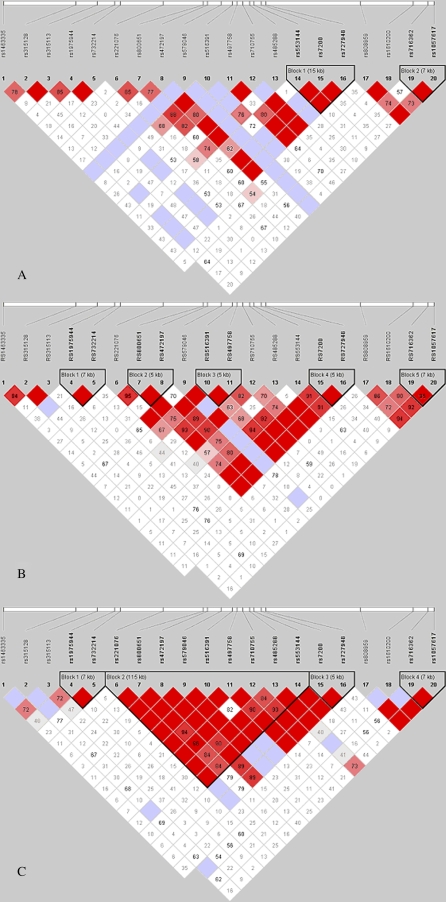
Comparison of pairwise linkage disequilibrium (LD) estimates (D′) in three populations. Pairwise LD estimated between each of 20 single nucleotide polymorphism (SNP) markers genotyped on chromosome 12q (67953342−68500427; [National Center for Biotechnology Information (NCBI) build 35; Illumina panel 42 (Illumina, Inc., San Diego, CA)] using Haploview (Julian Maller, developer, Massachusetts Institute of Technology). Haplotype blocks are shown according to the definition by Gabriel and colleagues (45). A represents the LD between 20 single nucleotide polymorphisms (SNPs) and founders from the Yoruban (YRI) population published by the HapMap project (www.hapmap.org; estimated from 120 chromosomes); B shows the same set of SNPs in an African-Caribbean population from Barbados (estimated from 900 chromosomes); and C shows the same set of SNPs in European Americans from Tangier Island, Virginia (estimated from 354 chromosomes). The 20 SNPs are aligned to the pairwise LD plot. Squares illustrate strong (red), little/no (white), and nonsignificant (blue) LD.
<b>Figure 2.</b>
Figure 2.
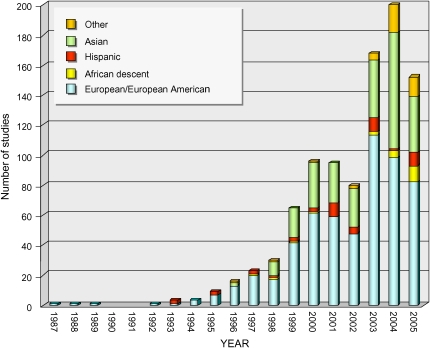
Number of published genetic association studies on asthma and associated phenotypes in different ethnic populations (European/European American, African descent, Hispanic, Asian, other) during 1987–2005. Summaries are derived from the data provided in the online supplement by Ober and Hoffjan (12), which include summaries of associations between specific variants in 120 HLA and non-HLA genes, phenotype, and the population studied, and are based on a compilation of 492 references. In studies that included more than one independent population, each population was counted. “African descent” includes African-American and African-Caribbean populations, and populations from continental Africa (Tunisia, South Africa). “Hispanic” includes Puerto Rican, Mexican American, Costa Rican, Mexican, and Venezuelan. “Other” includes ethnically mixed populations, and aboriginal Australian, Indonesian, and Hawaiian populations.
<b>Figure 3.</b>
Figure 3.
LD plots and tagging SNPs from a selected segment on chromosome 12q for two populations. Illustration of SNPs selected by the Tagger algorithm (90) on a set of 20 SNPs at r2 = 0.8. A represents the LD between 20 SNPs and European Americans from Tangier Island, Virginia (estimated from 354 chromosomes), and B represents the same set of SNPs in founders from the African-Caribbean population from Barbados (estimated 900 chromosomes). SNPs retained by Tagger are shown with blue marker identifiers for the two populations and include 12 of 20 SNPs for the Tangier sample and 18 of 20 (80%) SNPs for the Barbados sample.

References

    1. Centers for Disease Control and Prevention. Asthma Prevalence, health care use and mortality, 2000–2001. Atlanta, GA: National Center for Health Statistics; 2003.
    1. Allen M, Heinzmann A, Noguchi E, Abecasis G, Broxholme J, Ponting CP, Bhattacharyya S, Tinsley J, Zhang Y, Holt R, et al. Positional cloning of a novel gene influencing asthma from chromosome 2q14. Nat Genet 2003;35(3):258–263. - PubMed
    1. Walley AJ, Chavanas S, Moffatt MF, Esnouf RM, Ubhi B, Lawrence R, Wong K, Abecasis GR, Jones EY, Harper JI, et al. Gene polymorphism in Netherton and common atopic disease. Nat Genet 2001;29(2):175–178. - PubMed
    1. Laitinen T, Polvi A, Rydman P, Vendelin J, Pulkkinen V, Salmikangas P, Makela S, Rehn M, Pirskanen A, Rautanen A, et al. Characterization of a common susceptibility locus for asthma-related traits. Science 2004;304:300–304. - PubMed
    1. Martinez FD, Graves PE, Baldini M, Solomon S, Erickson R. Association between genetic polymorphisms of the beta2-adrenoceptor and response to albuterol in children with and without a history of wheezing. J Clin Invest 1997;100:3184–3188. - PMC - PubMed

Publication types