Peptidyl-prolyl cis/trans isomerases and transcription: is there a twist in the tail?
- PMID: 17203101
- PMCID: PMC1796747
- DOI: 10.1038/sj.embor.7400873
Peptidyl-prolyl cis/trans isomerases and transcription: is there a twist in the tail?
Abstract
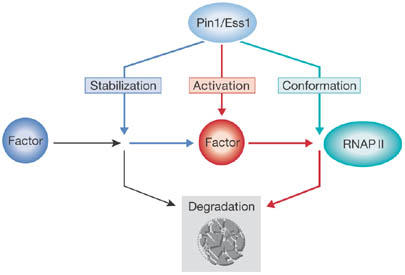
Eukaryotic transcription is regulated predominantly by the post-translational modification of the participating components. One such modification is the cis-trans isomerization of peptidyl-prolyl bonds, which results in a conformational change in the protein involved. Enzymes that carry out this reaction include the yeast peptidyl-prolyl cis/trans isomerase Ess1 and its human counterpart Pin1, both of which recognize phosphorylated target motifs exclusively. Consequently, they operate together with proline-directed serine-threonine kinases and phosphatases. High-profile client proteins involved in transcription include steroid hormone receptors, cell-cycle regulators and immune mediators. Other key targets are elements of the transcription machinery, including the multiply phosphorylated carboxy-terminal domain of RNA polymerase II. Changes in isomerase activity have been shown to alter the transactivation potential, protein stability or intracellular localization of these client proteins. The resulting disruption to developmental processes and cell proliferation has been linked, in some cases, to human cancers.
Figures

References
-
- Acquaviva C, Bossis G, Ferrara P, Brockly F, Jariel-Encontre I, Piechaczyk M (2002) Multiple degradation pathways for Fos family proteins. Ann NY Acad Sci 973: 426–434 - PubMed
-
- Adhikary S et al. (2005) The ubiquitin ligase HectH9 regulates transcriptional activation by Myc and is essential for tumor cell proliferation. Cell 123: 409–421 - PubMed
-
- Akoulitchev S, Chuikov S, Reinberg D (2000) TFIIH is negatively regulated by cdk8-containing mediator complexes. Nature 407: 102–106 - PubMed
-
- Archambault J, Pan G, Dahmus GK, Cartier M, Marshall N, Zhang S, Dahmus ME, Greenblatt J (1998) FCP1, the RAP74-interacting subunit of a human protein phosphatase that dephosphorylates the carboxyl-terminal domain of RNA polymerase IIO. J Biol Chem 273: 27593–27601 - PubMed
Publication types
MeSH terms
Substances
LinkOut - more resources
Full Text Sources
Molecular Biology Databases
Miscellaneous