


Dietary calcium intake and renin angiotensin system polymorphisms alter the blood pressure response to aerobic exercise: a randomized control design
- PMID: 17204161
- PMCID: PMC1779272
- DOI: 10.1186/1743-7075-4-1
Dietary calcium intake and renin angiotensin system polymorphisms alter the blood pressure response to aerobic exercise: a randomized control design
Abstract
Background: Dietary calcium intake and the renin angiotensin system (RAS) regulate blood pressure (BP) by modulating calcium homeostasis. Despite similar BP regulatory effects, the influence of dietary calcium intake alone and combined with RAS polymorphisms on the BP response following acute aerobic exercise (i.e., postexercise hypotension) has not been studied. Thus, we examined the effect of dietary calcium intake and selected RAS polymorphisms on postexercise hypotension.
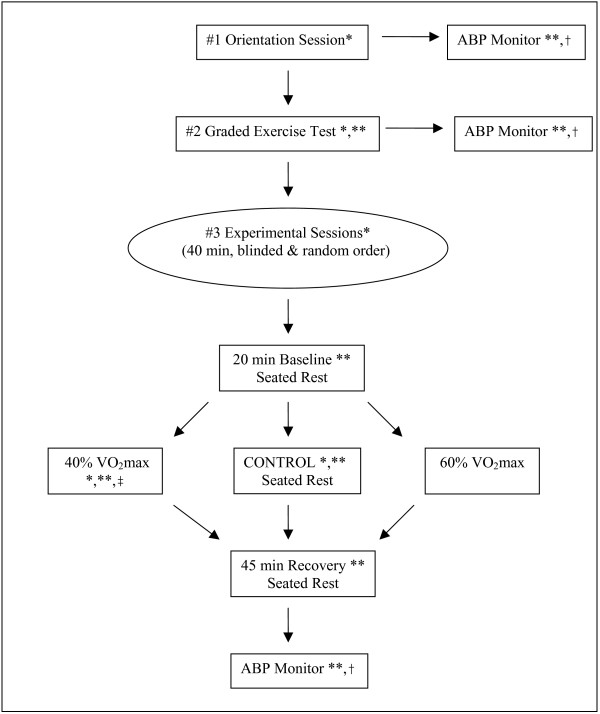
Methods: Subjects were men (n = 50, 43.8 +/- 1.3 yr) with high BP (145.3 +/- 1.5/85.9 +/- 1.1 mm Hg). They completed three experiments: non-exercise control and two cycle bouts at 40% and 60% of maximal oxygen consumption (VO2max). Subjects provided 3 d food records on five protocol-specific occasions. Dietary calcium intake was averaged and categorized as low (<880 mg/d = LowCa) or high (> or = 880 mg/d = HighCa). RAS polymorphisms (angiotensin converting enzyme insertion/deletion, ACE I/D; angiotensin II type 1 receptor, AT1R A/C) were analyzed with molecular methods. Genotypes were reduced from three to two: ACE II/ID and ACE DD; or AT1R AA and AT1R CC/AC. Repeated measure ANCOVA tested if BP differed among experiments, dietary calcium intake level and RAS polymorphisms.
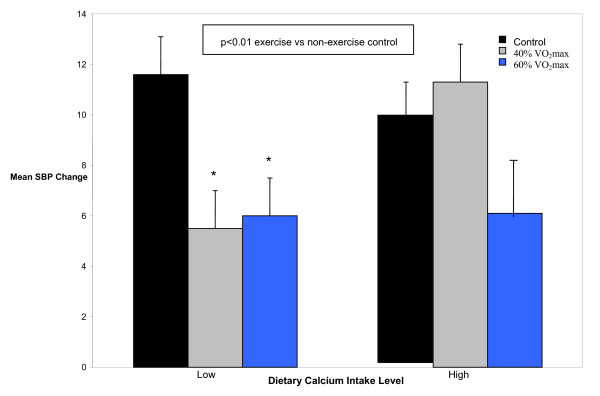
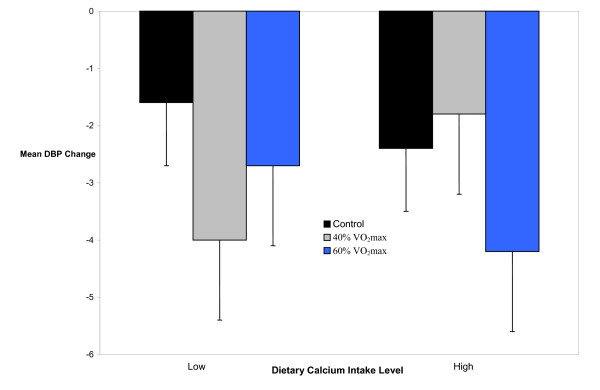
Results: Systolic BP (SBP) decreased 6 mm Hg after 40% and 60% VO2max compared to non-exercise control for 10 h with LowCa (p < 0.01), but not with HighCa (p > or = 0.05). Under these conditions, diastolic BP (DBP) did not differ between dietary calcium intake levels (p > or = 0.05). With LowCa, SBP decreased after 60% VO2max versus non-exercise control for 10 h among ACE II/ID (6 mm Hg) and AT1R AA (8 mm Hg); and by 8 mm Hg after 40% VO2max among ACE DD and AT1R CC/CA (p < 0.01). With HighCa, SBP (8 mm Hg) and DBP (4 mm Hg) decreased after 60% VO2max compared to non-exercise control for 10 h (p < 0.05), but not after 40% VO2max (p > or = 0.05).
Conclusion: SBP decreased after exercise compared to non-exercise control among men with low but not high dietary calcium intake. Dietary calcium intake interacted with the ACE I/D and AT1R A/C polymorphisms to further modulate postexercise hypotension. Interactions among dietary calcium intake, exercise intensity and RAS polymorphisms account for some of the variability in the BP response to exercise.
Figures
References
-
- Chobanian AV, Bakris GL, Black HR, Cushman WC, Green LA, Izzo JL, Jr, Jones DW, Materson BJ, Oparil S, Wright JT, Jr, Roccella EJ. Seventh Report of the Joint National Committee on Prevention, Detection, Evaluation, and Treatment of High Blood Pressure. JNC 7-Complete Version. Hypertension. 2003;42:1206–1252. doi: 10.1161/01.HYP.0000107251.49515.c2. - DOI - PubMed
-
- Seals DR, Tanaka H, Clevenger CM, Monahan KD, Reiling MJ, Hiatt WR, Davey KP, DeSouza CA. Blood pressure reductions with exercise and sodium restriction in postmenopausal women with elevated systolic pressure: Role of arterial stiffness. J Am Coll Cardiol. 2001;38:506–513. doi: 10.1016/S0735-1097(01)01348-1. - DOI - PubMed
LinkOut - more resources
Full Text Sources
Miscellaneous
