


NPY Y1 receptor is involved in ghrelin- and fasting-induced increases in foraging, food hoarding, and food intake
- PMID: 17204592
- PMCID: PMC3509278
- DOI: 10.1152/ajpregu.00597.2006
NPY Y1 receptor is involved in ghrelin- and fasting-induced increases in foraging, food hoarding, and food intake
Abstract
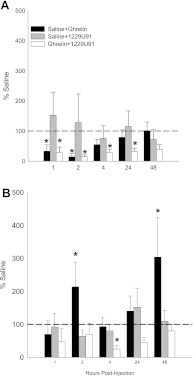
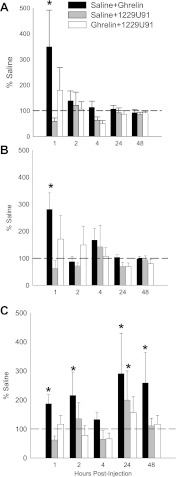
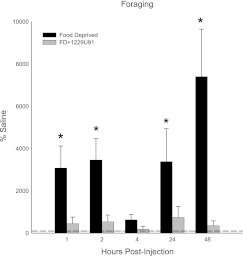
Fasting triggers a constellation of physiological and behavioral changes, including increases in peripherally produced ghrelin and centrally produced hypothalamic neuropeptide Y (NPY). Refeeding stimulates food intake in most species; however, hamsters primarily increase foraging and food hoarding with smaller increases in food intake. Fasting-induced increases in foraging and food hoarding in Siberian hamsters are mimicked by peripheral ghrelin, central NPY, and NPY Y1 receptor agonist injections. Because fasting stimulates ghrelin and subsequently NPY synthesis/release, it may be that fasting-induced increased hoarding is mediated by NPY Y1 receptor activation. Therefore, we asked: Can an Y1 receptor antagonist block fasting- or ghrelin-induced increases in foraging, food hoarding, and food intake? This was accomplished by injecting the NPY Y1 receptor antagonist 1229U91 intracerebroventricularly in hamsters fasted, fed, or given peripheral ghrelin injections and housed in a running wheel-based food delivery foraging system coupled with simulated-burrow housing. Three foraging conditions were used: 1) no running wheel access, free food, 2) running wheel access, free food, or 3) foraging requirement (10 revolutions/pellet) for food. Fasting was a more potent stimulator of foraging and food hoarding than ghrelin. Concurrent injections of 1229U91 completely blocked fasting- and ghrelin-induced increased foraging and food intake and attenuated, but did not always completely block, fasting- and ghrelin-induced increases in food hoarding. Collectively, these data suggest that the NPY Y1 receptor is important for the effects of ghrelin- and fasting-induced increases in foraging and food intake, but other NPY receptors and/or other neurochemical systems are involved in increases in food hoarding.
Figures



References
-
- Ariyasu H, Takaya K, Tagami T, Ogawa Y, Hosoda K, Akamizu T, Suda M, Koh T, Natsui K, Toyooka S, Shirakami G, Usui T, Shimatsu A, Doi K, Hosoda H, Kojima M, Kangawa K, Nakao K. Stomach is a major source of circulating ghrelin, and feeding state determines plasma ghrelin-like immunoreactivity levels in humans. J Clin Endocrinol Metab 86: 4753–4758, 2001. - PubMed
-
- Asakawa A, Inui A, Kaga T, Yuzuriha H, Nagata T, Ueno N, Makino S, Fujimiya M, Niijima A, Fujino MA, Kasuga M. Ghrelin is an appetite-stimulatory signal from stomach with structural resemblance to motilin. Gastroenterology 120: 337–345, 2001. - PubMed
-
- Bartness TJ Food hoarding is increased by pregnancy, lactation, and food deprivation in Siberian hamsters. Am J Physiol Regul Integr Comp Physiol 272: R118–R125, 1997. - PubMed
-
- Bartness TJ, Clein MR. Effects of food deprivation and restriction, and metabolic blockers on food hoarding in Siberian hamsters. Am J Physiol Regul Integr Comp Physiol 266: R1111–R1117, 1994. - PubMed
-
- Bartness TJ, Day DE. Food hoarding: a quintessential anticipatory appetitive behavior. Prog Psychobiol Physiol Psychol 18: 69–100, 2003.
MeSH terms
Substances
LinkOut - more resources
Full Text Sources
Research Materials
Miscellaneous
