


The dynamic vacuum orthosis: a functional and economical benefit?
- PMID: 17206496
- PMCID: PMC2269030
- DOI: 10.1007/s00264-006-0306-5
The dynamic vacuum orthosis: a functional and economical benefit?
Abstract
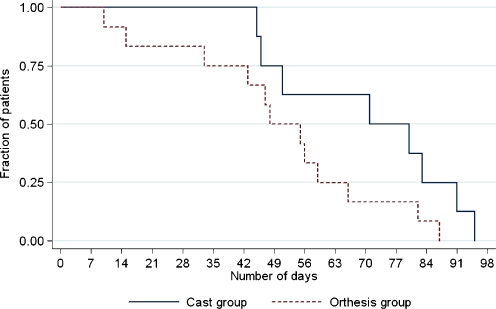
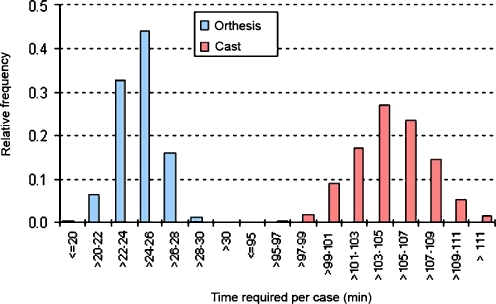
In a prospective, randomised study, 27 patients with internally fixed ankle fractures were treated post-operatively for a period of six weeks by application of either a new dynamic vacuum orthosis with permitted mobilisation to 10 degrees -0 degrees -10 degrees at the ankle joint or a synthetic cast. Full weight bearing was allowed in both groups after two weeks. The cast group was prescribed four weeks of physiotherapy following six weeks of immobilisation. After ten weeks, the Olerud and Molander score showed a significant difference in favour of the orthosis. Early functional outcomes were significantly better for this group after six weeks and ten weeks. Patients in the orthosis group who were in formal employment returned to work 24 days earlier than those in the control group. Treatment of the orthosis patients took up three to four times less working time for the medical personnel. A saving of 38 euros on directly ascertainable costs could be evaluated. Rehabilitation of ankle fractures with a dynamic vacuum orthosis leads to better early functional results and greater patient satisfaction. The orthosis fulfils the conditions for early return to work. Treatment with an orthosis not only reduces working time for medical personnel but economises on expenditure for treatment and rehabilitation.
Une étude randomisée a été réalisée chez 27 patients présentant une fracture de la cheville et traités sur une période de six semaines soit par une orthèse dynamique permettant une mobilisation de 10° dans chaque secteur soit par une immobilisation plâtrée. Une marche avec appui complet a été autorisée dans les deux groupes, après 15 jours. Le groupe des patients plâtrés a bénéficié de 4 semaines de rééducation après six semaines d’immobilisation. Après 10 semaines, le score d’Olerud et de Molander montre une différence significative dans les résultats en faveur de l’orthèse. En effet, le devenir fonctionnel de ces patients a été de façon significative bien meilleur pour ce groupe après six semaines et après dix semaines. Ces patients sont retournés au travail 24 jours plus tôt que dans le groupe contrôle. Le traitement par orthèse permet d’économiser 38 euros et du temps médical. La rééducation de la fracture des chevilles grâce à l’orthèse dynamique permet un résultat fonctionnel excellent et relativement rapide. Cette orthèse met les patients dans de bonnes conditions pour un retour précoce à l’emploi, ce traitement permet également d’économiser le travail des médecins et permet également de faire des économies sur le temps de rééducation.
Figures

References
-
- Project Nr. 0894–2401, BASiS Institut, TUEV Product Service. 2005a. Ref Type: Generic
-
- Project Nr. 0896–2402, BASiS Institut, TUEV Product Service. 2005b. Ref Type: Generic
-
- {'text': '', 'ref_index': 1, 'ids': [{'type': 'PubMed', 'value': '8451961', 'is_inner': True, 'url': 'https://pubmed.ncbi.nlm.nih.gov/8451961/'}]}
- Ahl T, Dalen N, Lundberg A, Bylund C (1993) Early mobilization of operated on ankle fractures. Prospective, controlled study of 40 bimalleolar cases. Acta Orthop Scand 64:95–99 - PubMed
-
- Akeson WH, Amiel D, Abel MF, Garfin SR, Woo SL (1987) Effects of immobilization on joints. Clin Orthop 28–37 - PubMed
-
- Augat P, Merk J, Ignatius A, Margevicius K, Bauer G, Rosenbaum D, Claes L (1996) Early, full weight bearing with flexible fixation delays fracture healing. Clin Orthop 194–202 - PubMed
Publication types
MeSH terms
LinkOut - more resources
Full Text Sources
Medical
Miscellaneous
