. 2007 Mar;143(3):1347-61.
doi: 10.1104/pp.106.093203. Epub 2007 Jan 5.

The grapevine transcription factor VvMYBPA1 regulates proanthocyanidin synthesis during fruit development

Affiliations

The grapevine transcription factor VvMYBPA1 regulates proanthocyanidin synthesis during fruit development

Jochen Bogs et al. Plant Physiol. 2007 Mar.

Abstract

Proanthocyanidins (PAs; or condensed tannins) can protect plants against herbivores, contribute to the taste of many fruits, and act as dietary antioxidants beneficial for human health. We have previously shown that in grapevine (Vitis vinifera) PA synthesis involves both leucoanthocyanidin reductase (LAR) and anthocyanidin reductase (ANR). Here we report the characterization of a grapevine MYB transcription factor VvMYBPA1, which controls expression of PA pathway genes including both LAR and ANR. Expression of VvMYBPA1 in grape berries correlated with PA accumulation during early berry development and in seeds. In a transient assay, VvMYBPA1 activated the promoters of LAR and ANR, as well as the promoters of several of the general flavonoid pathway genes. VvMYBPA1 did not activate the promoter of VvUFGT, which encodes the anthocyanin-specific enzyme UDP-glucose:flavonoid-3-O-glucosyltransferase, suggesting VvMYBPA1 is specific to regulation of PA biosynthesis in grapes. The Arabidopsis (Arabidopsis thaliana) MYB transcription factor TRANSPARENT TESTA2 (TT2) regulates PA synthesis in the seed coat of Arabidopsis. By complementing the PA-deficient seed phenotype of the Arabidopsis tt2 mutant with VvMYBPA1, we confirmed the function of VvMYBPA1 as a transcriptional regulator of PA synthesis. In contrast to ectopic expression of TT2 in Arabidopsis, constitutive expression of VvMYBPA1 resulted in accumulation of PAs in cotyledons, vegetative meristems, leaf hairs, and roots in some of the transgenic seedlings. To our knowledge, this is the first report of a MYB factor that controls genes of the PA pathway in fruit, including both LAR and ANR, and this single MYB factor can induce ectopic PA accumulation in Arabidopsis.


Figures
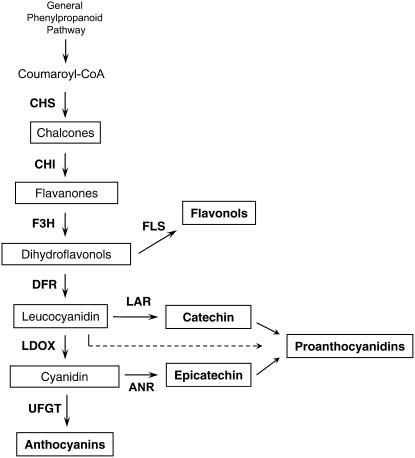
Figure 1.
Figure 1.
Scheme of the flavonoid pathway leading to synthesis of anthocyanins, flavonols, and PAs. The enzymes involved in the pathway are shown as follows: CHS, chalcone synthase; CHI, chalcone isomerase; F3′H, flavonoid-3′-hydroxylase; F3′5′H, flavonoid-3′,5′-hydroxylase; F3H, flavanone-3β-hydroxylase; DFR, dihydroflavonol-4-reductase; LDOX, leucoanthocyanidin dioxygenase; FLS, flavonol synthase; LAR, leucoanthocyanidin reductase; ANR, anthocyanidin reductase; and UFGT, UDP-Glc:flavonoid-3-O-glucosyltransferase. The F3′H and F3′5′H enzymes, which hydroxylate flavanones and dihydroflavonols, were omitted to clarify the scheme of the flavonoid pathway (see Bogs et al., 2006). Note that Arabidopsis lacks LAR.
Figure 2.
Figure 2.
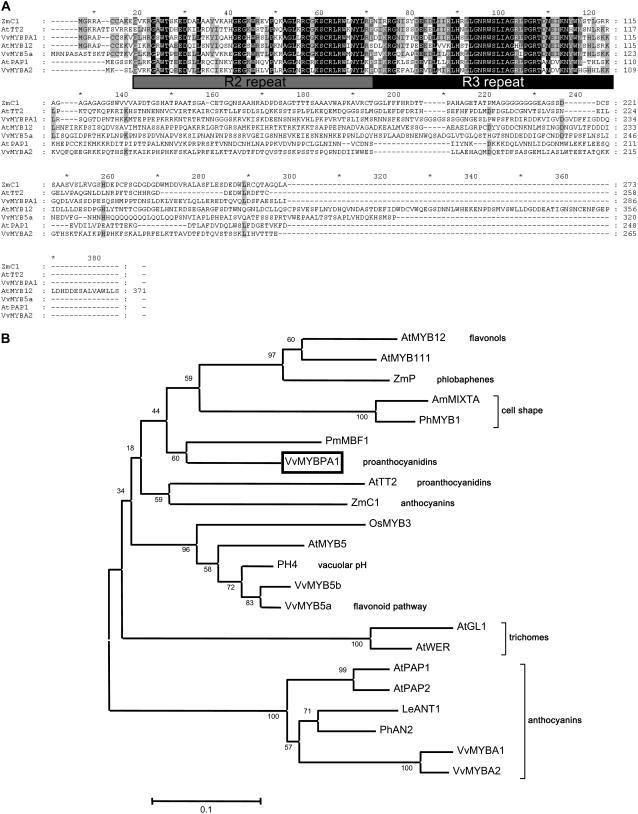
A, Alignment of the deduced amino acid sequences of the MYB-type transcriptional regulators ZmC1 (maize), AtTT2, AtPAP1, AtMYB12 (Arabidopsis), and the grapevine regulators VvMYBPA1, VvMYBA2, and VvMYB5a. The R2 and R3 repeats of the MYB domain are indicated below the alignment. Identical amino acids are indicated in black, similar amino acids in gray. Sequences were aligned with the ClustalW program and displayed using the GeneDoc program (Version 2.6.002). B, Phylogenetic tree showing selected plant MYB transcription factors from GenBank or EMBL database. Functions of some of the proteins are given in bold. The ClustalW multiple sequence alignment was formed using the domain of the MYB proteins and the default parameters of the MEGA package (Kumar et al., 2004). The tree was constructed from the ClustalW alignment using the neighbor-joining method by the MEGA program. The scale bar represents 0.1 substitutions per site and the numbers next to the nodes are bootstrap values from 1,000 replicates. The GenBank accession numbers of the MYB proteins are as follows: VvMYBPA1 (AM259485), AtGL1 (P27900), ZmP (P27898), ZmC1 (AAA33482), VvMYBA1 (BAD18977), VvMYBA2 (BAD18978), AtPAP1 (AAG42001), PhAN2 (AAF66727), LeANT1 (AAQ55181), OsMYB4 (T02988), AtMYB5 (U26935), PhMYB1 (Z13996), AmMixta (CAA55725), AtMYB12 (CAB09172), AtMYB111 (AAK97396), PmMBF1 (AAA82943), AtTT2 (Q9FJA2), PH4 (AAY51377), AtPAP1 (AAG42001), AtPAP2 (AAG42002), AtWER (CAC01874), VvMYB5a (AAS68190), and VvMYB5b (Q58QD0).
Figure 3.
Figure 3.
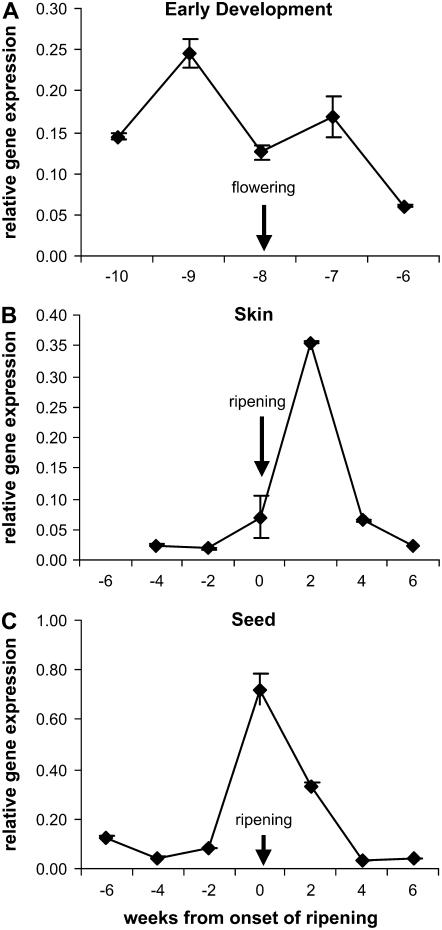
Transcript levels of VvMYBPA1 during grape flower and berry development. Gene expression was determined by real-time PCR and is shown relative to expression of VvUbiquitin1 in each sample. All data is presented as mean of three replicates with error bars indicating ±ses.
Figure 4.
Figure 4.
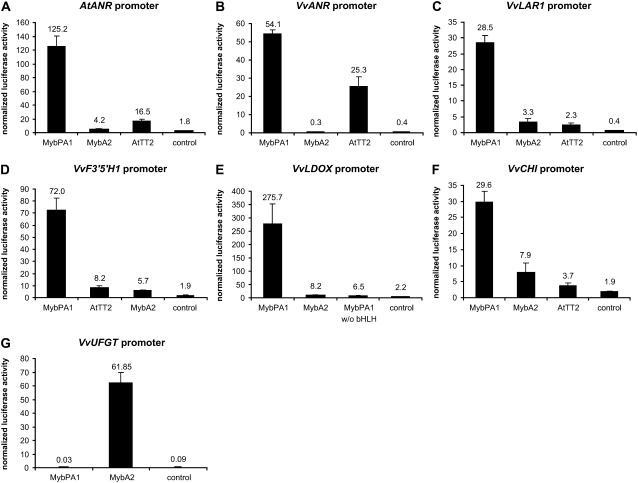
VvMYBPA1 activates promoters of flavonoid pathway genes involved in PA synthesis. The MYB transcription factors and promoters used for transfection of grape cell cultures are indicated. Control indicates the activity of the respective promoter transfected without a MYB factor. Each transfection (except E, MybPA1 without bHLH) contained the 35SEGL3 construct encoding the bHLH protein EGL3 (GenBank accession no. NM20235) from Arabidopsis and as internal control the Renilla luciferase plasmid pRluc (Horstmann et al., 2004). The normalized luciferase activity was calculated as the ratio between the firefly and the Renilla luciferase activity. Each column represents the mean value of three independent experiments with error bars indicating ±ses.
Figure 5.
Figure 5.
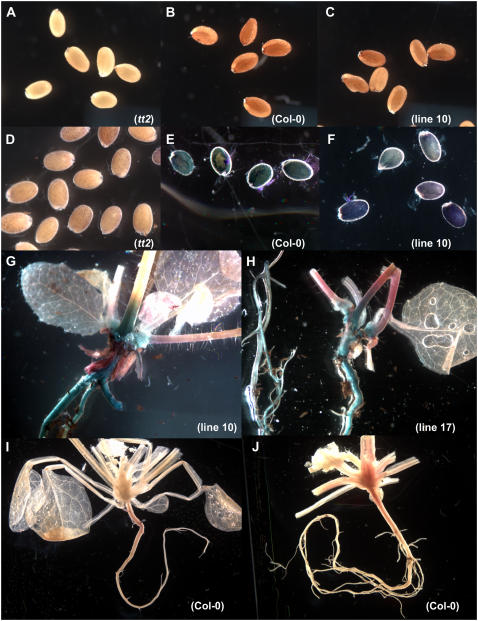
Complementation of the PA-deficient tt2 mutant seed phenotype by expression of VvMYBPA1 and ectopic PA formation of these plants. At least three independent lines showed a similar pattern of PA accumulation. A, Pale Arabidopsis tt2 seeds. B, Brown Col wild-type seeds. C, Brown tt2 35S∷MYBPA1 seeds. D to H, PAs were localized by staining the seeds or plants with DMACA, which specifically stains PAs blue. D, tt2 seeds. E, Col wild-type seeds. F, tt2 35S∷MYBPA1 seeds. G and H, PA formation in the hypocotyls, roots, and bases of the rosette leaves of tt2 35S∷MYBPA1 plants. PA formation in Arabidopsis wild-type plants (Col-0) after DMACA staining was exclusively observed in seeds (I and J).
Figure 6.
Figure 6.
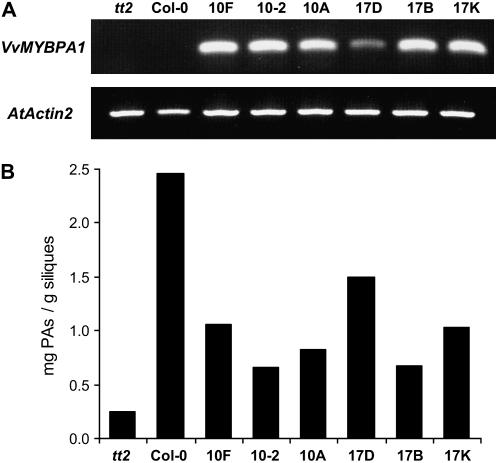
VvMYBPA1 expression in Arabidopsis tt2 mutant induced PA accumulation in developing siliques. A, Detection of VvMYBPA1 transcript in tt2 mutant, Col-0 wild-type and tt2 35S∷MYBPA1 lines 10F, 10-2, 10A, 17D, 17B, and 17 K by reverse transcription-PCR. Expression of the Arabidopsis Actin2 gene was used as a positive control. B, Quantification of PAs (total epicatechins) after acid-catalyzed hydrolysis of PA polymers in siliques of Arabidopsis tt2, Col-0 wild-type, and tt2 35S∷MYBPA1 lines 10F, 10-2, 10A, 17D, 17B, and 17 K by HPLC. Technical replicates could not be performed due to the limited amount of silique tissue.
Figure 7.
Figure 7.
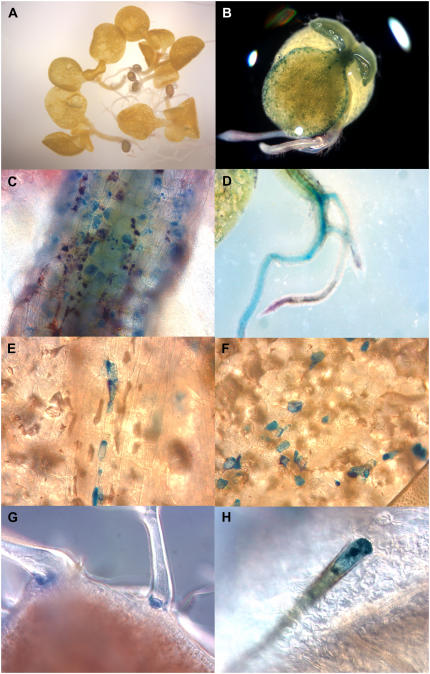
PA accumulation of Arabidopsis tt2 seedlings expressing VvMYBPA1. Plants died before full development of their first leaves. PAs were localized by staining the plants with DMACA, which specifically stains PAs blue. At least five independent lines showed a similar pattern of PA accumulation. A, Arabidopsis tt2 seedlings as negative control. B, Whole tt2 35S∷MYBPA1 seedlings with PAs in the apical meristem and the cotyledons. C, Hypocotyl. D, Root. E and F, Cells of cotyledons. G, Basal cells of trichome. H, Trichome.

References

    1. Abrahams S, Lee E, Walker AR, Tanner GJ, Larkin PJ, Ashton AR (2003) The Arabidopsis TDS4 gene encodes leucoanthocyanidin dioxygenase (LDOX) and is essential for proanthocyanidin synthesis and vacuole development. Plant J 35 624–636 - PubMed
    1. Abrahams S, Tanner GJ, Larkin PJ, Ashton AR (2002) Identification and biochemical characterization of mutants in the proanthocyanidin pathway in Arabidopsis. Plant Physiol 130 561–576 - PMC - PubMed
    1. Bagchi D, Bagchi M, Stohs SJ, Das DK, Ray SD, Kuszynski CA, Joshi SS, Pruess HG (2000) Free radicals and grape seed proanthocyanidin extract: importance in human health and disease prevention. Toxicology 148 187–197 - PubMed
    1. Baudry A, Heim MA, Dubreucq B, Caboche M, Weisshaar B, Lepiniec L (2004) TT2, TT8, and TTG1 synergistically specify the expression of BANYULS and proanthocyanidin biosynthesis in Arabidopsis thaliana. Plant J 39 366–380 - PubMed
    1. Baxter IR, Young JC, Armstrong G, Foster N, Bogenschutz N, Cordova T, Peer WA, Hazen SP, Murphy AS, Harper JF (2005) A plasma membrane H+-ATPase is required for the formation of proanthocyanidins in the seed coat endothelium of Arabidopsis thaliana. Proc Natl Acad Sci USA 102 2649–2654 - PMC - PubMed

Publication types

MeSH terms

Associated data

LinkOut - more resources