Isotretinoin, pregnancies, abortions and birth defects: a population-based perspective
- PMID: 17214828
- PMCID: PMC1859978
- DOI: 10.1111/j.1365-2125.2006.02837.x
Isotretinoin, pregnancies, abortions and birth defects: a population-based perspective
Abstract
Aims: To estimate the population-based incidence rates of pregnancy, spontaneous and elective abortions, and birth defects associated with isotretinoin use, and to determine predictors of pregnancy while on isotretinoin.
Methods: Using the RAMQ (medical and pharmaceutical data), MED-ECHO (hospitalizations) and ISQ (births and deaths) databases for the period 1984-2002, a cohort of 8609 women between 13 and 45 years of age and with a first prescription for isotretinoin (date of entry in the cohort) was identified. Women were eligible if they were insured by RAMQ for their medications at least 12 months before entry in the cohort and until 1 month after the end of their isotretinoin treatment. Pregnancies, spontaneous and elective abortions, and birth defects were identified using procedure codes and medical diagnoses.
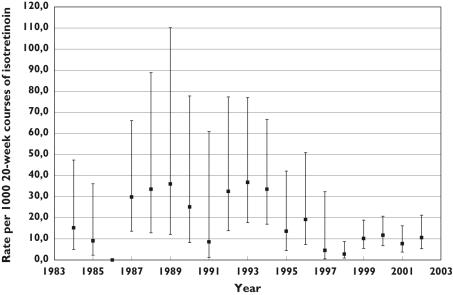
Results: Of the 8609 women included, 90 became pregnant, an annual incident pregnancy rate during isotretinoin treatment of 32.7 per 1000 person-years of treatment (95% confidence interval 26.6, 40.1). Of the 90 women who became pregnant while on the drug, 76 terminated the pregnancy (84%), three had a spontaneous abortion (3%), two had trauma during delivery resulting in neonatal deaths (2%) and nine had a live birth (10%). Among the live births, only one had a congenital anomaly of the face and neck (11%). Adjusting for potential confounders, predictors of becoming pregnant while on isotretinoin were lower socio-economic level, one or more visits to the doctor or to the emergency department, or one or more hospitalization while on isotretinoin; concomitant isotretinoin and oral contraceptive use had a preventive effect.
Conclusions: This first non-interventional population-based study generated incidence rates of pregnancy while on isotretinoin four times greater than what has been reported in the literature thus far; elective abortion rates were also much higher in our study. This shows the importance of using population-based data for public health purposes.
Figures
Comment in
-
Suggestions for effective contraception in isotretinoin therapy.Br J Clin Pharmacol. 2009 Jan;67(1):137-8. doi: 10.1111/j.1365-2125.2008.03235.x. Epub 2008 Nov 17. Br J Clin Pharmacol. 2009. PMID: 19076160 Free PMC article. No abstract available.
References
-
- Holmes SC, Bankowska U, Mackie RM. The prescription of isotretinoin to women: is every precaution taken? Br J Dermatol. 1998;138:450–5. - PubMed
-
- Azoulay L, Oraichi D, Bérard A. Patterns and utilization of isotretinoin from 1984 to 2003: is there need for concern? Eur J Clin Pharmacol. 2006;62:667–74. - PubMed
-
- Moskop JC, Smith ML, De Ville K. Ethical aspects of teratogenic medications: the case of isotretinoin. J Clin Ethics. 1997;8:264–78. - PubMed
-
- Honein MA, Paulozzi LJ, Erickson JD. Continued occurrence of Accutanemd– exposed pregnancies. Teratology. 2001;64:142–7. - PubMed
-
- Mitchell AA, Van Bennekom CM, Louik C. A pregnancy-prevention program in women of childbearing age receiving isotretinoin. N Engl J Med. 1995;333:101–6. - PubMed
Publication types
MeSH terms
Substances
LinkOut - more resources
Full Text Sources
Medical