


Stem-righting mechanism in gymnosperm trees deduced from limitations in compression wood development
- PMID: 17218339
- PMCID: PMC2802951
- DOI: 10.1093/aob/mcl270
Stem-righting mechanism in gymnosperm trees deduced from limitations in compression wood development
Abstract
Background and aims: In response to inclination stimuli, gymnosperm trees undergo corrective growth during which compression wood develops on the lower side of the inclined stem. High compressive growth stress is generated in the compression wood region and is an important factor in righting the stem. The aims of the study were to elucidate how the generation of compressive growth stress in the compression wood region is involved in the righting response and thus to determine a righting mechanism for tree saplings.
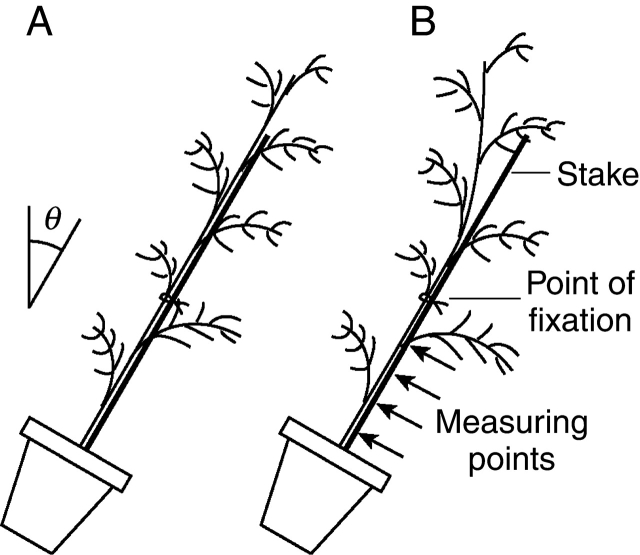
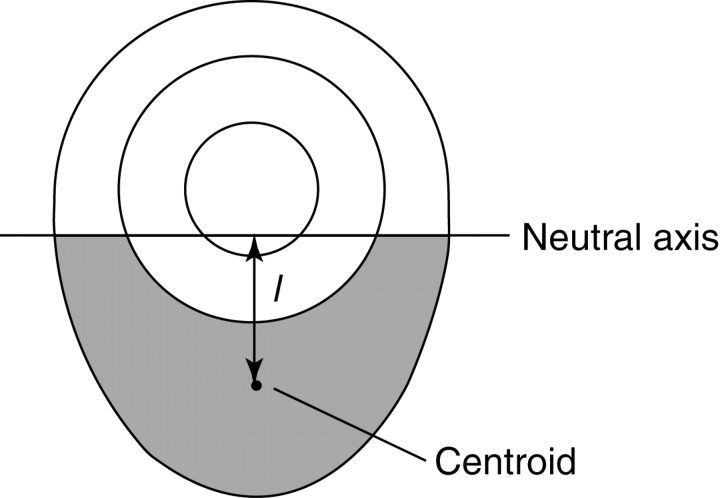
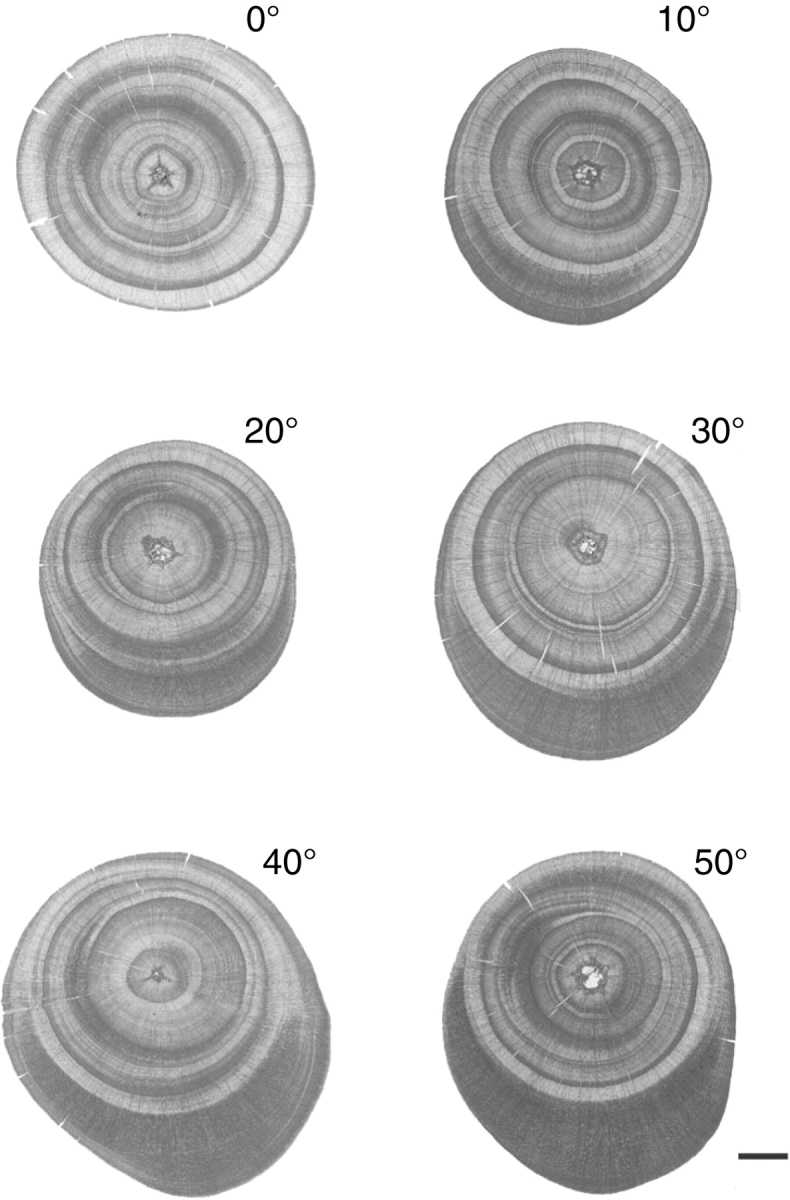
Methods: Cryptomeria japonica saplings were grown at inclinations of 0 degrees (vertical) to 50 degrees. At each inclination angle, the growth stress on the lower side of the inclined stem was investigated, together with the degree of compression-wood development such as the width of the current growth layer and lignin content, and the upward bending moment.
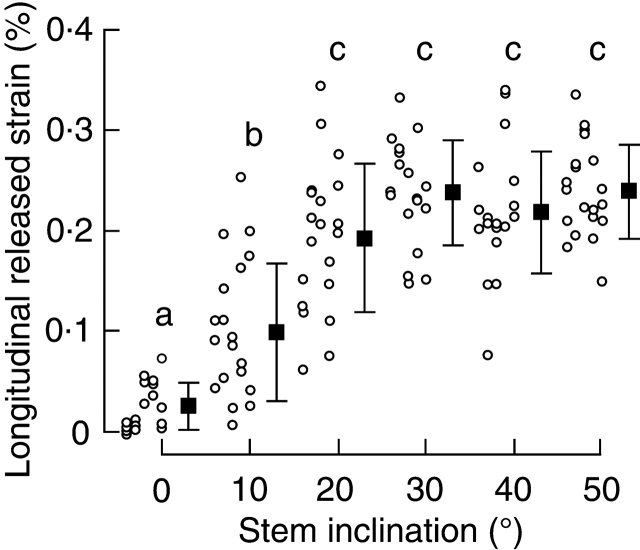
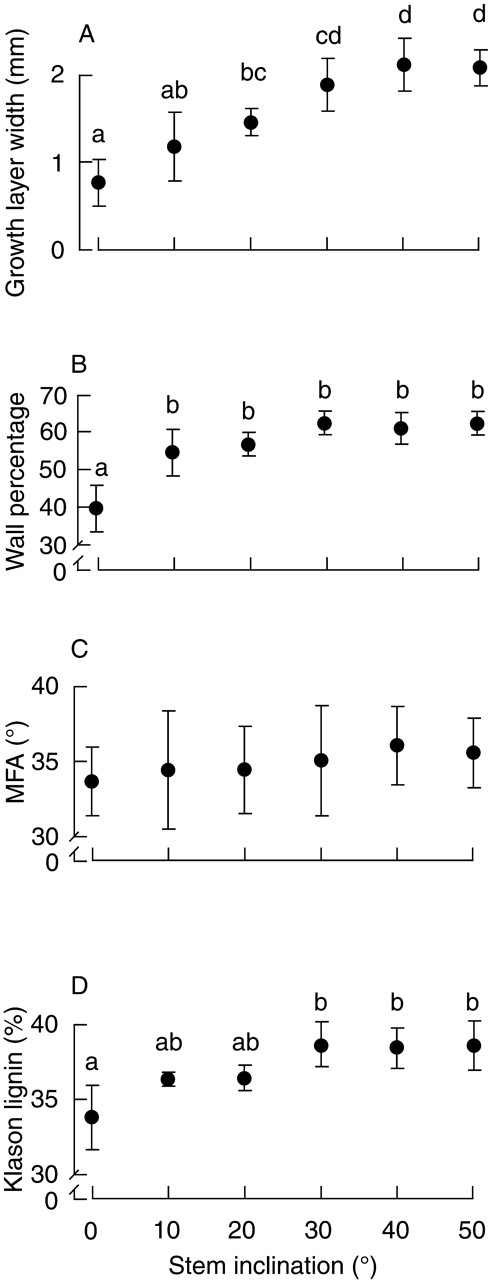
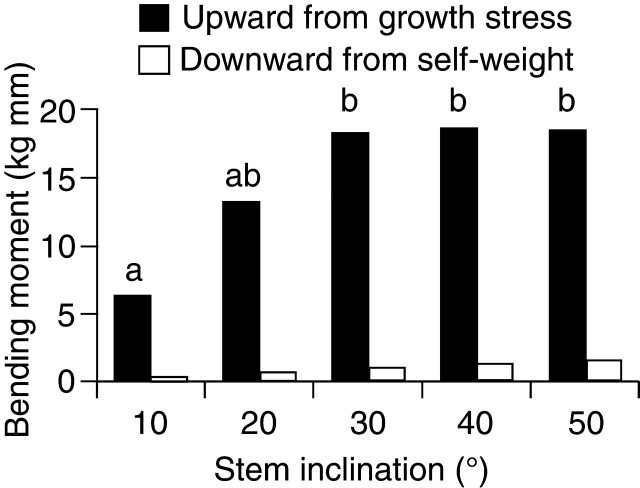
Key results: Growth stress, the degree of compression wood development, and the upward moment grew as the stem inclination angle increased from 0 to 30 degrees, but did not rise further at inclinations > 30 degrees.
Conclusions: The results suggest the following righting mechanism for gymnosperm saplings. As the stem inclination is elevated from 0 to 30 degrees, the degree of compression wood development increases to force the sapling back to its original orientation; at inclinations > 30 degrees, the maximum degree of compression wood is formed and additional time is needed for the stem to reorient itself.
Figures
References
-
- Archer RR. Growth stresses and strains in trees. Berlin: Springer-Verlag; 1986.
-
- Bamber RK. A general theory for the origin of growth stresses in reaction wood: how trees stay upright. IAWA Journal. 2001;22:205–212.
-
- Barnett JR, Bonham VA. Cellulose microfibril angle in the cell wall of wood fibres. Biological Reviews. 2004;79:461–472. - PubMed
-
- Boyd JD. Tree growth stresses. V. Evidence of an origin in differentiation and lignification. Wood Science and Technology. 1972;6:251–262.
-
- Browning BL. Methods of wood chemistry. Vol. 2. New York, NY: Interscience; 1967.
