


An isokinetic eccentric programme for the management of chronic lateral epicondylar tendinopathy
- PMID: 17224433
- PMCID: PMC2658962
- DOI: 10.1136/bjsm.2006.033324
An isokinetic eccentric programme for the management of chronic lateral epicondylar tendinopathy
Abstract
Background: Lateral epicondylitis represents a frequent overuse injury. In spite of many conservative treatment procedures, prolonged symptoms and relapse are frequently observed.
Objective: To compare the outcome of patients performing an isokinetic eccentric training with that of age-, gender-, activity-matched patients receiving a non-strengthening classical rehabilitation.
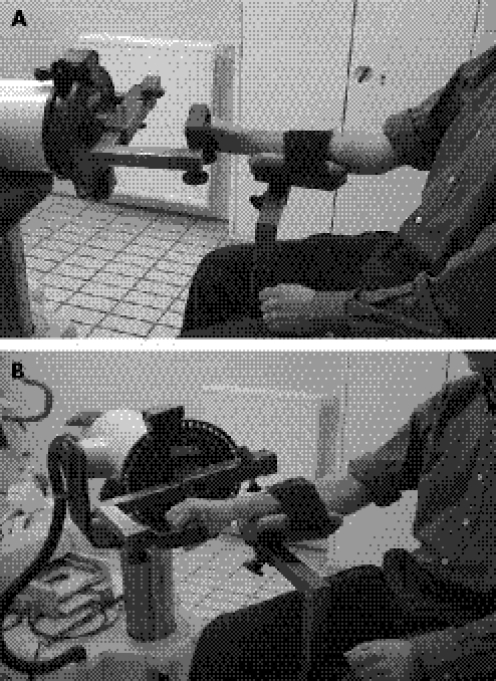
Methods: Ninety-two patients with unilateral chronic lateral epicondylar tendinopathy (mean duration of symptoms 8+/-3 months) were assigned either to a control group (n = 46) or to an eccentrically trained group (n = 46). The control group underwent a passive standardised rehabilitation programme that excluded strengthening exercises. In addition to this programme, the trained group also performed eccentric exercises based on the repetitive lengthening of the active musculo-tendinous unit. The latter exercises started with submaximal contraction intensity and slow speed movement. Modalities were progressively intensified (increase in intensity contraction and speed movement) over a long period of treatment. Programme effectiveness was assessed through pain score evaluation, a disability questionnaire, muscle strength measurement and ultrasonographic examination.
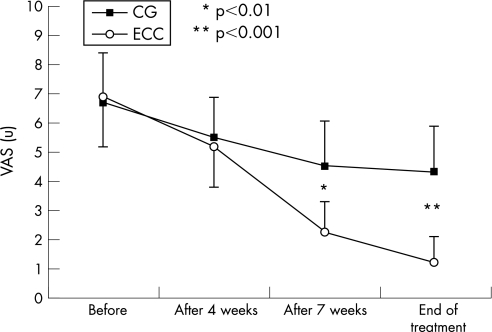
Results: Compared to the non-strengthening control group, the following observations were made in the eccentrically trained group: (1) a significantly more marked reduction of pain intensity, mainly after one month of treatment; (2) an absence of strength deficit on the involved side through bilateral comparison for the forearm supinator and wrist extensor muscles; (3) an improvement of the tendon image as demonstrated by decreasing thickness and a recovered homogenous tendon structure; and (4) a more marked improvement in disability status during occupational, spare time and sports activities.
Conclusion: These results highlight the relevance of implementing isokinetic adapted eccentric training in the management of chronic lateral epicondylar tendinopathy.
References
-
- Hong Q N, Durand M J, Loisel P. Treatment of lateral epicondylitis: Where is the evidence? Joint, Bone, Spine: Rev Rhum 200471369–373. - PubMed
-
- Walker‐Bone K, Palmer K T, Reading I.et al Prevalence and impact of musculoskeletal disorders of the upper limb in the general population. Arthritis Rheum 200451642–651. - PubMed
-
- Ciccotti M G, Charlton W P. Epicondylitis in the athlete. Clin Sports Med 20012077–93. - PubMed
-
- Järvinen M. Epidemiology of tendon injuries in sports. Clin Sports Med 199211493–504. - PubMed
-
- Pienimäki T T, Kauranen K, Vanharanta H. Bilaterally decreased motor performance of arms in patients with chronic tennis elbow. Arch Phys Med Rehabil 1997781092–1095. - PubMed
MeSH terms
LinkOut - more resources
Full Text Sources
Medical
