. 2007 Jan 23;104(4):1219-23.
doi: 10.1073/pnas.0610286104. Epub 2007 Jan 16.

All four CatSper ion channel proteins are required for male fertility and sperm cell hyperactivated motility

Affiliations

All four CatSper ion channel proteins are required for male fertility and sperm cell hyperactivated motility

Huayu Qi et al. Proc Natl Acad Sci U S A. .

Abstract

Mammalian spermatozoa become motile at ejaculation, but before they can fertilize the egg, they must acquire more thrust to penetrate the cumulus and zona pellucida. The forceful asymmetric motion of hyperactivated spermatozoa requires Ca2+ entry into the sperm tail by an alkalinization-activated voltage-sensitive Ca2+-selective current (ICatSper). Hyperactivation requires CatSper1 and CatSper2 putative ion channel genes, but the function of two other related genes (CatSper3 and CatSper4) is not known. Here we show that targeted disruption of murine CatSper3 or CatSper4 also abrogated ICatSper, sperm cell hyperactivated motility and male fertility but did not affect spermatogenesis or initial motility. Direct protein interactions among CatSpers, the sperm specificity of these proteins, and loss of ICatSper in each of the four CatSper-/- mice indicate that CatSpers are highly specialized flagellar proteins.


Conflict of interest statement

Conflict of interest: M.M.M. and J.A.C. are employees of Hydra Biosciences, a company with pending patents related to CatSper protein function. As employees, both have stock options in Hydra Biosciences. D.E.C. also owns stock in Hydra Biosciences. All other authors have no conflict of interest.

Figures
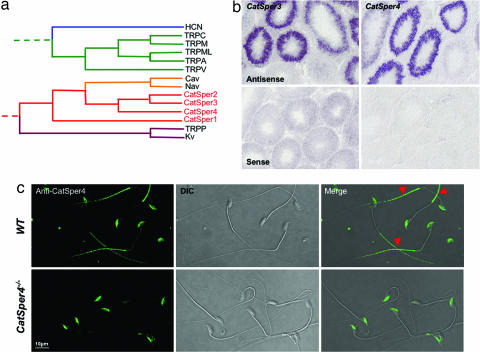
Fig. 1.
Fig. 1.
CatSper ion channels and CatSper3 and CatSper4 localization. (a) Simplified homology tree of voltage-gated ligand ion channels. One representative member of each channel family was chosen and aligned by using an identity matrix with ClustalW (Ver. 1.4). (b) In situ hybridization using CatSper3- and CatSper4-specific probes shows mRNA in specific stages within the testis. CatSper mRNAs were not detected in some stages of spermatogenic cells along the testis seminiferous epithelium, in contrast to the testis sections stained with sense probes. (c) Immunostaining of mouse epididymal sperm with anti-CatSper4 antibody. Labeling of the sperm head is nonspecific, as shown by comparison with the CatSper4−/− sperm; CatSper4 is specifically labeled only in the principal piece of the tail (arrowheads).
Fig. 2.
Fig. 2.
CatSper3−/− and CatSper4−/− male mice are infertile, and their sperm fail to hyperactivate. (a) WT, CatSper3−/−, or CatSper4−/− males (four each) were mated to two WT females over 3 months. WT males fathered 14 litters, compared with no litters for CatSper3−/− and CatSper4−/− males. As expected for WT 129Sv mice, an average of approximately eight pups per litter were born. (b) Initially, the percentage of motile sperm from WT and mutant mice was comparable. Over 90 min, 50–70% of isolated sperm cells from WT mice remained motile, whereas ≈80% of spermatozoa from CatSper−/− mice lost their motility. (c) In standard computer-assisted sperm analysis measurements of path velocity (VAP, velocity of the averaged path), linear velocity, and track velocity, WT and CatSper-null sperm cells were initially similar, with significant differences by 90 min. (d) Mature spermatozoa from WT, CatSper3−/−, or CatSper4−/− mice have normal morphology. (e) Measurement of bending angle (inset, α) shows that capacitated WT sperm cells have larger ranges of motion than CatSper3−/− and CatSper4−/− sperm cells. Thus, mutant mice spermatozoa lack this aspect of hyperactivated motility.
Fig. 3.
Fig. 3.
ICatSper was absent in CatSper−/− sperm. (a) Sperm (WT) whole-cell current evoked by a 1-s ramp from −100 to +100 mV, holding potential (HP) = 0 mV. The Na+-peak current recorded at −100 mV in DVF conditions was −970 pA and decreased to −13 pA in 2 mM Ca2+. (b) Monovalent current through CatSper channels (DVF solution) was absent in CatSper−/− sperm cells. (c) Average of the Na+ current in DVF solution measured from WT and CatSper−/− sperm cells.
Fig. 4.
Fig. 4.
Interactions between CatSper proteins. (a) Epitope-tagged CatSper2 (FLAG-CS2), CatSper3 (HA-CS3), or CatSper4 (FLAG-CS4) were transfected into an MZ8 cell line stably expressing CatSper1 (CS1). FLAG-CatSper2, HA-CatSper3, and FLAG-CatSper4 were detected in the respective cell lysates (Left). After immunoprecipitation with anti-HA and -FLAG antibodies, immune complexes were probed with anti-CatSper1 antibody (Right). Negative controls were lysates from CatSper1 cells transfected with FLAG-GIRK4 or HA-TRPV6. (b) Proteins solubilized from testis microsomes were immunoprecipitated with specific anti-CatSper antibodies. Anti-CatSper3 and -CatSper4 pulled down CatSper3 and CatSper4 from WT testes but not from homozygous mutant testes (Left). These antibodies also pulled down their respective proteins from CatSper1−/− mice (Center). Anti-CatSper1 coimmunoprecipitated CatSper3 and CatSper4 in the same protein complexes from WT but not from CatSper1−/− testes (Right). Bottom Left shows CatSper1 in preparations used for immunoprecipitations; Bottom Right shows immunoprecipitation input control with anti-Na, K-ATPase, a plasma membrane protein.

Comment in

  • Wrath of the wraiths of CatSper3 and CatSper4.
    Babcock DF. Babcock DF. Proc Natl Acad Sci U S A. 2007 Jan 23;104(4):1107-8. doi: 10.1073/pnas.0610909104. Epub 2007 Jan 16. Proc Natl Acad Sci U S A. 2007. PMID: 17227862 Free PMC article. No abstract available.

References

    1. Yanagimachi R. Zygote. 1994;2:371–382. - PubMed
    1. Eisenbach M, Giojalas LC. Nat Rev Mol Cell Biol. 2006;7:276–285. - PubMed
    1. Ho HC, Granish KA, Suarez SS. Dev Biol. 2002;250:208–217. - PubMed
    1. Carlson AE, Westenbroek RE, Quill TA, Ren D, Clapham DE, Hille B, Garbers DL, Babcock DF. Proc Natl Acad Sci USA. 2003;100:14864–14868. - PMC - PubMed
    1. Cooke HJ, Saunders PT. Nat Rev Genet. 2002;3:790–801. - PubMed

Publication types

Associated data
