


Cell cycle progression and de novo centriole assembly after centrosomal removal in untransformed human cells
- PMID: 17227892
- PMCID: PMC2063937
- DOI: 10.1083/jcb.200607073
Cell cycle progression and de novo centriole assembly after centrosomal removal in untransformed human cells
Abstract
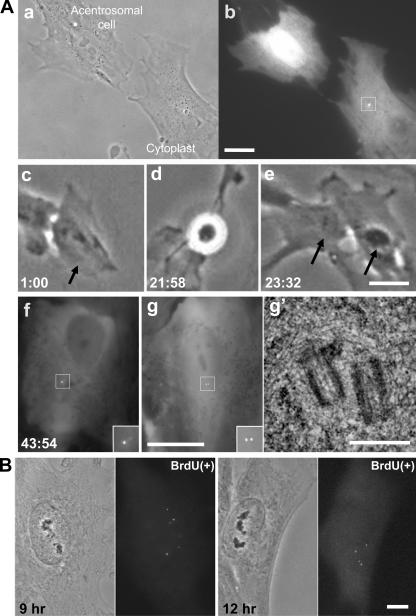
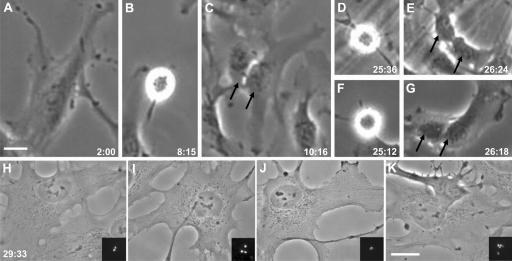
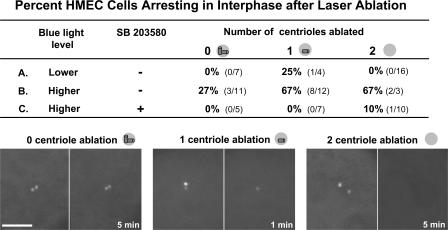
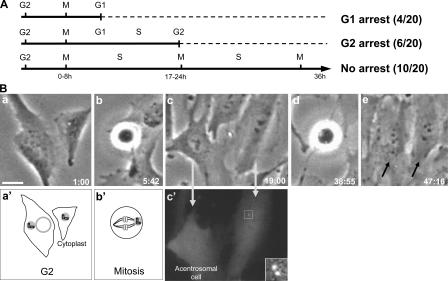
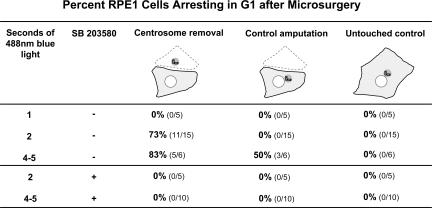
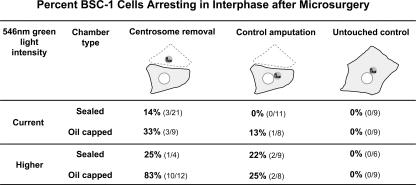
How centrosome removal or perturbations of centrosomal proteins leads to G1 arrest in untransformed mammalian cells has been a mystery. We use microsurgery and laser ablation to remove the centrosome from two types of normal human cells. First, we find that the cells assemble centrioles de novo after centrosome removal; thus, this phenomenon is not restricted to transformed cells. Second, normal cells can progress through G1 in its entirety without centrioles. Therefore, the centrosome is not a necessary, integral part of the mechanisms that drive the cell cycle through G1 into S phase. Third, we provide evidence that centrosome loss is, functionally, a stress that can act additively with other stresses to arrest cells in G1 in a p38-dependent fashion.
Figures
References
-
- Ambrosino, C., and A.R. Nebreda. 2001. Cell cycle regulation by p38 MAP kinases. Biol. Cell. 93:47–51. - PubMed
-
- Doxsey, S., D. McCollum, and W. Theurkauf. 2005. a. Centrosomes in cellular regulation. Annu. Rev. Cell Dev. Biol. 21:411–434. - PubMed
-
- Doxsey, S., W. Zimmerman, and K. Mikule. 2005. b. Centrosome control of the cell cycle. Trends Cell Biol. 15:303–311. - PubMed
-
- Ehrhardt, A.G., and G. Sluder. 2005. Spindle pole fragmentation due to proteasome inhibition. J. Cell. Physiol. 204:808–818. - PubMed
