


COBAS AmpliPrep-COBAS TaqMan hepatitis B virus (HBV) test: a novel automated real-time PCR assay for quantification of HBV DNA in plasma
- PMID: 17229858
- PMCID: PMC1829141
- DOI: 10.1128/JCM.00914-06
COBAS AmpliPrep-COBAS TaqMan hepatitis B virus (HBV) test: a novel automated real-time PCR assay for quantification of HBV DNA in plasma
Abstract
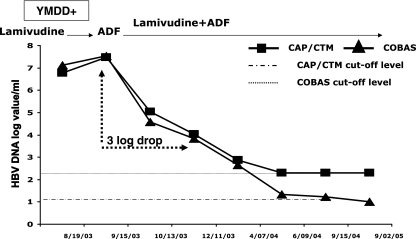
Success in antiviral therapy for chronic hepatitis B is supported by highly sensitive PCR-based assays for hepatitis B virus (HBV) DNA. Nucleic acid extraction from biologic specimens is technically demanding, and reliable PCR results depend on it. The performances of the fully automatic system COBAS AmpliPrep-COBAS TaqMan 48 (CAP-CTM; Roche, Branchburg, NJ) for HBV DNA extraction and real-time PCR quantification were assessed and compared to the endpoint PCR COBAS AMPLICOR HBV monitor (CAHBM; Roche). Analytical evaluation with a proficiency panel showed that CAP-CTM quantitated HBV DNA levels in one single run over a wide dynamic range (7 logs) with a close correlation between expected and observed values (r = 0.976, interassay variability below 5%). Clinical evaluation, as tested with samples from 92 HBsAg-positive patients, demonstrated excellent correlation with CAHBM (r = 0.966, mean difference in quantitation = 0.36 log(10) IU/ml). CAP-CTM detected 10% more viremic patients and longer periods of residual viremia in those on therapy. In lamivudine (LAM)-resistant patients, the reduction of HBV DNA after 12 months of Adefovir (ADF) was higher in the combination (LAM+ADF) schedule than in ADF monotherapy (5.1 logs versus 3.5 logs), suggesting a benefit in continuing LAM. CAP-CTM detected HBV DNA in liver biopsy samples from 15% of HBsAg-negative, anti-HBcAg-positive graft donors with no HBV DNA in plasma. The amount of intrahepatic HBV DNA was significantly lower in occult HBV infection than in overt disease. CAP-CTM can improve the management of HBV infection and the assessment of antiviral therapy and drug resistance, supporting further insights in the emerging area of occult HBV infection.
Figures

References
-
- Allain, J. P. 2004. Occult hepatitis B virus infection: implications in transfusion. Vox Sang 86:83-91. - PubMed
-
- Brechot. C., V. Thiers, D. Kremsdorf, B. Nalpas, S. Pol, and P. Paterlini-Brechot. 2001. Persistent hepatitis B virus infection in subjects without hepatitis B surface antigen: clinically significant or purely “occult”? Hepatology 34:194-203. - PubMed
-
- Brechot, C. 2004. Pathogenesis of hepatitis B virus-related hepatocellular carcinoma: old and new paradigms. Gastroenterology 127:S56-S61. - PubMed
-
- Cacciola, I., T. Pollicino, G. Squadrito, G. Cerenzia, M. E. Orlando, and G. Raimondo. 1999. Occult hepatitis B virus infection in patients with chronic hepatitis C liver disease. N. Engl. J. Med. 341:22-26. - PubMed
-
- Cacciola, I., T. Pollicino, G. Squadrito, G. Cerenzia, D. Villari, R. de Franchis, T. Santantonio, S. Brancatelli, G. Colucci, and G. Raimondo. 2000. Quantification of intrahepatic hepatitis B virus (HBV) DNA in patients with chronic HBV infection. Hepatology 31:507-512. - PubMed
Publication types
MeSH terms
Substances
LinkOut - more resources
Full Text Sources
Research Materials
Miscellaneous
