doi: 10.1128/JCM.02426-06.
Epub 2007 Jan 17.
Generic detection of coronaviruses and differentiation at the prototype strain level by reverse transcription-PCR and nonfluorescent low-density microarray
Affiliations
- PMID: 17229859
- PMCID: PMC1829107
- DOI: 10.1128/JCM.02426-06
Item in Clipboard
Generic detection of coronaviruses and differentiation at the prototype strain level by reverse transcription-PCR and nonfluorescent low-density microarray
J Clin Microbiol.
2007 Mar.
Abstract
A nonfluorescent low-cost, low-density oligonucleotide array was designed for detecting the whole coronavirus genus after reverse transcription (RT)-PCR. The limit of detection was 15.7 copies/reaction. The clinical detection limit in patients with severe acute respiratory syndrome was 100 copies/sample. In 39 children suffering from coronavirus 229E, NL63, OC43, or HKU1, the sensitivity was equal to that of individual real-time RT-PCRs.
Figures
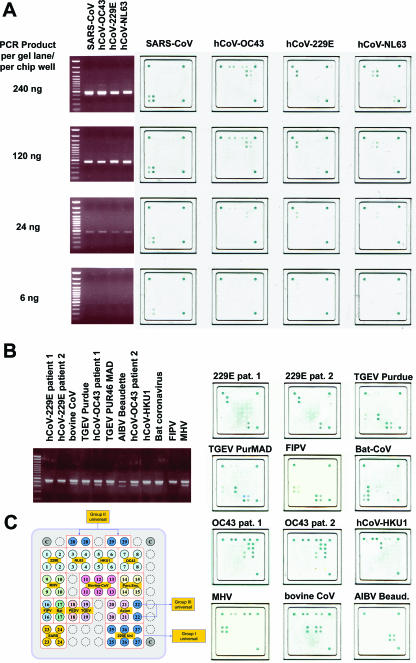
(A) For four different prototype coronaviruses, as indicated above the four rightmost panels, the amounts of DNA shown in the left column were subjected to gel analysis or array hybridization. Blue dots on the arrays represent hybridization signals. (B) Prototype coronaviruses as indicated above each agarose gel slot were amplified, and the depicted PCR products were hybridized to oligonucleotide arrays as shown in the panel on the right. (C) Spotting pattern of oligonucleotides on array. Each coronavirus group (I to III) is represented by a set of universal probes (blue). Strain-specific probes are depicted in different colors. Each probe is represented at least in duplicate spots. Spots in the upper left and right, as well as in the lower right corner, are staining controls containing biotin. Abbreviations: TGEV, transmissible gastroenteritis virus; AIBV, avian infectious bronchitis virus; FIPV, feline infectious peritonitis virus; MHV, mouse hepatitis virus.
References
-
- Aragon, L. M., F. Navarro, V. Heiser, M. Garrigo, M. Espanol, and P. Coll. 2006. Rapid detection of specific gene mutations associated with isoniazid or rifampicin resistance in Mycobacterium tuberculosis clinical isolates using non-fluorescent low-density DNA microarrays. J. Antimicrob. Chemother. 57:825-831. - PubMed
-
- Cavanagh, D. 1997. Nidovirales: a new order comprising Coronaviridae and Arteriviridae. Arch. Virol. 142:629-633. - PubMed
-
- Drosten, C., L. L. Chiu, M. Panning, H. N. Leong, W. Preiser, J. S. Tam, S. Gunther, S. Kramme, P. Emmerich, W. L. Ng, H. Schmitz, and E. S. Koay. 2004. Evaluation of advanced reverse transcription-PCR assays and an alternative PCR target region for detection of severe acute respiratory syndrome-associated coronavirus. J. Clin. Microbiol. 42:2043-2047. - PMC - PubMed
-
- Drosten, C., S. Gottig, S. Schilling, M. Asper, M. Panning, H. Schmitz, and S. Gunther. 2002. Rapid detection and quantification of RNA of Ebola and Marburg viruses, Lassa virus, Crimean-Congo hemorrhagic fever virus, Rift Valley fever virus, dengue virus, and yellow fever virus by real-time reverse transcription-PCR. J. Clin. Microbiol. 40:2323-2330. - PMC - PubMed
Publication types
MeSH terms
Substances
LinkOut - more resources
Full Text Sources
Other Literature Sources