A randomised comparison of deferasirox versus deferoxamine for the treatment of transfusional iron overload in sickle cell disease
- PMID: 17233848
- PMCID: PMC1974786
- DOI: 10.1111/j.1365-2141.2006.06455.x
A randomised comparison of deferasirox versus deferoxamine for the treatment of transfusional iron overload in sickle cell disease
Abstract
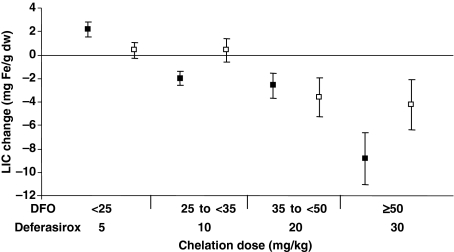
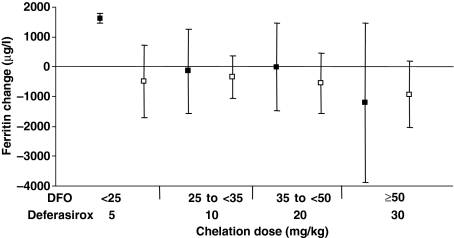
Deferasirox is a once-daily, oral iron chelator developed for treating transfusional iron overload. Preclinical studies indicated that the kidney was a potential target organ of toxicity. As patients with sickle cell disease often have abnormal baseline renal function, the primary objective of this randomised, open-label, phase II trial was to evaluate the safety and tolerability of deferasirox in comparison with deferoxamine in this population. Assessment of efficacy, as measured by change in liver iron concentration (LIC) using biosusceptometry, was a secondary objective. A total of 195 adult and paediatric patients received deferasirox (n = 132) or deferoxamine (n = 63). Adverse events most commonly associated with deferasirox were mild, including transient nausea, vomiting, diarrhoea, abdominal pain and skin rash. Abnormal laboratory studies with deferasirox were occasionally associated with mild non-progressive increases in serum creatinine and reversible elevations in liver function tests. Discontinuation rates from deferasirox (11.4%) and deferoxamine (11.1%) were similar. Over 1 year, similar dose-dependent LIC reductions were observed with deferasirox and deferoxamine. Once-daily oral deferasirox has acceptable tolerability and appears to have similar efficacy to deferoxamine in reducing iron burden in transfused patients with sickle cell disease.
Figures
References
-
- Adams RJ, McKie VC, Hsu L, Files B, Vichinsky E, Pegelow C, Abboud M, Gallagher D, Kutlar A, Nichols FT, Bonds DR, Brambilla D. Prevention of a first stroke by transfusions in children with sickle cell anemia and abnormal results on transcranial Doppler ultrasonography. New England Journal of Medicine. 1998;339:5–11. - PubMed
-
- Ballas SK. Iron overload is a determinant of morbidity and mortality in adult patients with sickle cell disease. Seminars in Hematology. 2001;38(Suppl. 1):30–36. - PubMed
-
- Brittenham GM, Farrel DE, Harris JW, Feldman ES, Danish EH, Muir WA, Tripp JH, Bellon EM. Magnetic susceptibility measurement of human iron stores. New England Journal of Medicine. 1982;307:1671–1675. - PubMed
-
- Brittenham GM, Cohen AR, McLaren CE, Martin MB, Griffith PM, Nienhuis AW, Young NS, Allen CJ, Farrell DE, Harris JW. Hepatic iron stores and plasma ferritin concentration in patients with sickle cell anemia and thalassemia major. American Journal of Hematology. 1993;42:81–85. - PubMed
-
- Cappellini MD, Cohen A, Piga A, Bejaoui M, Perrotta S, Agaoglu L, Aydinok Y, Kattamis A, Kilinc Y, Porter J, Capra M, Galanello R, Fattoum S, Drelichman G, Magnano C, Verissimo M, Athanassiou-Metaxa M, Giardina P, Kourakli-Symeonidis A, Janka-Schaub G, Coates T, Vermylen C, Olivieri N, Thuret I, Opitz H, Ressayre-Dfaffer C, Marks P, Alberti D. A Phase III study of deferasirox (ICL670), a once-daily oral iron chelator, in patients with β-thalassemia. Blood. 2006;107:3455–3462. - PubMed
Publication types
MeSH terms
Substances
LinkOut - more resources
Full Text Sources
Other Literature Sources
Medical