


Family presence and surveillance during weaning from prolonged mechanical ventilation
- PMID: 17234477
- PMCID: PMC2077984
- DOI: 10.1016/j.hrtlng.2006.07.002
Family presence and surveillance during weaning from prolonged mechanical ventilation
Abstract
Objectives: The research was designed to describe the care and communication processes during weaning from long-term mechanical ventilation (LTMV). A portion of those findings, specifically, how family members interact with the patient and respond to the ventilator and associated intensive care unit bedside equipment during LTMV weaning, are reported here.
Methods: Ethnography was conducted in a medical intensive care unit (MICU) and step-down MICU following 30 adults who were being weaned from LTMV (>4 days). Data collection involved field observations conducted from November 2001 to July 2003; interviews with patients, family members, and MICU clinicians; and clinical record review.
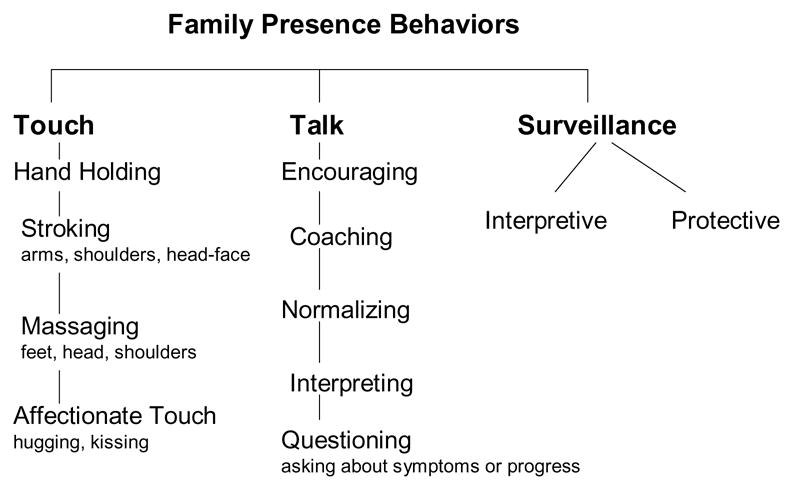
Results: Family members were present at the patients' bedside during 46% of weaning trials and interacted with patients through touch, talking, and surveillance. Families' bedside surveillance activities were interpretive of numeric monitor displays and laboratory values, protective of patient safety and comfort, and often focused exclusively on weaning. Interpretive language and surveillance were learned from and imitative of clinician behaviors. Clinicians characterized the family's presence as helpful, a hindrance, or having no effect on the weaning process. Quantitative analysis using random coefficient modeling examining the effect of family presence on length of weaning trials showed significantly longer daily weaning trials when families were present (P < .0001).
Conclusion: Critical care clinicians influence families' acquisition of interpretive surveillance skills at the bedside of patients who are being weaned from LTMV. This study provides a potentially useful conceptual framework of family behaviors with long-term critically ill patients that could enhance the dialogue about family-centered care and guide future research on family presence in the intensive care unit.
Figures
References
-
- Auerbach SM, Kiesler DJ, Wartella J, Rausch S, Ward KR, Ivatury R. Optimism, satisfaction with needs met, interpersonal perceptions of the healthcare team, and emotional distress in patients’ family members during critical care hospitalization. Am J Crit Care. 2005;14(3):202–210. - PubMed
-
- Bouman CC. Identifying priority concerns of families of ICU patients. Dimens Crit Care Nurs. 1984;3(5):313–319. - PubMed
-
- Burr G. Contextualizing critical care family needs through triangulation: an Australian study. Intensive Crit Care Nurs. 1998;14(4):161–169. - PubMed
-
- Daley L. The perceived immediate needs of families with relatives in the intensive care setting. Heart Lung. 1984;13(3):231–237. - PubMed
-
- Hickey M. What are the needs of families of critically ill patients? A review of the literature since 1976. Heart Lung. 1990;19(4):401–415. - PubMed
