


Relationships of circulating carotenoid concentrations with several markers of inflammation, oxidative stress, and endothelial dysfunction: the Coronary Artery Risk Development in Young Adults (CARDIA)/Young Adult Longitudinal Trends in Antioxidants (YALTA) study
- PMID: 17234732
- PMCID: PMC2440581
- DOI: 10.1373/clinchem.2006.074930
Relationships of circulating carotenoid concentrations with several markers of inflammation, oxidative stress, and endothelial dysfunction: the Coronary Artery Risk Development in Young Adults (CARDIA)/Young Adult Longitudinal Trends in Antioxidants (YALTA) study
Abstract
Background: Serum carotenoid concentrations relate inversely to cardiovascular disease incidence. To clarify the effect of carotenoids on atherosclerotic risk factors, we examined the association of circulating carotenoids with inflammation, oxidative stress, endothelial dysfunction, and smoking.
Methods: Black and white men and women in the Coronary Artery Risk Development in Young Adults study, ages 18 to 30 years at recruitment (1985-1986) from 4 US cities, were investigated over 15 years. We included 2048 to 4580 participants in analyses of the sum of serum alpha-carotene, beta-carotene, zeaxanthin/lutein, and beta-cryptoxanthin concentrations and of lycopene at year 0 and at year 7.
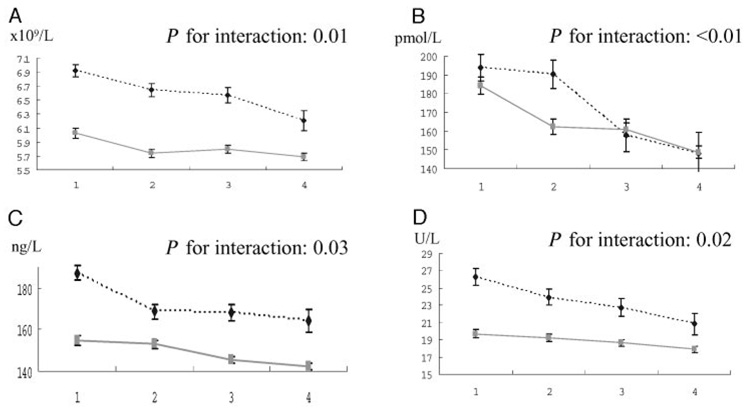
Results: The year 0 sum of 4 carotenoids was inversely associated (all P <0.05) with year 0 leukocyte count (slope per sum carotenoid SD, -0.17); year 7 fibrinogen (slope, -0.10); year 7 and year 15 C-reactive protein (slope, -0.12 and -0.09); and year 15 F(2)-isoprostanes (slope, -13.0), soluble P-selectin (slope, -0.48), and soluble intercellular adhesion molecule-1 (sICAM1; slope, -5.1). Leukocyte counts and sICAM1 and F(2)-isoprostane concentrations had stronger associations in smokers than in nonsmokers, and sICAM1 concentrations were higher in the highest carotenoid quartile in smokers than in the lowest carotenoid quartile in nonsmokers. Superoxide dismutase was positively associated with the sum of 4 carotenoids (slope, 0.12; P <0.01). Lycopene was inversely associated only with sICAM1. The year 7 carotenoid associations with these markers were mostly similar to those at year 0.
Conclusions: Circulating serum carotenoids were associated, some interactively with smoking, in apparently beneficial directions with markers of inflammation, oxidative stress, and endothelial dysfunction.
Figures
References
-
- De Waart FG, Schouten EG, Stalenhoef AF, Kok FJ. Serum carotenoids, α-tocopherol and mortality risk in a prospective study among Dutch elderly. Int J Epidemiol. 2001;30:136–143. - PubMed
-
- Kohlmeier L, Kark JD, Gomez-Gracia E, Martin BC, Steck SE, Kardinaal AF, et al. Lycopene and myocardial infarction risk in the EURAMIC study. Am J Epidemiol. 1997;146:618–626. - PubMed
-
- Evans RW, Shaten BJ, Day BW, Kuller LH. Prospective association between lipid soluble antioxidants and coronary heart disease in men: the Multiple Risk Factor Intervention Trial. Am J Epidemiol. 1998;147:180–186. - PubMed
-
- Buijsse B, Feskens EJ, Schlettwein-Gsell D, Ferry M, Kok FJ, Kromhout D, et al. Plasma carotene and α-tocopherol in relation to 10-y all-cause and cause-specific mortality in European elderly: the Survey in Europe on Nutrition and the Elderly, a Concerted Action (SENECA) Am J Clin Nut. 2005;82:879–886. - PubMed
-
- Fortmann SP, Ford E, Criqui MH, Folsom AR, Harris TB, Hong Y, et al. CDC/AHA Workshop on Markers of Inflammation and Cardiovascular Disease: Application to Clinical and Public Health Practice: report from the population science discussion group. Circulation. 2004;110:e554–e559. - PubMed
Publication types
MeSH terms
Substances
Grants and funding
LinkOut - more resources
Full Text Sources
Medical
Research Materials
