


Cutaneous blood flow and sweat rate responses to exogenous administration of acetylcholine and methacholine
- PMID: 17234802
- PMCID: PMC2442825
- DOI: 10.1152/japplphysiol.01069.2006
Cutaneous blood flow and sweat rate responses to exogenous administration of acetylcholine and methacholine
Abstract
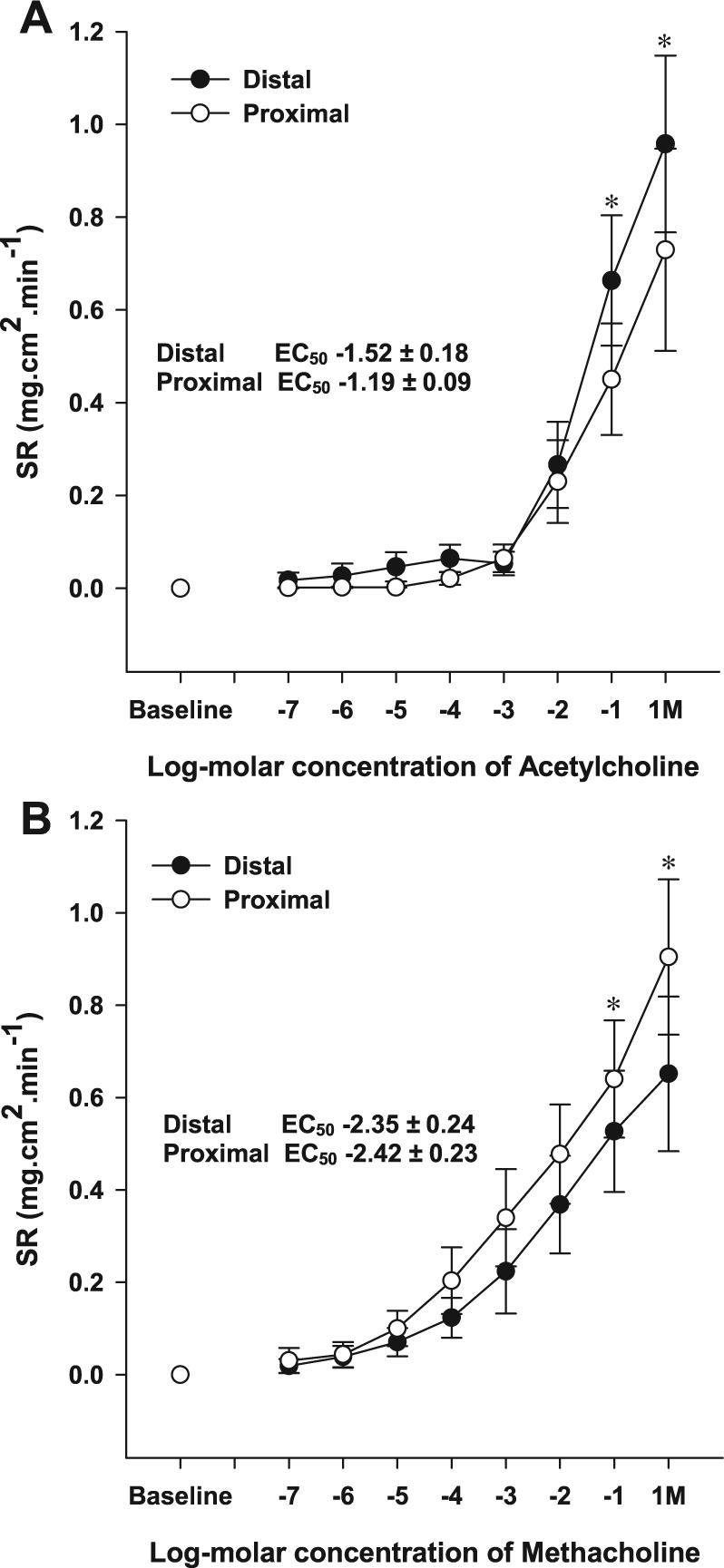
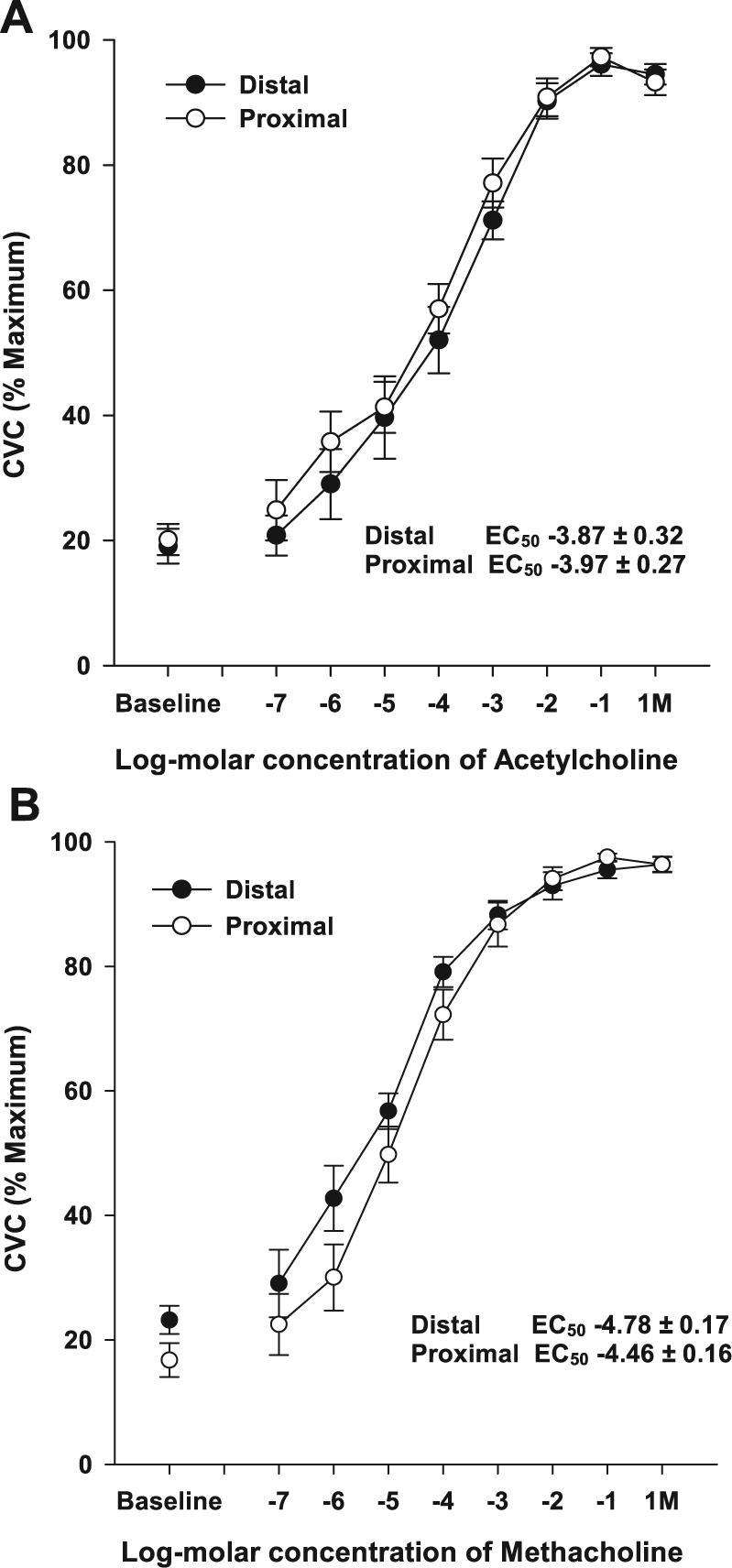
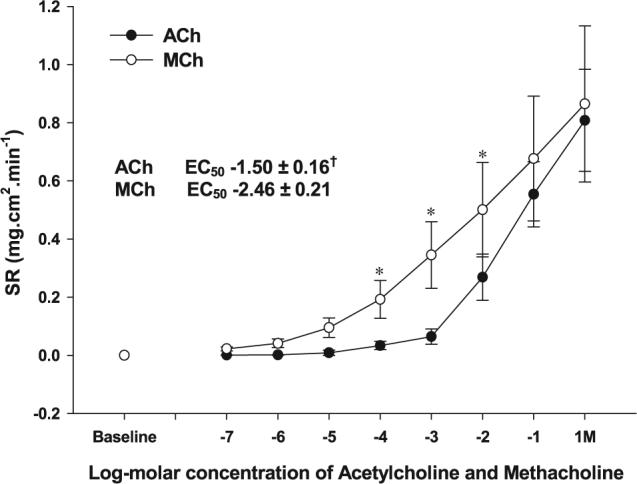
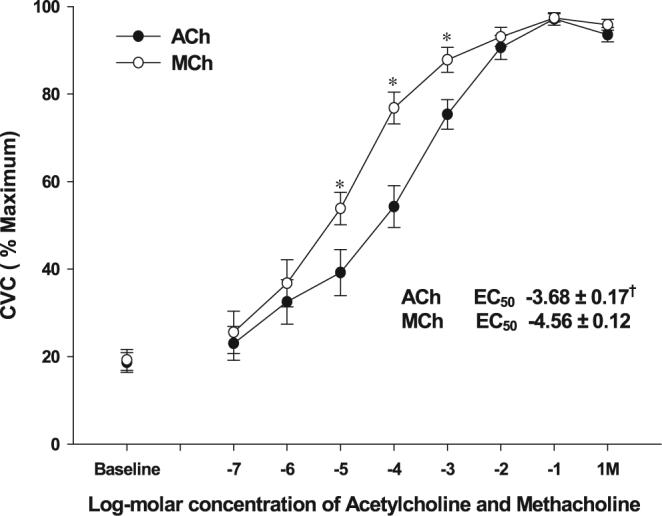
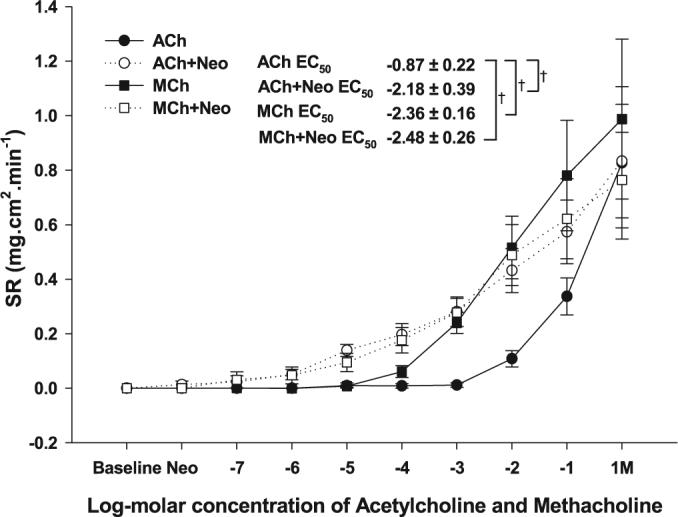
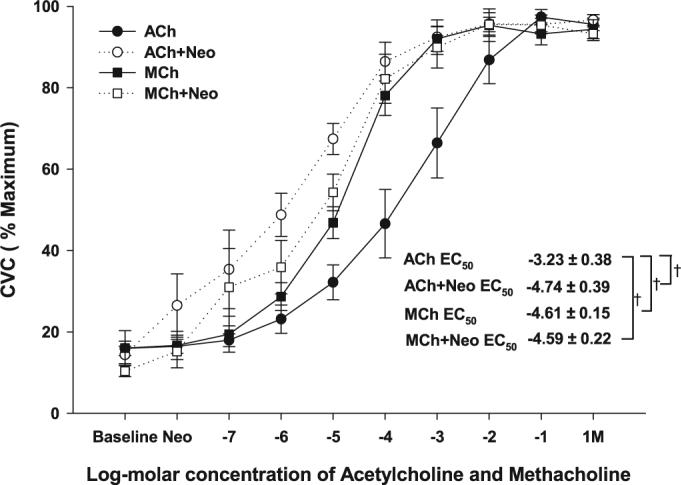
The aim of this study was to evaluate cutaneous vasodilation and sweating responses to exogenous administration of acetylcholine (ACh) and methacholine (MCh), which have different sensitivities to endogenous cholinesterase. Four intradermal microdialysis probes were placed in dorsal forearm skin: two sites were perfused with ACh (1 x 10(-7)-1 M) and the other two with the same molar concentrations of MCh. Sweat rate (SR) and cutaneous blood flow were simultaneously assessed directly over each microdialysis membrane. Dose-response curves were constructed, and the effective concentration of the drug resulting in 50% of the maximal response (EC(50)) was identified. For SR and cutaneous vascular conductance (CVC), there were no significant differences in EC(50) between sites receiving the same drug: -1.52 +/- 0.18 and -1.19 +/- 0.09 log-molar concentration of ACh at distal and proximal sites, respectively, and -2.35 +/- 0.24 and -2.42 +/- 0.23 log-molar concentration of MCh at distal and proximal sites, respectively, for SR (P > 0.05) and -3.87 +/- 0.32 and -3.97 +/- 0.27 log-molar concentration of ACh at distal and proximal sites, respectively, and -4.78 +/- 0.17 and -4.46 +/- 0.16 log-molar concentration of MCh at distal and proximal sites, respectively, for CVC (P > 0.05). However, the EC(50) for CVC and SR was significantly lower at the MCh than at the ACh sites. A second procedure was performed to confirm that differences in responses between ACh and MCh could be attributed to different cholinesterase sensitivities. Similarly, four microdialysis membranes were placed in dorsal forearm skin: two sites were perfused with ACh and other two with MCh. However, one of each of the ACh and MCh sites was also perfused with 10 microM neostigmine (an acetylcholinesterase inhibitor). Neostigmine at the ACh site induced a leftward shift (i.e., lower EC(50)) of the SR and CVC dose-response curves compared with the site treated with ACh alone, resulting in no difference in the EC(50) for SR and CVC between the ACh + neostigmine and the MCh site. These results suggest that elevations in SR and CVC occur earlier with MCh than with ACh treatment because of differences in cholinesterase susceptibility between these drugs.
Figures
Similar articles
-
Role of nitric oxide in methacholine-induced sweating and vasodilation in human skin.J Appl Physiol (1985). 2006 Apr;100(4):1355-60. doi: 10.1152/japplphysiol.00122.2005. Epub 2005 Oct 20. J Appl Physiol (1985). 2006. PMID: 16239618
-
Topical anaesthesia does not affect cutaneous vasomotor or sudomotor responses in human skin.Auton Autacoid Pharmacol. 2013 Oct;33(3-4):25-33. doi: 10.1111/aap.12007. Epub 2013 May 13. Auton Autacoid Pharmacol. 2013. PMID: 23663206 Clinical Trial.
-
Cyclooxygenase inhibition does not alter methacholine-induced sweating.J Appl Physiol (1985). 2014 Nov 1;117(9):1055-62. doi: 10.1152/japplphysiol.00644.2014. Epub 2014 Sep 11. J Appl Physiol (1985). 2014. PMID: 25213633 Free PMC article.
-
Nicotinic receptor activation augments muscarinic receptor-mediated eccrine sweating but not cutaneous vasodilatation in young males.Exp Physiol. 2017 Feb 1;102(2):245-254. doi: 10.1113/EP085916. Epub 2016 Dec 26. Exp Physiol. 2017. PMID: 27859779
-
Regional contributions of nitric oxide synthase to cholinergic cutaneous vasodilatation and sweating in young men.Exp Physiol. 2020 Feb;105(2):236-243. doi: 10.1113/EP088295. Epub 2020 Jan 19. Exp Physiol. 2020. PMID: 31821642
Cited by
-
Sex differences in postsynaptic sweating and cutaneous vasodilation.J Appl Physiol (1985). 2013 Feb;114(3):394-401. doi: 10.1152/japplphysiol.00877.2012. Epub 2012 Nov 15. J Appl Physiol (1985). 2013. PMID: 23154992 Free PMC article.
-
Expression variation and covariation impair analog and enable binary signaling control.Mol Syst Biol. 2018 May 14;14(5):e7997. doi: 10.15252/msb.20177997. Mol Syst Biol. 2018. PMID: 29759982 Free PMC article.
-
Age-related differences in postsynaptic increases in sweating and skin blood flow postexercise.Physiol Rep. 2014 Jul 16;2(7):e12078. doi: 10.14814/phy2.12078. Physiol Rep. 2014. PMID: 25347861 Free PMC article.
-
Activation of cholinergic anti-inflammatory pathway involved in therapeutic actions of α-mangostin on lipopolysaccharide-induced acute lung injury in rats.Int J Immunopathol Pharmacol. 2020 Jan-Dec;34:2058738420954941. doi: 10.1177/2058738420954941. Int J Immunopathol Pharmacol. 2020. PMID: 32886564 Free PMC article.
-
Vasodilatation in the rat dorsal hindpaw induced by activation of sensory neurons is reduced by paclitaxel.Neurotoxicology. 2011 Jan;32(1):140-9. doi: 10.1016/j.neuro.2010.09.006. Epub 2010 Oct 7. Neurotoxicology. 2011. PMID: 20932997 Free PMC article.
References
-
- Andreassen AK, Gullestad L, Holm T, Simonsen S, Kvernebo K. Endothelium-dependent vasodilation of the skin microcirculation in heart transplant recipients. Clin Transplant. 1998;12:324–332. - PubMed
-
- Benarroch EE. The acetylcholine-induced flare response in evaluation. Ann Neurol. 1991;29:590–595. - PubMed
-
- Berghoff M, Kilo S, Hilz MJ, Freeman R. Differential impairment of the sudomotor and nociceptor axon-reflex in diabetic peripheral neuropathy. Muscle Nerve. 2006;33:494–499. - PubMed
-
- Boutsiouki P, Georgiou S, Clough GF. Recovery of nitric oxide from acetylcholine-mediated vasodilatation in human skin in vivo. Microcirculation. 2004;11:249–259. - PubMed
Publication types
MeSH terms
Substances
Grants and funding
LinkOut - more resources
Full Text Sources
Research Materials
