


Genomewide scan for linkage reveals evidence of several susceptibility loci for alopecia areata
- PMID: 17236136
- PMCID: PMC1785354
- DOI: 10.1086/511442
Genomewide scan for linkage reveals evidence of several susceptibility loci for alopecia areata
Abstract
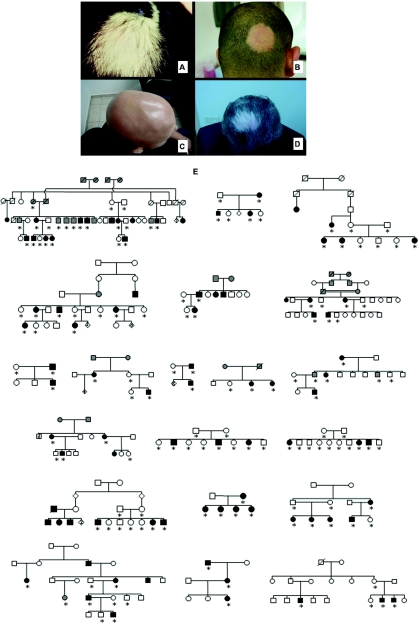
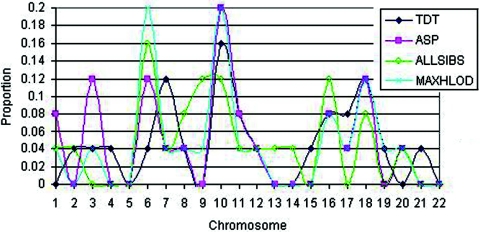
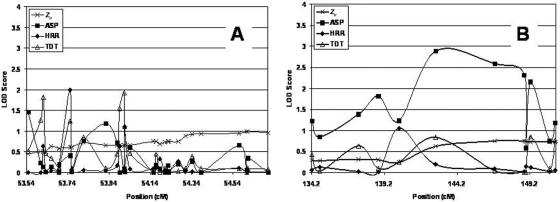
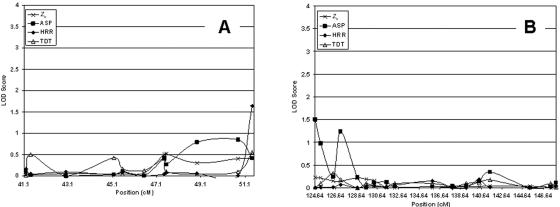
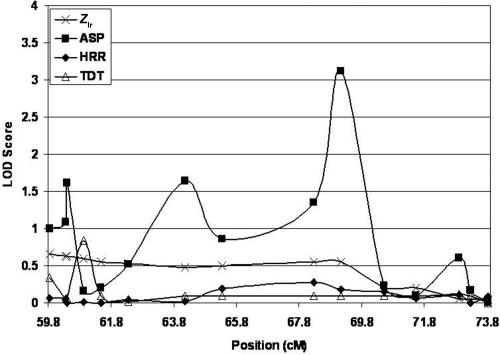
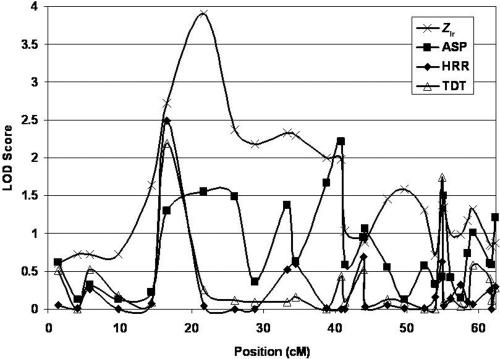
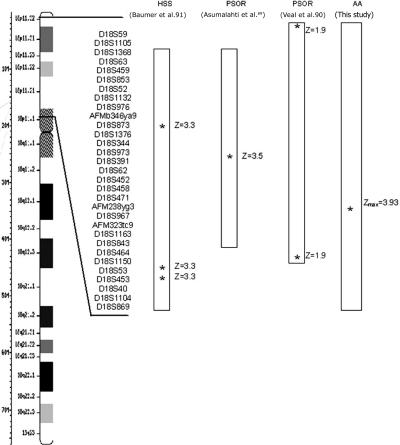
Alopecia areata (AA) is a genetically determined, immune-mediated disorder of the hair follicle that affects 1%-2% of the U.S. population. It is defined by a spectrum of severity that ranges from patchy localized hair loss on the scalp to the complete absence of hair everywhere on the body. In an effort to define the genetic basis of AA, we performed a genomewide search for linkage in 20 families with AA consisting of 102 affected and 118 unaffected individuals from the United States and Israel. Our analysis revealed evidence of at least four susceptibility loci on chromosomes 6, 10, 16 and 18, by use of several different statistical approaches. Fine-mapping analysis with additional families yielded a maximum multipoint LOD score of 3.93 on chromosome 18, a two-point affected sib pair (ASP) LOD score of 3.11 on chromosome 16, several ASP LOD scores >2.00 on chromosome 6q, and a haplotype-based relative risk LOD of 2.00 on chromosome 6p (in the major histocompatibility complex locus). Our findings confirm previous studies of association of the human leukocyte antigen locus with human AA, as well as the C3H-HeJ mouse model for AA. Interestingly, the major loci on chromosomes 16 and 18 coincide with loci for psoriasis reported elsewhere. These results suggest that these regions may harbor gene(s) involved in a number of different skin and hair disorders.
Figures
References
Web Resources
-
- National Alopecia Areata Foundation, http://www.naaf.org/
-
- National Alopecia Areata Registry, http://www.mdanderson.org/departments/alopecia/
-
- Online Mendelian Inheritance in Man (OMIM), http://www.ncbi.nlm.nih.gov/Omim/ (for AA, HLA alleles, IL1, MX1, MICA, PTPN22, IL1RN, IL1F5, Down syndrome, ASP1, AIRE, Crohn disease, NOD2, CFH, and age-related macular degeneration)
References
-
- Barlag K, Ruzicka T (1995) Sudden graying or whitening of the scalp hair [in German]. Dtsch Med Wochenschr 120:158–159 - PubMed
Publication types
MeSH terms
Grants and funding
LinkOut - more resources
Full Text Sources
Other Literature Sources
Medical
Molecular Biology Databases
