


Capsaicin exposure elicits complex airway defensive motor patterns in normal humans in a concentration-dependent manner
- PMID: 17236796
- PMCID: PMC3121193
- DOI: 10.1016/j.pupt.2006.11.006
Capsaicin exposure elicits complex airway defensive motor patterns in normal humans in a concentration-dependent manner
Abstract
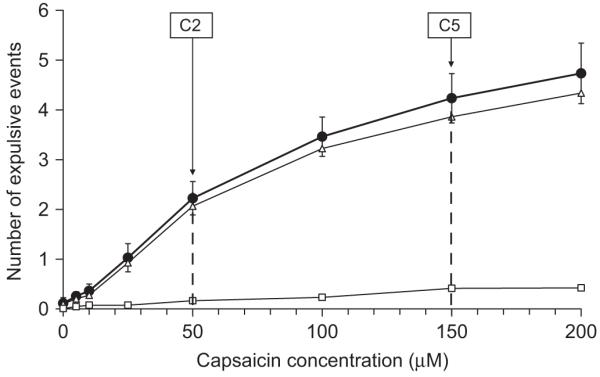
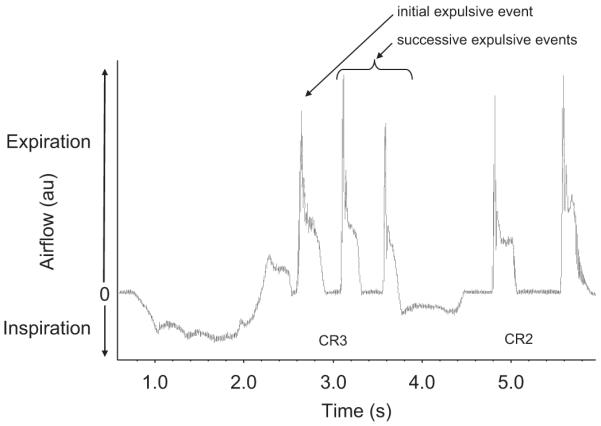
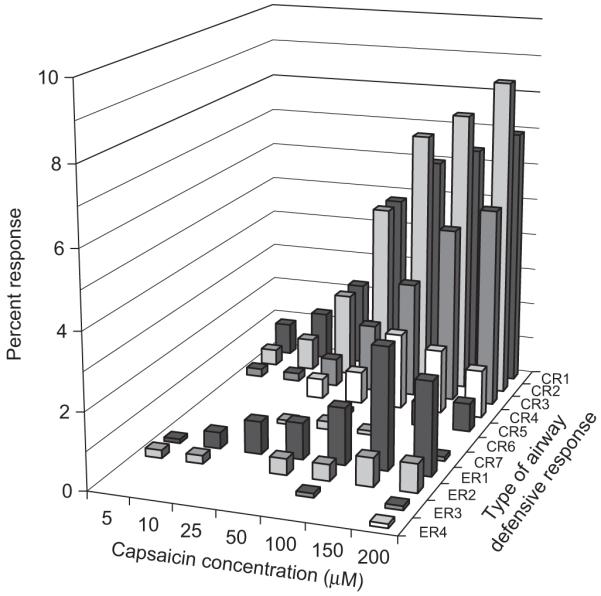
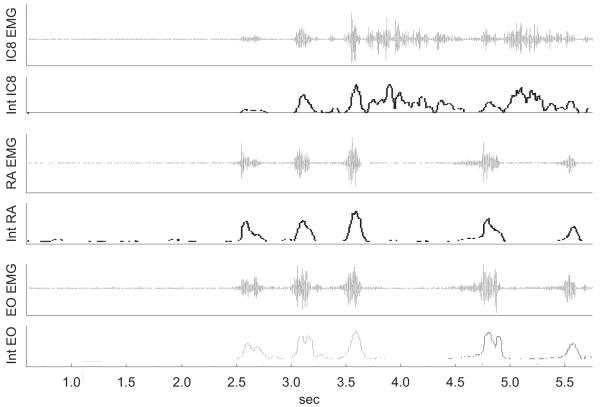
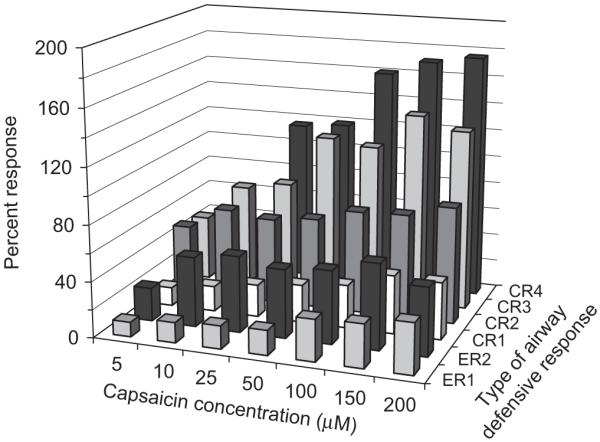
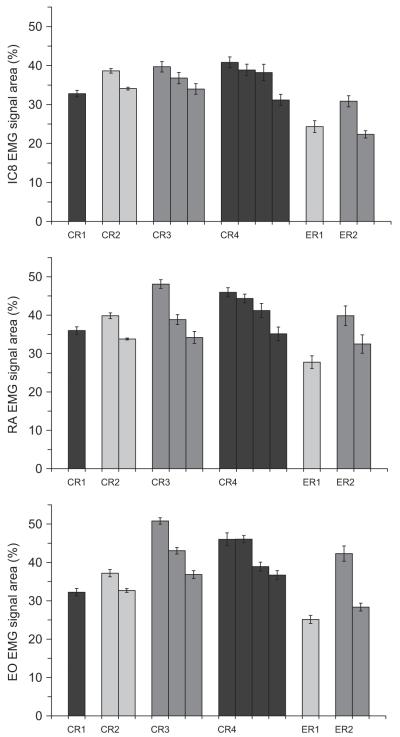
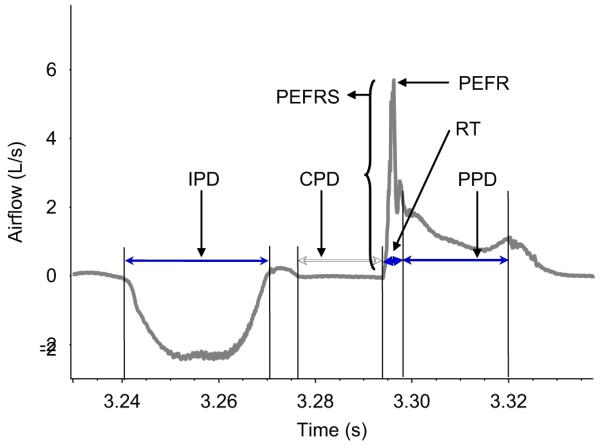
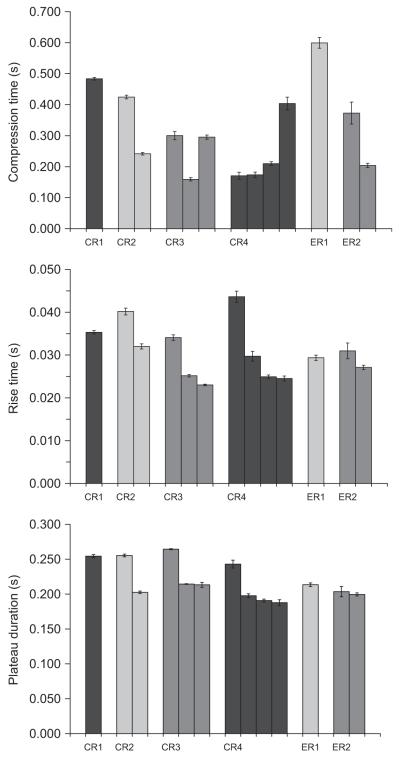
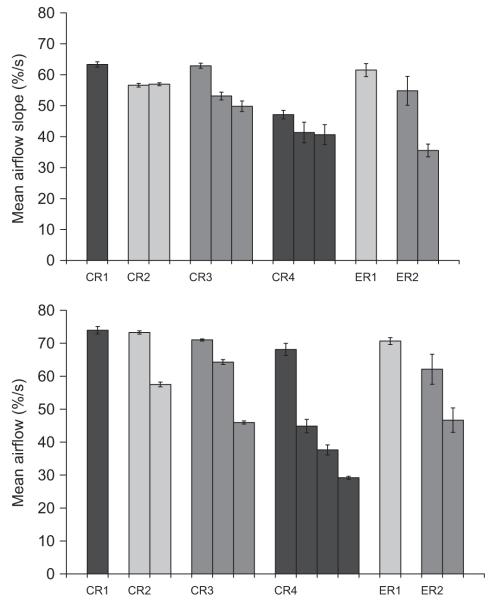
The airway defensive response to tussive agents, such as capsaicin, is frequently assessed by counting the number of cough sounds, or expulsive events. This method does not identify or differentiate important respiratory events that occur in the respiratory muscles and lungs, which are critical in assessing airway defensive responses. The purpose of this study was to characterize the airway defensive behaviours (cough and expiration reflex) to capsaicin exposure in humans. We observed complex motor behaviours in response to capsaicin exposure. These behaviours were defined as cough reacceleration (CRn) and expiration reflex (ERn), where n is the number of expulsive events with and without a preceding inspiratory phase, respectively. Airway defensive responses were defined in terms of frequency (number of expulsive events), strength (activation of abdominal muscles) and behaviour type (CRn vs. ERn). Thirty-six subjects (15 females, 24+/-4 yr) were instrumented with EMG electrodes placed over the rectus abdominis (RA), external abdominal oblique (EO) and the 8th intercostal space (IC8). A custom-designed mouth pneumotachograph was used to assess the airflow acceleration, plateau velocity and phase duration of the expulsive phase. Subjects inhaled seven concentrations of capsaicin (5-200 microM) in a randomized block order. The total number of expulsive events (frequency) and the sum of integrated EMG for the IC8, RA and EO (strength) increased in a curvilinear fashion. Differentiating the airway defense responses into type demonstrated predominately CR1 and CR2 (i.e. inspiration followed by one and two expulsive events, respectively) with very few ER's at <50 microM capsaicin. At higher concentrations (>50 microM) ER's with one or more expulsive events (ER1) appeared, and the number of CR's with three or more expulsive events (CR3) increased. The decrease in EMG activation and airflow measurements with each successive expulsive event suggests a decline in power and shear force as the number of expulsive events increased. Therefore, the airway defensive response to capsaicin is a complex motor pattern that functions to coordinate ER's and CR's with differing numbers of expulsive events possibly to prevent aspirations and keep air moving to promote clearance.
Figures
References
-
- National Ambulatory Care Survey: 1989 Results Series 13 # 36 (PHS) 92–1771 DHHS. 1992. Medical4.
-
- Bolser DC, DeGennaro FC. Effect of codeine on the inspiratory and expiratory burst pattern during fictive cough in cats. Brain Res. 1994;662:30. - PubMed
-
- Tatar M, Korpas J, Poliacek H, Zahradny V. Changes induced by severe hypoxia in respiratory defence reflexes in anaesthetized cats. Respiration. 1986;49:114–21. - PubMed
-
- Ebihara S, Saito H, Kanda A, Nakajoh M, Takahashi H, Arai H, et al. Impaired efficacy of cough in patients with Parkinson disease. Chest. 2003;124:1009–11. - PubMed
-
- Fontana GA, Pantaleo T, Lavorini F, Benvenuti F, Gangemi S. Defective motor control of coughing in Parkinson’s disease. Am J Respir Crit Care Med. 1998;158:458–64. - PubMed
Publication types
MeSH terms
Substances
Grants and funding
LinkOut - more resources
Full Text Sources
Other Literature Sources
Medical
Miscellaneous
