. 2007 Mar;143(3):1385-97.
doi: 10.1104/pp.106.091736. Epub 2007 Jan 19.

Carbon cycling in Anabaena sp. PCC 7120. Sucrose synthesis in the heterocysts and possible role in nitrogen fixation

Affiliations

Carbon cycling in Anabaena sp. PCC 7120. Sucrose synthesis in the heterocysts and possible role in nitrogen fixation

Andrea C Cumino et al. Plant Physiol. 2007 Mar.

Abstract

Nitrogen (N) available to plants mostly originates from N(2) fixation carried out by prokaryotes. Certain cyanobacterial species contribute to this energetically expensive process related to carbon (C) metabolism. Several filamentous strains differentiate heterocysts, specialized N(2)-fixing cells. To understand how C and N metabolism are regulated in photodiazotrophically grown organisms, we investigated the role of sucrose (Suc) biosynthesis in N(2) fixation in Anabaena sp. PCC 7120 (also known as Nostoc sp. PCC 7120). The presence of two Suc-phosphate synthases (SPS), SPS-A and SPS-B, directly involved in Suc synthesis with different glucosyl donor specificity, seems to be important in the N(2)-fixing filament. Measurement of enzyme activity and polypeptide levels plus reverse transcription-polymerase chain reaction experiments showed that total SPS expression is greater in cells grown in N(2) versus combined N conditions. Only SPS-B, however, was seen to be active in the heterocyst, as confirmed by analysis of green fluorescent protein reporters. SPS-B gene expression is likely controlled at the transcriptional initiation level, probably in relation to a global N regulator. Metabolic control analysis indicated that the metabolism of glycogen and Suc is likely interconnected in N(2)-fixing filaments. These findings suggest that N(2) fixation may be spatially compatible with Suc synthesis and support the role of the disaccharide as an intermediate in the reduced C flux in heterocyst-forming cyanobacteria.


Figures
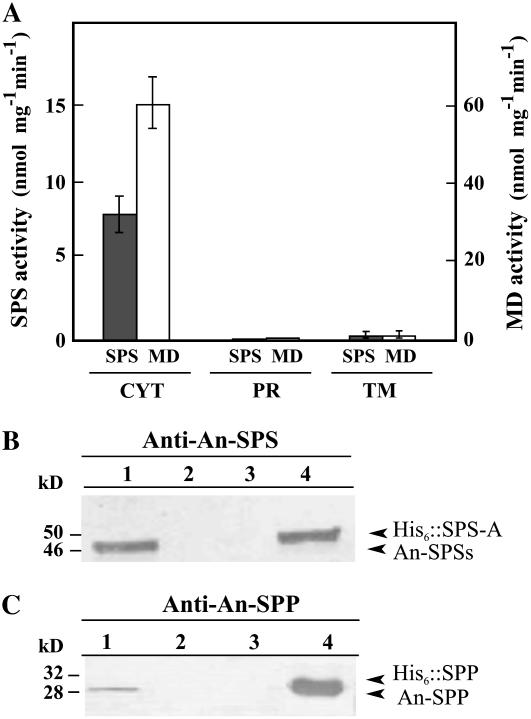
Figure 1.
Figure 1.
Subcellular localization of Suc biosynthesis enzymes in Anabaena sp. PCC 7120 cells. A, SPS activity from cytoplasmic (CYT), periplasmic (PR), and total membrane (TM) protein extracts. Malate dehydrogenase (MD) activity was used as the cytoplasmic marker. SPS activity was assayed in the presence of UDP-Glc. Data are the mean ± se of five independent experiments. B and C, Immunoblotting of protein extracts. Lanes 1 to 3, CYT, PR, and TM, respectively. Lane 4, Control proteins (His6∷SPS-A [50 kD] or His6∷SPP [32 kD]). Polypeptides were revealed with anti-An-SPS (B) or anti-An-SPP (C). Approximately 200 and 1.5 μg of protein were loaded on lanes 1 to 3 and 4, respectively. Positions of molecular mass markers are indicated on the left (kD); arrowheads indicate the positions of native Anabaena SPSs (An-SPSs, approximately 46 kD), SPP (An-SPP, approximately 28 kD), and the recombinant proteins.
Figure 2.
Figure 2.
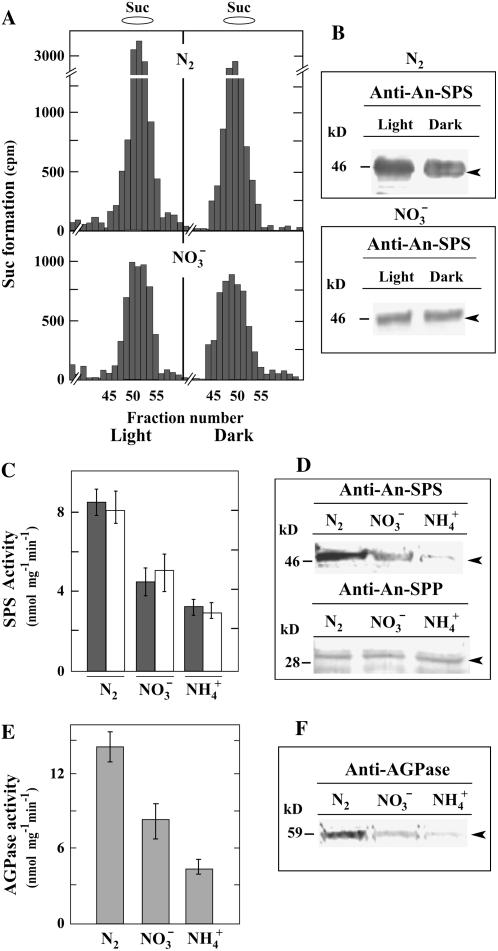
Effect of N source on SPS, SPP, and AGPase expression in Anabaena sp. PCC 7120 cells. A, Effect of light on the synthesis of Suc. Cells grown in N2-fixing (N2) or nitrate (NO3) environment (top/bottom) were harvested during midlight or middark, permeabilized with toluene, and incubated with UDP-[U-14C]Glc and Fru-6P. Labeled products were chromatographically separated and radioactivity determined in each fraction. The position of standard Suc is indicated at the top. B, Immunoblot analysis of proteins (100 μg/lane) from cells grown in N2 (top) or NO3 (bottom) revealed with anti-An-SPS. Cells were harvested in the midlight or middark. C to F, Cells grown in N2, NO3, or ammonium (NH4+) assimilation conditions and harvested during midlight. C, SPS activity assayed in the presence of UDP-Glc (dark gray bars) or ADP-Glc (white bars). Data are the mean ± se of five independent experiments. D, Immunoblot analysis using anti-An-SPS (top, 100 μg/lane) or anti-An-SPP (bottom, 40 μg/lane). Positions of molecular mass markers indicated on the left (kD); arrowheads indicate position of Anabaena SPSs or SPP. E, AGPase activity. Data are the mean ± se of three independent experiments. F, Immunoblot analysis (40 μg/lane) revealed with anti-An-AGPase.
Figure 3.
Figure 3.
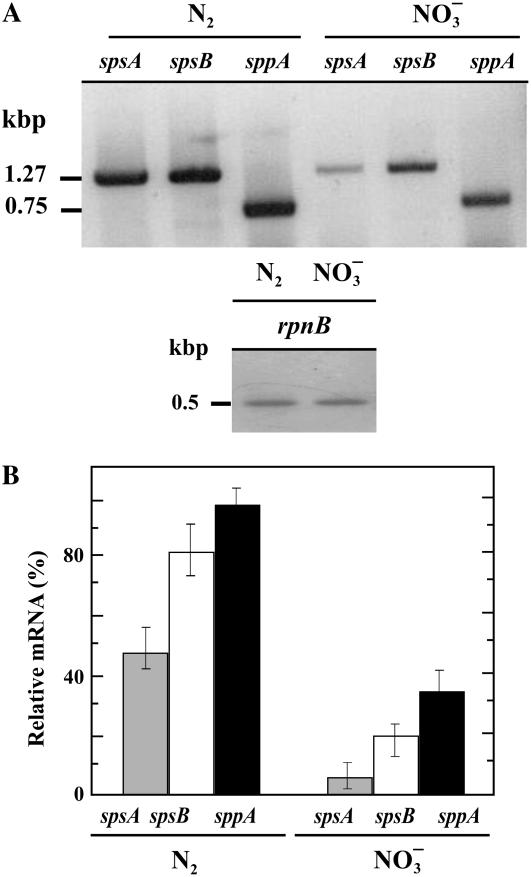
Expression of spsA, spsB, and sppA in Anabaena sp. PCC 7120 cells grown in N2 or NO3. A, RT-PCR analysis from total RNA. Amplification of Anabaena rpnB used as loading control. Position of molecular size markers indicated on the left. B, Densitometry of mRNA levels corresponding to detection in A. Values are the mean ± se of five independent experiments.
Figure 4.
Figure 4.
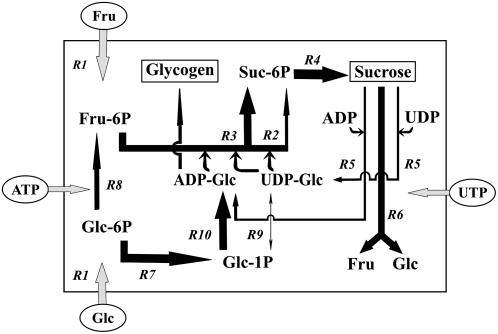
Metabolic flux map of primary and intermediate reactions involved in Suc and glycogen metabolism in a model of illuminated N2-fixing Anabaena filaments. Arrow widths are proportional to flux values; arrowhead indicates direction of net flux. Each flux is assigned for a number of reactions (R1–R10) indicated in Table I. The intracellular space contained is framed. Metabolites (Fru, Glc, ATP, and UTP) taken up from the extracellular medium are shown in ovals and sink final products (glycogen and Suc) in rectangles.
Figure 5.
Figure 5.
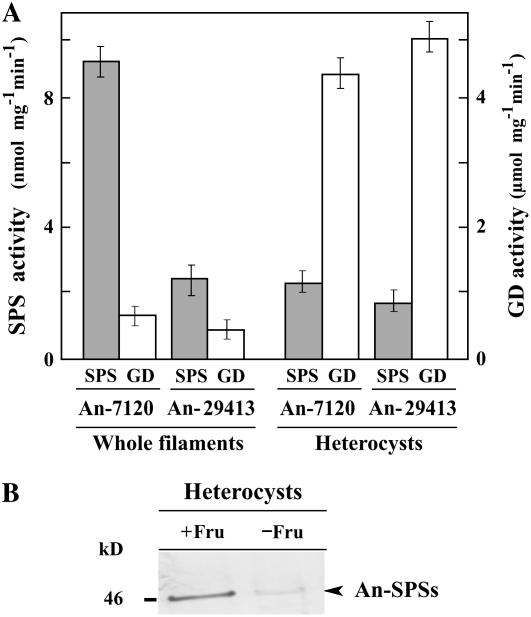
SPS expression in two Anabaena strains grown in N2-fixing conditions. A, SPS activity (gray bars) assayed in whole filaments or heterocyst extracts of Anabaena sp. PCC 7120 (An-7120) and A. variabilis ATCC 29413 (An-29413). Glc-6P dehydrogenase (GD) activity (white bars) was included as a heterocyst marker. Results are the mean ± se (n = 5). B, Immunoblot analysis of SPS expression from heterocyst extracts of Anabaena cells grown in N-deprived conditions with (+Fru) or without (−Fru) 10 mm Fru.
Figure 6.
Figure 6.
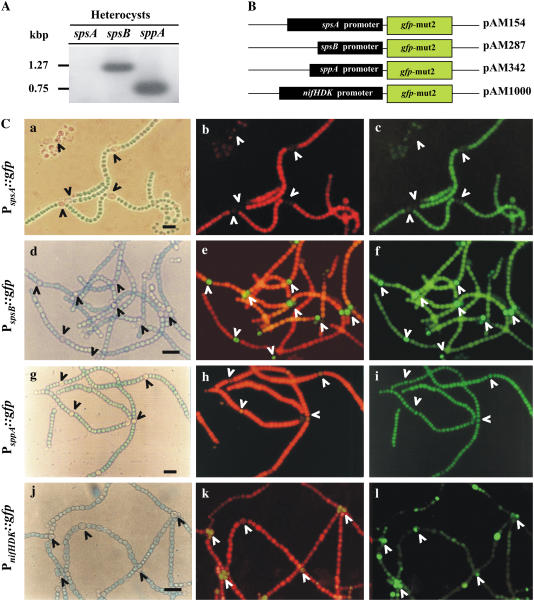
Cellular localization of spsA, spsB, and sppA expression in N2-fixing filaments of Anabaena sp. PCC 7120. A, RT-PCR analysis from total heterocyst RNA. B, Schematic representation showing a physical map of the GFP fusion constructs. The gfp sequence was fused in frame with upstream sequences of the translational start codon of spsA, spsB, sppA, and nifHDK. C, Cellular expression of PspsAgfp, PspsBgfp, and PsppAgfp reporter transcriptional fusion in Anabaena sp. PCC 7120 filaments subjected to prolonged diazotrophic growth. Each horizontal set of photographs corresponds with the same microscopic field. Contrast photomicrographs were obtained in full-spectrum light (a, d, g, and j). Chlorophyll fluorescence micrographs were taken without the emission filter (b, e, h, and k). GFP fluorescence micrographs were obtained with the corresponding emission filter (c, f, i, and l). Arrowheads indicate heterocysts. All microphotos taken at the same magnification (1,000×). Images photographed and processed with same settings to allow qualitative comparison of fluorescence intensities. Scale bars, 10 μm.
Figure 7.
Figure 7.
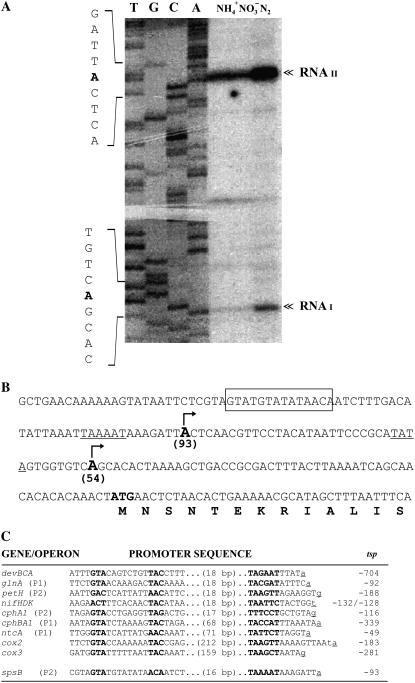
Origins of spsB transcription and analysis of the putative promoter regions. A, Primer extension mapping of the tsps of spsB carried out with total RNA (30 μg) from Anabaena cells grown in different N sources and the oligonucleotides B-ol-tsp3. A similar result was obtained with B-ol-tsp4 (data not shown). The sequencing ladders presented (lanes T, G, C, and A) were generated with the same primers used in the primer extension reactions. Arrowhead points to the extension product identifying the putative tsps. B, Nucleotide sequence of the spsB upstream region. The tsps (arrows) and start translation codon are in bold. Numbers in parentheses indicate the relative position from the translation start. A sequence similar to the consensus NtcA-binding sequence is boxed. The −10 box regions are underlined. C, Sequence alignments of NtcA-activated promoters (P) whose products act during differentiation and in the mature Anabaena heterocyst (devBCA, ATP-binding cassette transporter; glnA, Gln synthetase; petH, ferredoxin-NADP reductase; nifHDK, nitrogenase complex; cphA1, cyanophycin synthetase; cphBA1, cyanophycinase; ntcA, N regulator; cox2 and cox3, terminal respiratory oxidases). Location of the tsps with respect to the tsp of the corresponding gene is indicated. The consensus for NtcA-binding site and −10 hexamers is in bold.
Figure 8.
Figure 8.
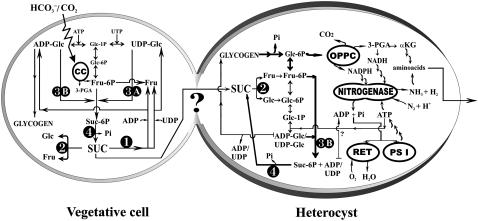
Schematic diagram of Suc pathway in N2-fixing Anabaena filament cells. Suc enzyme localization in Anabaena sp. PCC 7120 illuminated filaments based on this study and Curatti et al. (2006). Photosynthetic C fixation through the Calvin cycle (CC) occurs in the vegetative cells and could lead to Suc and glycogen biosynthesis. Heterocysts act as an important sink for carbohydrates from vegetative cells and as a source of fixed N (Wolk et al., 1994). In heterocysts, which could also synthesize glycogen and Suc, the reductants for N2 and O2 reduction are generated by the activity of the oxidative pentose-P cycle (OPPC), the NADPH heterocyst-specific ferrodoxin, and respiratory electron transport (RET), as well as the ATP synthesis by cyclic phosphorylation (PSI). Suc enzymes are indicated as (1) SuS; (2) A/N-Inv; (3A) SPS-A; (3B) SPS-B; and (4) SPP. αKG, α-Ketoglutarate.

References

    1. Alonso AP, Vigeolas H, Raymond P, Rolin D, Dieuaide-Noubhani M (2005) A new substrate cycle in plants: evidence for a high glucose-phosphate-to-glucose turnover from in vivo steady-state and pulse-labeling experiments with [13C]glucose and [14C]glucose. Plant Physiol 138 2220–2232 - PMC - PubMed
    1. Babb VM, Haigler CH (2001) Sucrose phosphate synthase activity rises in correlation with high-rate cellulose synthesis in three heterotrophic systems. Plant Physiol 127 1234–1242 - PMC - PubMed
    1. Ballicora MA, Iglesias AA, Preiss J (2003) ADP-glucose pyrophosphorylase, a regulatory enzyme for bacterial glycogen synthesis. Microbiol Mol Biol Rev 67 213–225 - PMC - PubMed
    1. Barreiro R (1999) Metabolic control analysis of carbon pathways. PhD thesis. UMI Dissertation Services, Ann Arbor, MI
    1. Berman-Frank I, Lundgren P, Falkowski P (2003) Nitrogen fixation and photosynthetic oxygen evolution in cyanobacteria. Res Microbiol 154 157–164 - PubMed

Publication types

MeSH terms

Associated data

LinkOut - more resources