Review
. 2007 Jan;87(1):69-98.
doi: 10.1152/physrev.00022.2006.

Matrix metalloproteinases in lung: multiple, multifarious, and multifaceted

Affiliations
Review

Matrix metalloproteinases in lung: multiple, multifarious, and multifaceted

Kendra J Greenlee et al. Physiol Rev. 2007 Jan.

Abstract

The matrix metalloproteinases (MMPs), a family of 25 secreted and cell surface-bound neutral proteinases, process a large array of extracellular and cell surface proteins under normal and pathological conditions. MMPs play critical roles in lung organogenesis, but their expression, for the most part, is downregulated after generation of the alveoli. Our knowledge about the resurgence of the MMPs that occurs in most inflammatory diseases of the lung is rapidly expanding. Although not all members of the MMP family are found within the lung tissue, many are upregulated during the acute and chronic phases of these diseases. Furthermore, potential MMP targets in the lung include all structural proteins in the extracellular matrix (ECM), cell adhesion molecules, growth factors, cytokines, and chemokines. However, what is less known is the role of MMP proteolysis in modulating the function of these substrates in vivo. Because of their multiplicity and substantial substrate overlap, MMPs are thought to have redundant functions. However, as we explore in this review, such redundancy most likely evolved as a necessary compensatory mechanism given the critical regulatory importance of MMPs. While inhibition of MMPs has been proposed as a therapeutic option in a variety of inflammatory lung conditions, a complete understanding of the biology of these complex enzymes is needed before we can reasonably consider them as therapeutic targets.


Figures

FIG. 1
FIG. 1
Matrix metalloproteinase (MMP) discovery timeline. This diagram depicts discovery of the MMP family members chronologically with the exception of MMP1, which was actually the second MMP discovered. Over ∼40 years (1961−2001), 28 different MMP genes have been identified. The founding member of the MMP family, Xenopus collagenase, now thought to be collagenase 4 (MMP18), was discovered in 1961 by J. Gross and C. M. Lapiere (85) and the last member, epilysin (MMP28), was reported separately by two groups: W. Parks and A. Y. Strongin in 2001. With the completion of the genome project, it is clear that all members of this family have now been identified (see Refs. 13, 17, 18, 29, 50, 76, 91, 97, 101, 124, 151, 182, 209, 222, 234, 235, 239, 245, 258, 269, 294, 297, 298, 304, 309, 310).
FIG. 2
FIG. 2
MMP expression in mouse lung development. MMP2, MMP14, and an MMP inducer, CD147, are constitutively expressed in all five distinct stages of lung development: primary budding (E9.5−11.5), pseudoglandular (E12−16.5), canalicular (E17−18), saccular (E19-P5), and alveolar (P5-P21). Expression of these MMPs and their inducer tapers off with the completion of lung development. Expression of most other MMPs occurs following the postnatal period and in adult lungs. In inflammatory lung diseases, cells of the hematopoetic origin (e.g., macrophages, neutrophils, eosinophils, lymphocytes) home to the lung and express MMP8, MMP9, and MMP12. Alternatively, many MMPs are induced in the alveolar epithelial cells in response to exposure to environmental agents. For example, alveolar and bronchial epithelial cells express MMP7 and MMP9 induced by exposure to pathogens or toxins, respectively (see Refs. 3, 33, 34, 66, 122, 160, 165, 229).
FIG. 3
FIG. 3
Role of MMPs in adaptive immunity. In response to inhaled allergens, Th2 inflammatory cells home to the lung and initiate allergic lung disease that can manifest in many pathological features such as accumulation of eosiniphils, basophils, and neutrophils; increases in mucus production; goblet cell metaplasia; and narrowing of the airways. Increases in concentration of interleukin (IL)-4 and IL-13, the canonical Th2 cytokines, also orchestrate upregulation of MMPs in the lung mesenchymal cells (MMP2, MMP3), hematopoietic cells (MMP9, MMP12), and epithelial cells (MMP7). In experimental models where MMPs are inhibited or in mice deficient in MMP2, MMP9, or MMP2/MMP9 there is an accumulation of inflammatory cells in the lung parenchyma and that predisposes mice to death from asphyxiation (see Refs. 48, 49, 88, 170, 186).
FIG. 4
FIG. 4
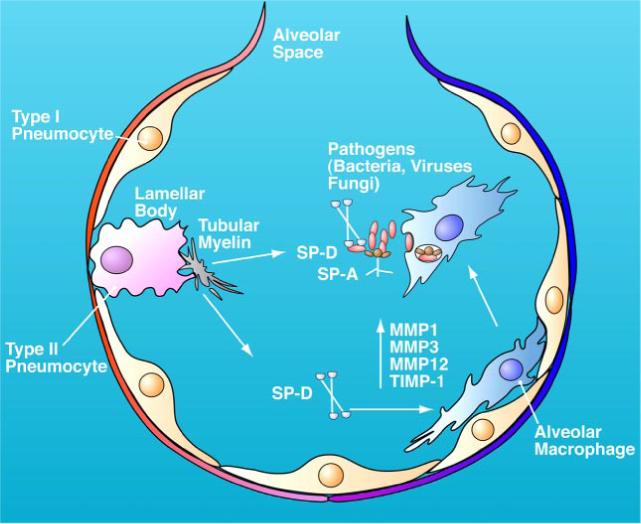
Role of MMPs in innate immunity: clearance of lung pathogens. Schematic diagram of the interaction between alveolar epithelial type II cells, macrophage, MMPs, and surfactant proteins in the alveoli. Alveoli are the gas exchange unit in the lung and are lined with pulmonary surfactant, a dynamic and lipid-rich fluid that is associated with four proteins, two of which (SP-A, SP-D) play important roles in bacterial clearance. SP-D is an in vivo target of cleavage by MMPs; induces expression of MMP1, MMP3, and MMP12; and activates alveolar macrophages. SP-A and SP-D can bind the offending pathogens that enter the airway and enhance their clearance by activated macrophages in the lung. Whether induction of MMPs in alveolar macrophages directly affects bacterial killing is unknown (see Refs. 156, 273, 296, 306).
FIG. 5
FIG. 5
Proteolytic effector function: chemokine gradient formation. The schematic diagrams depict the migration (extravasation, intraparenchymal homing, and transepithelial egression) of allergic inflammatory cells recruited to the lungs under normal conditions (top) or in the absence of MMPs (bottom). Cellular migration is shown progressing from right to left, with recently extravasated cells (including T cells, monocytes, eosinophils, and mast cells) traversing the pulmonary interstitium and the airway epithelium to enter the airway lumen, where they are cleared in the wild-type (WT) mice (top) and less so in MMP null mice (bottom). Interstitial inflammatory cells are recruited to the lumen by establishing a transepithelial chemotactic gradient in which chemokines (CCL) are strongly expressed in the lumen and on the apical surface of epithelial cells relative to the interstitium. Lack of MMPs disrupts the formation of this chemokine gradient and impairs migration of cells at the points marked “X”.
FIG. 6
FIG. 6
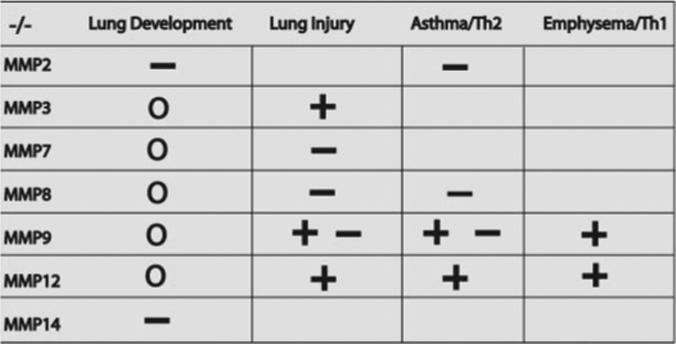
Effect of MMP deletion in lung development and in animal models of lung diseases. In MMP14 and a small subset of MMP2 null mice (back-crossed to C57BL/6), developmental lung defects (−; disadvantageous) have been reported (8, 112, 122, 193). Gene deletion in all other MMPs (0; no effect) has not been shown to result in abnormal lung development. Absence of MMP3 (144), MMP9 (68), and MMP12 (186) has been shown to be advantageous (+; beneficial) in a mouse model of acute lung injury. Whereas others have shown that absence of MMP7 (302), MMP8 (203), and MMP9 (19) is disadvantageous in a mouse model of acute lung injury (−). In the absence of MMP2 (49), MMP8 (88), and MMP9 (48, 170), mice develop exaggerated allergic inflammation in an acute model of asthma that is consistent with a disadvantage (−); however, inhibition of MMP9 showed a beneficial (+) effect in other studies (68). In the absence of MMP9 and MMP12, there was a consistent beneficial (+) effect in a mouse model of smoking-related lung disease. Blank area indicates that mice deficient in the MMPs have not been tested or the results of the studies have not been published to date.

References

    1. Mechanisms and limits of induced postnatal lung growth. Am J Respir Crit Care Med. 2004;170:319–343. - PubMed
    1. Adamson IYR, Vincent R, Bakowska J. Differential production of metalloproteinases after instilling various urban air particle samples to rat lung. Exp Lung Res. 2003;29:375–388. - PubMed
    1. Ahokas K, Lohi J, Illman SA, Llano E, Elomaa O, Impola U, Karjalainen-Lindsberg ML, Saarialho-Kere U. Matrix metalloproteinase-21 is expressed epithelially during development and in cancer and is up-regulated by transforming growth factor-beta 1 in keratinocytes. Lab Invest. 2003;83:1887–1899. - PubMed
    1. Al-Aqeel AI. Al-Aqeel Sewairi syndrome, a new autosomal recessive disorder with multicentric osteolysis, nodulosis, and arthropathy. The first genetic defect of matrix metalloproteinase 2 gene. Saudi Med J. 2005;26:24–30. - PubMed
    1. Anteby EY, Greenfield C, Natanson-Yaron S, Goldman-Wohl D, Hamani Y, Khudyak V, Ariel I, Yagel S. Vascular endothelial growth factor, epidermal growth factor and fibroblast growth factor-4 and -10 stimulate trophoblast plasminogen activator system and metalloproteinase-9. Mol Hum Reprod. 2004;10:229–235. - PubMed

Publication types

Substances

LinkOut - more resources