Comparative Study
. 2007 Jan;19(1):94-106.
doi: 10.1105/tpc.106.048199. Epub 2007 Jan 19.

S locus genes and the evolution of self-fertility in Arabidopsis thaliana

Affiliations
Comparative Study

S locus genes and the evolution of self-fertility in Arabidopsis thaliana

Sue Sherman-Broyles et al. Plant Cell. 2007 Jan.

Abstract

Loss of self-incompatibility (SI) in Arabidopsis thaliana was accompanied by inactivation of genes required for SI, including S-LOCUS RECEPTOR KINASE (SRK) and S-LOCUS CYSTEINE-RICH PROTEIN (SCR), coadapted genes that constitute the SI specificity-determining S haplotype. Arabidopsis accessions are polymorphic for PsiSRK and PsiSCR, but it is unknown if the species harbors structurally different S haplotypes, either representing relics of ancestral functional and structurally heteromorphic S haplotypes or resulting from decay concomitant with or subsequent to the switch to self-fertility. We cloned and sequenced the S haplotype from C24, in which self-fertility is due solely to S locus inactivation, and show that this haplotype was produced by interhaplotypic recombination. The highly divergent organization and sequence of the C24 and Columbia-0 (Col-0) S haplotypes demonstrate that the A. thaliana S locus underwent extensive structural remodeling in conjunction with a relaxation of selective pressures that once preserved the integrity and linkage of coadapted SRK and SCR alleles. Additional evidence for this process was obtained by assaying 70 accessions for the presence of C24- or Col-0-specific sequences. Furthermore, analysis of SRK and SCR polymorphisms in these accessions argues against the occurrence of a selective sweep of a particular allele of SCR, as previously proposed.


Figures
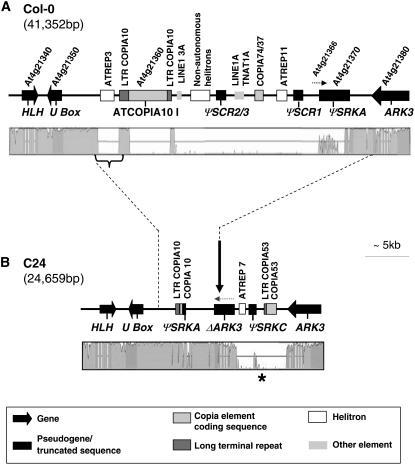
Figure 1.
Figure 1.
Structural and Sequence Divergence of the Col-0 and C24 S Locus Haplotypes. (A) Map of the Col-0 S locus with VISTA diagram depicting the levels of sequence identity to the C24 S haplotype. (B) Map of the C24 S locus with VISTA diagram depicting the levels of sequence identity to the Col-0 S haplotype. The vertical arrow indicates the recombination breakpoint inferred to have occurred between a ΨSRKA-containing and a ΨSRKC-containing S haplotype. The orientation (5′ to 3′) of the ΔARK3 sequence is shown by the stippled arrow. The maps show the S locus region, defined as the genomic region flanked by At4g21340 and At4g21380. The stippled lines between the Col-0 and C24 maps define the region of correspondence between the two maps. Annotated sequences and transposon-related elements are depicted according to the legend in the box. The regions in the VISTA diagrams shown in dark gray indicate coding regions. The bracket in (A) and the asterisk in (B) mark the ATREP3 and the CCOP regions, respectively, used as markers for the polymorphism studies summarized in Tables 1 and 2.
Figure 2.
Figure 2.
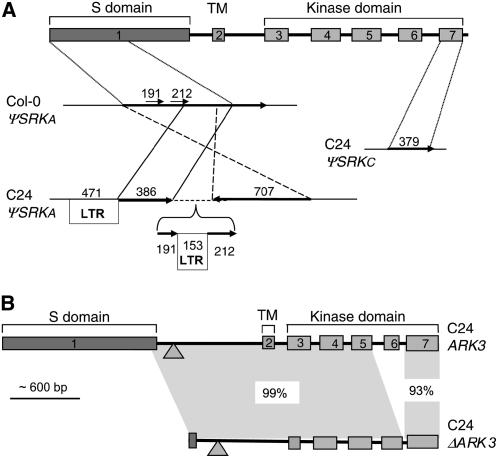
Magnified View of the ΨSRK and ARK3 Sequences of the C24 S Haplotype. (A) ΨSRK sequences. The organizations of the ΨSRKA and ΨSRKC sequences are shown in comparison to a diagrammatic view of the intron-exon structure of an SRK gene (top diagram). Regions of sequence identity are joined by diagonal or vertical lines, arrows indicate the relative orientation of the segments, and numbers above the arrows indicate the length of each segment. Note that the C24 ΨSRKC sequences correspond to exon 7, which explains the fact that C24 genomic DNA does not hybridize with a probe derived from ΨSRKC exon 1 (Table 2). The C24 ΨSRKA sequences, which correspond to 875 bp starting with the initiating ATG codon in exon 1, are highly rearranged relative to Col-0 ΨSRKA and are interspersed with LTR sequences. The unanchored contig in the C24 ΨSRKA sequence (see text) is indicated by a bracket. (B) Duplicate ARK3 sequences. The diagram compares the structures of the complete ARK3C24 gene and the truncated ΔARK3C24 sequence. The stippled triangles indicate the location of a 54-bp deletion found in both genes relative to ARK3Col-0. The extent of sequence identity shared by different regions of the two genes is indicated.
Figure 3.
Figure 3.
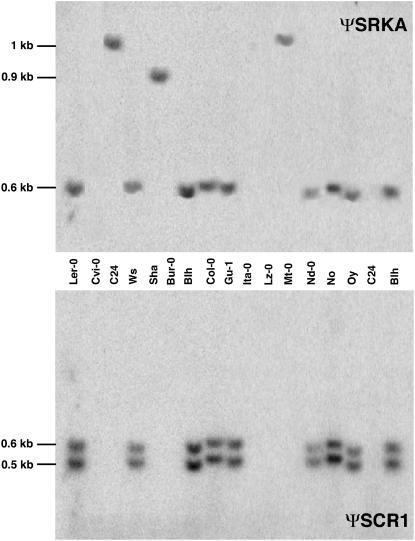
DNA Gel Blot of Representative A. thaliana Accessions. Genomic DNA was digested with HincII, and the same DNA gel blot was hybridized with a probe derived from ΨSRKA exon 1 (top panel) and a probe corresponding to ΨSCR1 (bottom panel). Both probes were amplified from the Col-0 S locus BAC T6K22 (see Methods). Note that only accessions that exhibit the same ΨSRKA RFLP pattern as Col-0 hybridize with the ΨSCR1 probe. Accessions that exhibit ΨSRKA RFLP patterns different from Col-0 (C24, Sha, and Mt-0) and those that do not hybridize with the ΨSRKA probe (Cvi-0, Bur-0, Ita-0, and Lz-0) do not hybridize with ΨSCR1.
Figure 4.
Figure 4.
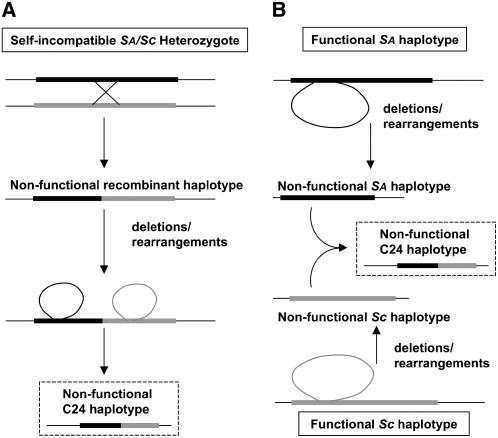
Two Possible Scenarios for the Generation of the C24 S Haplotype. (A) Recombination between Sa and Sc haplotypes in a heterozygous self-incompatible individual, causing loss of SI and subsequent restructuring of the locus mediated at least in part by transposons. (B) Inactivation of the Sa and Sc haplotypes by rearrangements and deletions, at least partly transposon-driven, followed by recombination in a self-fertile heterozygous individual. The S haplotypes in which the initial inactivating events are proposed to have occurred are shown in boxes with solid lines. The C24 S haplotypic configuration is shown in boxes with dashed lines.
Figure 5.
Figure 5.
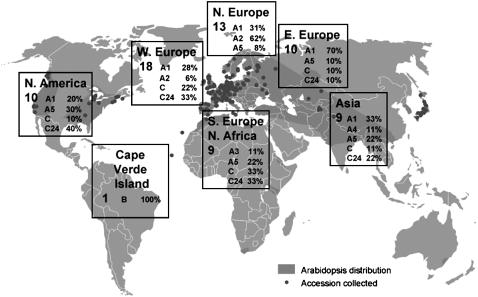
Geographical Distribution of S Locus Variants. The frequencies of different S haplotypes (designated as in Tables 1 and 2) in each of seven geographical areas are expressed as a percentage of accessions surveyed from each area (indicated by the number at the left side of each box). The map (obtained from www.natural-eu.org) shows the worldwide distribution of A. thaliana (dark shading) and the location of accessions available through seed stock centers (dots). Note that the distribution of different subtypes of the Sa class of haplotypes is consistent with independent diversification in different geographical areas. In particular, S haplotypes belonging to the A1 or A5 subtypes, which likely invaded Europe from Asia, apparently differentiated into the A2 subtype in western and northern Europe and into the A3 subtype in southern Europe.

References

    1. Bakker, E.G., Stahl, E.A., Toomajian, C., Nordborg, M., and Kreitman, M. (2006). Distribution of genetic variation within and among local populations of Arabidopsis thaliana over its species range. Mol. Ecol. 15 1405–1418. - PubMed
    1. Bechsgaard, J., Castric, V., Charlesworth, D., Vekemans, X., and Schierup, M.H. (2006). The transition to self-compatibility in Arabidopsis thaliana and evolution within S-haplotypes over 10 million years. Mol. Biol. Evol. 23 1741–1750. - PubMed
    1. Bennetzen, J. (2000). Comparative sequence analysis of plant nuclear genomes: Microcolinearity and its exceptions. Plant Cell 12 1021–1029. - PMC - PubMed
    1. Bergelson, J., Stahl, E.A., Dudek, S., and Kreitman, M. (1998). Genetic variation within and among populations of Arabidopsis thaliana. Genetics 148 1311–1323. - PMC - PubMed
    1. Boyes, D.C., Nasrallah, M.E., Vrebalov, J., and Nasrallah, J.B. (1997). The self-incompatibility (S) haplotypes of Brassica contain highly divergent and rearranged sequences of ancient origin. Plant Cell 9 237–247. - PMC - PubMed

Publication types

MeSH terms

Associated data