


Neutralizing antibody fails to impact the course of Ebola virus infection in monkeys
- PMID: 17238286
- PMCID: PMC1779296
- DOI: 10.1371/journal.ppat.0030009
Neutralizing antibody fails to impact the course of Ebola virus infection in monkeys
Abstract
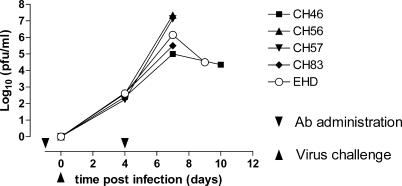
Prophylaxis with high doses of neutralizing antibody typically offers protection against challenge with viruses producing acute infections. In this study, we have investigated the ability of the neutralizing human monoclonal antibody, KZ52, to protect against Ebola virus in rhesus macaques. This antibody was previously shown to fully protect guinea pigs from infection. Four rhesus macaques were given 50 mg/kg of neutralizing human monoclonal antibody KZ52 intravenously 1 d before challenge with 1,000 plaque-forming units of Ebola virus, followed by a second dose of 50 mg/kg antibody 4 d after challenge. A control animal was exposed to virus in the absence of antibody treatment. Passive transfer of the neutralizing human monoclonal antibody not only failed to protect macaques against challenge with Ebola virus but also had a minimal effect on the explosive viral replication following infection. We show that the inability of antibody to impact infection was not due to neutralization escape. It appears that Ebola virus has a mechanism of infection propagation in vivo in macaques that is uniquely insensitive even to high concentrations of neutralizing antibody.
Conflict of interest statement
Figures
References
-
- Hangartner L, Zinkernagel RM, Hengartner H. Antiviral antibody responses: The two extremes of a wide spectrum. Nat Rev Immunol. 2006;6:231–243. - PubMed
Publication types
MeSH terms
Substances
Grants and funding
LinkOut - more resources
Full Text Sources
Other Literature Sources
Medical
