


Interferon-beta therapy reduces CD4+ and CD8+ T-cell reactivity in multiple sclerosis
- PMID: 17239199
- PMCID: PMC2265917
- DOI: 10.1111/j.1365-2567.2006.02518.x
Interferon-beta therapy reduces CD4+ and CD8+ T-cell reactivity in multiple sclerosis
Abstract
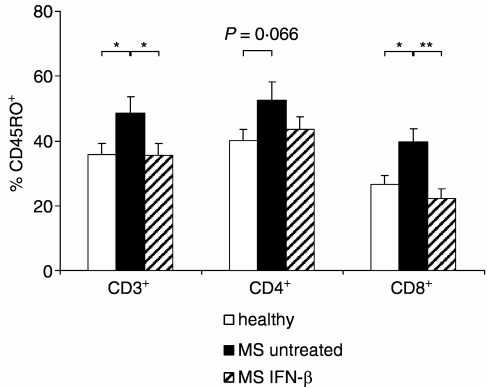
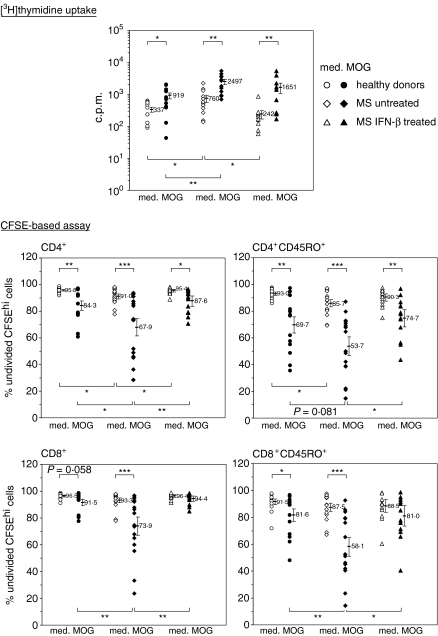
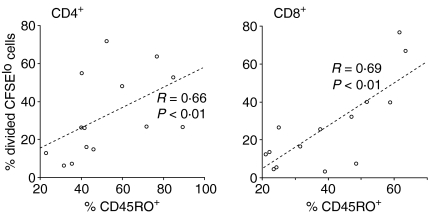
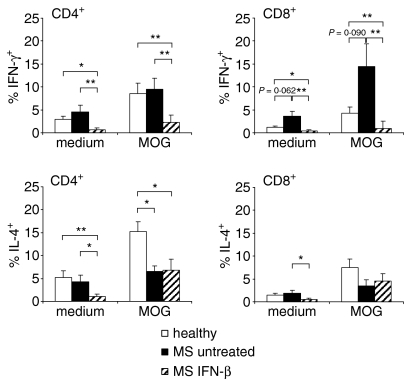
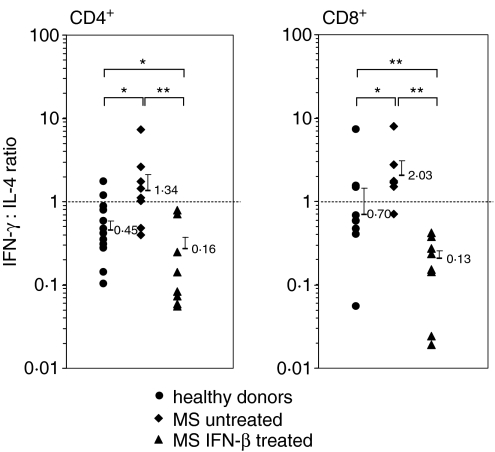
Therapy with interferon-beta (IFN-beta) has well-established clinical effects in multiple sclerosis (MS), albeit the immunomodulatory mechanisms are not fully understood. We assessed the prevalence and functional capacity of CD4+ and CD8+ T cells in healthy donors, and in untreated and IFN-beta-treated MS patients, in response to myelin oligodendrocyte glycoprotein (MOG). The proportion of CD45RO+ memory T cells was higher in MS patients than in healthy donors, but returned to normal values upon therapy with IFN-beta. While CD45RO+ CD4+ T cells from all three groups responded to MOG in vitro, untreated patients showed augmented proliferative responses compared to healthy individuals and IFN-beta treatment reduced this elevated reactivity back to the values observed in healthy donors. Similarly, the response of CD45RO+ CD8+ T cells to MOG was strongest in untreated patients and decreased to normal values upon immunotherapy. Overall, the frequency of peripheral CD45RO+ memory T cells ex vivo correlated with the strength of the cellular in vitro response to MOG in untreated patients but not in healthy donors or IFN-beta-treated patients. Compared with healthy individuals, responding CD4+ and CD8+ cells were skewed towards a type 1 cytokine phenotype in untreated patients, but towards a type 2 phenotype under IFN-beta therapy. Our data suggest that the beneficial effect of IFN-beta in MS might be the result of the suppression or depletion of autoreactive, pro-inflammatory memory T cells in the periphery. Assessment of T-cell subsets and their reactivity to MOG may represent an important diagnostic tool for monitoring successful immunotherapy in MS.
Figures
References
-
- Hafler DA, Slavik JM, Anderson DE, O'Connor KC, de Jager P, Baecher-Allan C. Multiple sclerosis. Immunol Rev. 2005;204:208–31. - PubMed
-
- Kieseier BC, Hemmer B, Hartung HP. Multiple sclerosis – novel insights and new therapeutic strategies. Curr Opin Neurol. 2005;18:211–20. - PubMed
-
- Sospedra M, Martin R. Immunology of multiple sclerosis. Annu Rev Immunol. 2005;23:683–747. - PubMed
-
- IFNB Multiple Sclerosis Study Group. Interferon β-1b is effective in relapsing–remitting multiple sclerosis. I. Clinical results of a multicenter, randomized, double-blind, placebo-controlled trial. Neurology. 1993;43:655–61. - PubMed
Publication types
MeSH terms
Substances
LinkOut - more resources
Full Text Sources
Other Literature Sources
Research Materials
