


doi: 10.1016/j.visres.2006.11.013.
Epub 2007 Jan 19.
Vividness of mental imagery: individual variability can be measured objectively
Affiliations
- PMID: 17239915
- PMCID: PMC1839967
- DOI: 10.1016/j.visres.2006.11.013
Item in Clipboard
Vividness of mental imagery: individual variability can be measured objectively
Vision Res.
2007 Feb.
Abstract
When asked to imagine a visual scene, such as an ant crawling on a checkered table cloth toward a jar of jelly, individuals subjectively report different vividness in their mental visualization. We show that reported vividness can be correlated with two objective measures: the early visual cortex activity relative to the whole brain activity measured by functional magnetic resonance imaging (fMRI) and the performance on a novel psychophysical task. These results show that individual differences in the vividness of mental imagery are quantifiable even in the absence of subjective report.
Figures
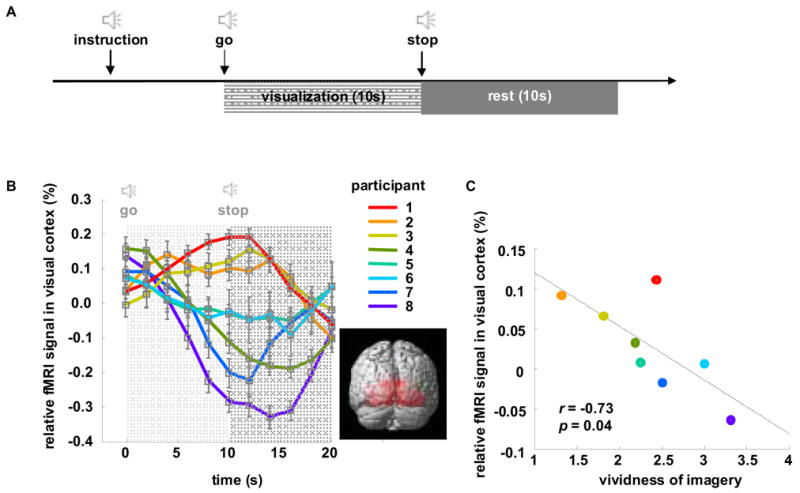
(A) Timeline of the visualization task. Participants began to visualize upon hearing the ‘go’ signal, and stopped visualization upon hearing the ‘stop’ signal, resulting a 10-second visualization phase and 10-second rest phase. All instructions are auditory. (B) Time course of the relative fMRI signal in visual cortex for 8 participants. Relative fMRI is taken as the BOLD signal in early visual cortex (Brodmann’s areas 17 and 18, illustrated in inset) minus the BOLD signal measured over all of gray matter. For plotting purposes, participants are ordered by their relative visual cortex activity averaged over the visualization window of 0 – 10 sec. The negative signal for some subjects is due in part to the subtraction of the whole brain activity – i.e., other regions can increase more than the visual cortex during the time window. (C) The relative visual cortex signal averaged over the visualization window correlates significantly with the subjective rating of vividness (p=0.04).
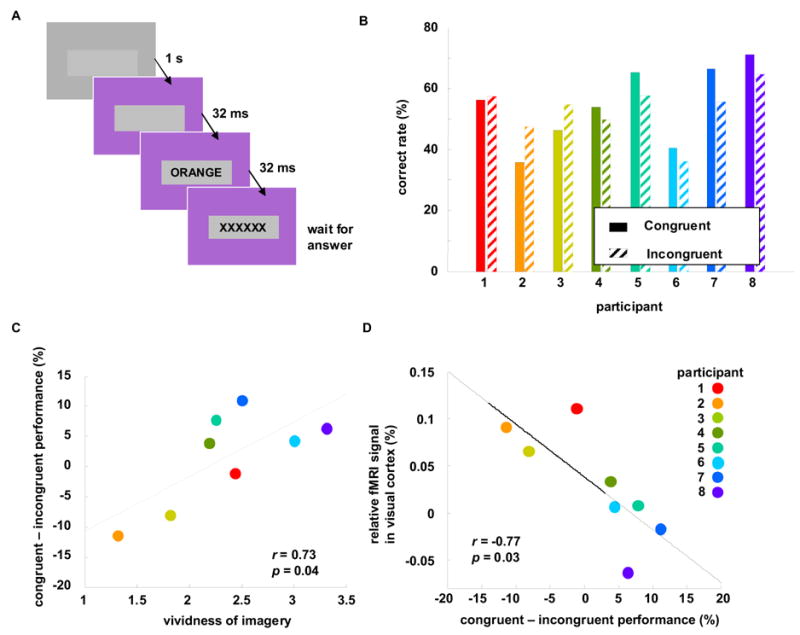
(A) Timeline of the color word identification task. On each trial, the background screen color turned from gray to yellow, orange, or purple, and 32 msec later the word “yellow”, “orange”, “purple”, or no word flashed for 32 msec in a central rectangle. Participants reported on the keyboard which of the three words they saw (or no word). (B) The performance in congruent trials (where word and background color were the same) and incongruent trials (word and background color were different). Participants are ordered as in Fig 1. (C) Correlation between vividness of visual imagery and the congruent-incongruent performance. The latter is defined as the difference between performances on congruent versus incongruent trials, as seen in B. (D) Correlation between the relative visual cortex activity and congruent-incongruent performance.
References
-
- Amedi A, Malach R, Pascual-Leone A. Negative BOLD differentiates visual imagery and perception. Neuron. 2005;5:859–872. - PubMed
-
- Bouvier SE, Engel SA. Behavioral deficits and cortical damage loci in cerebral achromatopsia. Cereb Cortex. 2006;2:183–191. - PubMed
-
- Ceci SJ, Bruck M. Jeopardy in the Courtroom: A Scientific Analysis of Children’s Testimony. American Psychological Association; 1995.
-
- De Vreese LP. Two systems for colour-naming defects: verbal disconnection vs colour imagery disorder. Neuropsychologia. 1991;1:1–18. - PubMed
-
- Dobson M, Markham R. Imagery ability and source monitoring: implications for eyewitness memory. Br J Psychol. 1993;(Pt 1):111–118. - PubMed
Publication types
MeSH terms
Grants and funding
LinkOut - more resources
Full Text Sources
