. 2007 Jan 25:7:16.
doi: 10.1186/1471-2407-7-16.

GSTT2 promoter polymorphisms and colorectal cancer risk

Affiliations

GSTT2 promoter polymorphisms and colorectal cancer risk

Sang-Geun Jang et al. BMC Cancer. .

Abstract

Background: Glutathione S-transferases are a group of enzymes that participate in detoxification and defense mechanisms against toxic carcinogens and other compounds. These enzymes play an important role in human carcinogenesis. In the present study, we sought to determine whether GSTT2 promoter single nucleotide polymorphisms (SNPs) are associated with colorectal cancer risk.

Methods: A total of 436 colorectal cancer patients and 568 healthy controls were genotyped for three GSTT2 promoter SNPs (-537G>A, -277T>C and -158G>A), using real-time TaqMan assay and direct sequencing. An electrophoretic mobility shift assay (EMSA) was performed to determine the effects of polymorphisms on protein binding to the GSTT2 promoter.

Results: The -537A allele (-537G/A or A/A) was significantly associated with colorectal cancer risk (OR = 1.373, p = 0.025), while the -158A allele (-158G/A or A/A) was involved in protection against colorectal cancer (OR = 0.539, p = 0.032). Haplotype 2 (-537A, -277T, -158G) was significantly associated with colorectal cancer risk (OR = 1.386, p = 0.021), while haplotype 4 (-537G, -277C, -158A) protected against colorectal cancer (OR = 0.539, p = 0.032). EMSA data revealed lower promoter binding activity in the -537A allele than its -537G counterpart.

Conclusion: Our results collectively suggest that SNPs and haplotypes of the GSTT2 promoter region are associated with colorectal cancer risk in the Korean population.


Figures
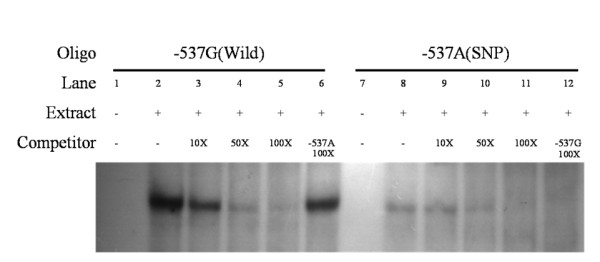
Figure 1
Figure 1
EMSA with HeLa nuclear extracts using -537G and -537A oligonucleotides. Binding activities of [γ-32P] ATP-labeled -537G (lane 1–6) and -537A (lane 7–12) oligonucleotides. The assay was performed in the presence (+) or absence (-) of HeLa nuclear extracts. Unlabeled -537G or -537A oligonucleotides were used in competition assays. Each binding reaction contained 5 mg of HeLa nuclear extracts and labeled -537G (lanes 2–6) or -537A (lanes 8–12) oligonucleotides. Excess unlabeled oligonucleotides (10-, 50- and 100-fold) were included in the binding reactions as competitors (Lanes 3–5 and 9–11, respectively). In addition, we added a 100-fold excess of unlabeled -537A and -537G oligonucleotides to compete with -537G (Lane 6) and -537A (Lane 12) oligonucleotides. The binding activity of -537G was unaffected, even in the presence of a 100-fold excess of -537A competitor (lane 6). However, the -537A oligonucleotide could not bind transcription factor (lane 12), and displayed no band in the presence of a 100-fold excess of -537G probe.

References

    1. Shin HR, Jung KW, Won YJ, Park JG. 2002 Annual report of the Korea Central Cancer Registry: Based on registered data from 139 hospitals. Cancer Res Treat. 2004;36:103–114. - PMC - PubMed
    1. Kim IJ, Shim Y, Kang HC, Park JH, Ku JL, Park HW, Park HR, Lim SB, Jeong ST, Kim WH, Park JG. Robust microsatellite instability (MSI) analysis by denaturing high-performance liquid chromatography (DHPLC) J Hum Genet. 2003;48:525–530. doi: 10.1007/s10038-003-0070-y. - DOI - PubMed
    1. Sheweita SA, Tilmisany AK. Cancer and phase II drug-metabolizing enzymes. Curr Drug Metab. 2003;4:45–58. doi: 10.2174/1389200033336919. - DOI - PubMed
    1. Cartwright RA, Glashan RW, Rogers HJ, Ahmad RA, Barham-Hall D, Higgins E, Kahn MA. Role of N-acetyltransferase phenotypes in bladder carcinogenesis: a pharmacogenetic epidemiological approach to bladder cancer. Lancet. 1982;2:842–845. doi: 10.1016/S0140-6736(82)90810-8. - DOI - PubMed
    1. Townsend D, Tew K. Cancer drugs, genetic variation and the glutathione-S-transferase gene family. Am J Pharmacogenomics. 2003;3:157–172. doi: 10.2165/00129785-200303030-00002. - DOI - PMC - PubMed

Publication types

MeSH terms

Substances
