. 2007 Apr 22;4(13):395-403.
doi: 10.1098/rsif.2006.0199.

Life extension of self-healing polymers with rapidly growing fatigue cracks

Affiliations

Life extension of self-healing polymers with rapidly growing fatigue cracks

A S Jones et al. J R Soc Interface. .

Abstract

Self-healing polymers, based on microencapsulated dicyclopentadiene and Grubbs' catalyst embedded in the polymer matrix, are capable of responding to propagating fatigue cracks by autonomic processes that lead to higher endurance limits and life extension, or even the complete arrest of the crack growth. The amount of fatigue-life extension depends on the relative magnitude of the mechanical kinetics of crack propagation and the chemical kinetics of healing. As the healing kinetics are accelerated, greater fatigue life extension is achieved. The use of wax-protected, recrystallized Grubbs' catalyst leads to a fourfold increase in the rate of polymerization of bulk dicyclopentadiene and extends the fatigue life of a polymer specimen over 30 times longer than a comparable non-healing specimen. The fatigue life of polymers under extremely fast fatigue crack growth can be extended through the incorporation of periodic rest periods, effectively training the self-healing polymeric material to achieve higher endurance limits.


Figures

Figure 1
Figure 1
Details of the self-healing process during fatigue.
Figure 2
Figure 2
Morphologies of Grubbs' catalyst: (a) as-received, (b) recrystallized by non-solvent addition and (c) recrystallized by freeze-drying.
Figure 3
Figure 3
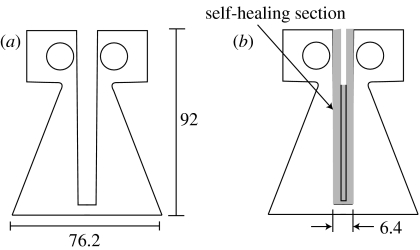
Geometries during the moulding process: (a) polymer shell and (b) complete specimen (grey area indicates the self-healing polymer material), dimensions in millimetre.
Figure 4
Figure 4
Schematic of fatigue loading parameters, frequency is 5 Hz, R=0.1.
Figure 5
Figure 5
Gel time of DCPD with different concentrations of as-received catalyst and recrystallized Grubbs' catalyst by non-solvent addition.
Figure 6
Figure 6
Fatigue at Kmax=0.676 MPa m1/2, R=0.1, f=5 Hz of TDCB polymer specimens. A, neat polymer; B, contains 20 pph microcapsules; C, contains 20 pph microcapsules and 5 pph of wax microspheres with 5 wt% of as-received catalyst; D, contains 20 pph microcapsules and 5 pph of wax microspheres with 5 wt% of recrystallized catalyst (non-solvent addition); E, contains 20 pph microcapsules and 5 pph of wax microspheres with 5 wt% of recrystallized catalyst (freeze dried). Numerals i, ii, iii and iv on curve E demark the locations where SEM images of the fracture plane are provided in figure 7.
Figure 7
Figure 7
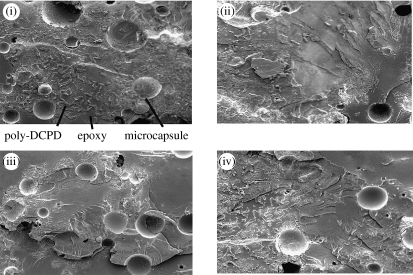
SEM of the fracture plane of a self-healing polymer correlating to curve E of figure 6. In all images, the crack is travelling from left to right. The width of each image represents 1 mm. (i) Fracture surface covered densely with poly-DCPD, (ii) fracture surface with occasional regions lacking poly-DCPD, (iii) fracture surface with adhesively bonded epoxy from the opposite fracture plane resulting in the retardation of crack growth rate and (iv) fracture surface showing occasional regions of poly-DCPD and significant uncovered areas.
Figure 8
Figure 8
Fatigue at Kmax=0.676 MPa m1/2, R=0.1, f=5 Hz of TDCB polymer specimens. B, contains 20 pph microcapsules; F, contains 20 pph microcapsules and 5 pph of wax microspheres; G, contains 20 pph microcapsules and 2.5 pph of recrystallized catalyst (non-solvent addition).
Figure 9
Figure 9
Fatigue crack growth at Kmax=0.50 Mpa m1/2 (Kmax/KIC=0.45) is completely arrested with accelerated healing kinetics. Fatigue crack growth at Kmax=0.676 MPa m1/2 is included for reference.
Figure 10
Figure 10
Faster healing kinetics result in improved fatigue crack growth resistance. Loadings that previously caused fast crack growth (Kmax/KIC=0.45) can be arrested, while under severe loading conditions the crack growth is significantly retarded. Filled circles, original data; open triangles, data from Brown et al. (2005); open circles with dot, complete arrest of fatigue crack achieved.
Figure 11
Figure 11
Fatigue with fast mechanical kinetics. Kmax=0.801, R=0.1, f=5 Hz. Without rest periods, the specimen fractures quickly, with rest periods (indicated by circles) significant life extension is achieved.

References

    1. Azimi H.R, Pearson R.A, Hertzberg R.W. Role of the crack-tip shielding mechanisms in fatigue of hybrid epoxy composites containing rubber and solid glass spheres. J. Appl. Polym. Sci. 1995;58:449–463. doi: 10.1002/app.1995.070580223. - DOI
    1. Azimi H.R, Pearson R.A, Hertzberg W. Fatigue of hybrid epoxy composites: epoxies containing rubber and hollow glass spheres. Polym. Eng. Sci. 1996;36:2352–2365. doi: 10.1002/pen.10633. - DOI
    1. Bascom W, Ting R, Moulton R, Riew C, Siebert A. The fracture of an epoxy polymer containing elastomeric modifiers. J. Mater. Sci. 1981;16:2657–2664. doi: 10.1007/BF02402827. - DOI
    1. Becu L, Maazouz A, Sautereau H, Gerard J.F. Fracture behavior of epoxy polymer modified with core-shell rubber particles. J. Appl. Polym. Sci. 1997;65:2419–2431. doi: 10.1002/(SICI)1097-4628(19970919)65:12%3C2419::AID-APP14%3E3.0.CO;2-W. - DOI
    1. Brown E.N, Sottos N.R, White S.R. Fracture testing of a self-healing polymer composite. Exp. Mech. 2002;42:372–379. doi: 10.1007/BF02412141. - DOI

Publication types