


Pharmacy Asthma Care Program (PACP) improves outcomes for patients in the community
- PMID: 17251316
- PMCID: PMC2117224
- DOI: 10.1136/thx.2006.064709
Pharmacy Asthma Care Program (PACP) improves outcomes for patients in the community
Abstract
Background: Despite national disease management plans, optimal asthma management remains a challenge in Australia. Community pharmacists are ideally placed to implement new strategies that aim to ensure asthma care meets current standards of best practice. The impact of the Pharmacy Asthma Care Program (PACP) on asthma control was assessed using a multi-site randomised intervention versus control repeated measures study design.
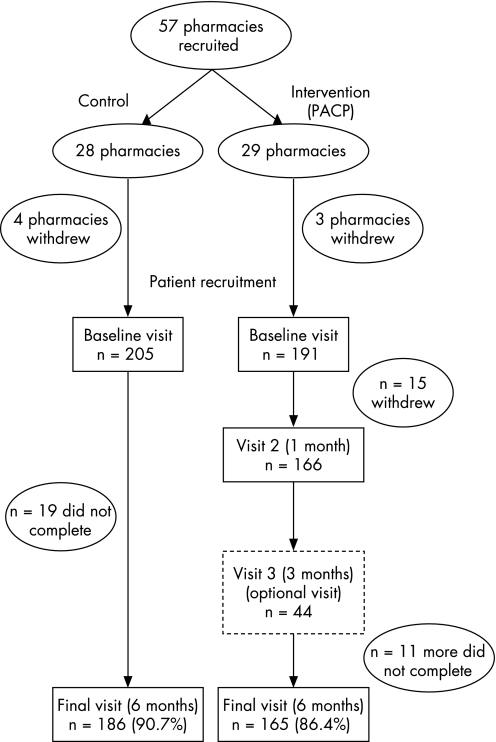
Methods: Fifty Australian pharmacies were randomised into two groups: intervention pharmacies implemented the PACP (an ongoing cycle of assessment, goal setting, monitoring and review) to 191 patients over 6 months, while control pharmacies gave their usual care to 205 control patients. Both groups administered questionnaires and conducted spirometric testing at baseline and 6 months later. The main outcome measure was asthma severity/control status.
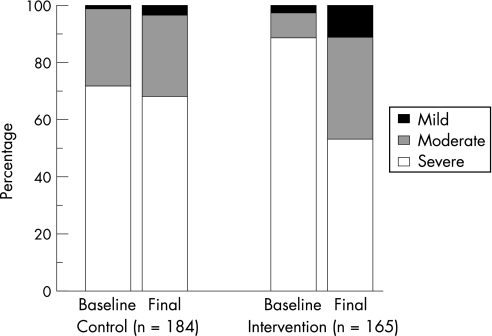
Results: 186 of 205 control patients (91%) and 165 of 191 intervention patients (86%) completed the study. The intervention resulted in improved asthma control: patients receiving the intervention were 2.7 times more likely to improve from "severe" to "not severe" than control patients (OR 2.68, 95% CI 1.64 to 4.37; p<0.001). The intervention also resulted in improved adherence to preventer medication (OR 1.89, 95% CI 1.08 to 3.30; p = 0.03), decreased mean daily dose of reliever medication (difference -149.11 microg, 95% CI -283.87 to -14.36; p=0.03), a shift in medication profile from reliever only to a combination of preventer, reliever with or without long-acting beta agonist (OR 3.80, 95% CI 1.40 to 10.32; p=0.01) and improved scores on risk of non-adherence (difference -0.44, 95% CI -0.69 to -0.18; p=0.04), quality of life (difference -0.23, 95% CI -0.46 to 0.00; p=0.05), asthma knowledge (difference 1.18, 95% CI 0.73 to 1.63; p<0.01) and perceived control of asthma questionnaires (difference -1.39, 95% CI -2.44 to -0.35; p<0.01). No significant change in spirometric measures occurred in either group.
Conclusions: A pharmacist-delivered asthma care programme based on national guidelines improves asthma control. The sustainability and implementation of the programme within the healthcare system remains to be investigated.
Conflict of interest statement
Competing interests: None.
References
-
- Australian Bureau of Statistics National health survey: summary of results. Canberra: Australian Bureau of Statistics, 2001
-
- Australian Institute of Health, Welfare (AIHW) Australia's health. Canberra: AIHW, 2004
-
- Australian Centre for Asthma Monitoring Health care expenditure and the burden of disease due to asthma in Australia. Canberra: Australian Institute of Health and Welfare, 200543
